Stop Chasing Certainty, Start Embracing Antifragility: The Guide to Thriving in Chaos.
Golden Hook & Introduction
SECTION
Nova: What if everything you've been taught about stability, about avoiding risk, about building things to last—is fundamentally wrong for true growth?
Atlas: Whoa, that's a bold claim, Nova. I mean, common sense definitely tells us the opposite. We all strive for stability, right? For things that are robust, that won't break. That is the goal.
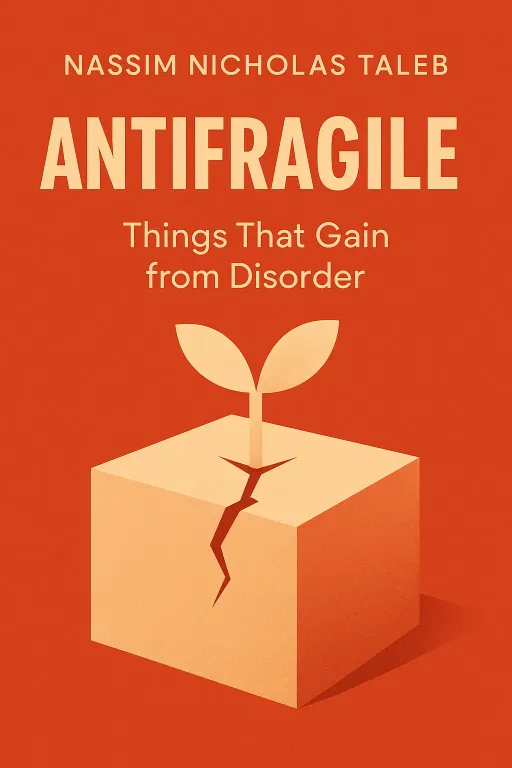
Nova: Absolutely, Atlas. It's our ingrained human instinct, isn't it? To build walls, to create certainty. But what if that very pursuit of predictability is actually making us weaker in the long run? That's the electrifying question at the heart of Nassim Nicholas Taleb's seminal work, "Antifragile."
Atlas: Nassim Nicholas Taleb. I know that name. Isn't he the brilliant, slightly provocative thinker who also gave us "The Black Swan"? The one who challenges so much of our conventional thinking about risk?
Nova: Exactly! Taleb, with his background as a former options trader and risk manager, has an unparalleled, almost street-smart, perspective on how systems truly behave under stress. He's not just an academic; he's lived in the trenches of financial markets, where unpredictability is the only constant. His ideas are widely acclaimed for completely upending our understanding of risk and uncertainty. And he argues that aiming for mere robustness is actually a missed opportunity, especially for those of us who are trying to build the future.
Atlas: Okay, so you’re saying that just being "robust" isn't enough. For our listeners who are constantly innovating and strategizing, the idea of building something that simply damage might actually be holding them back from something far more powerful. That makes me wonder, what's the difference? What is this "antifragility" that sounds like it goes beyond just being tough?
Antifragility: Beyond Robustness, Thriving in Disorder
SECTION
Nova: That's the million-dollar question, Atlas. Think of it this way: most things are fragile, meaning they break under stress. A delicate glass vase, for instance. Robust things, like a sturdy stone wall, resist damage. They can take a hit. But Taleb introduces a third category: the antifragile. These aren't just things that withstand shocks; they and when exposed to volatility, disorder, and stress.
Atlas: So you're saying a robust system just stays the same, like that stone wall. But an antifragile one actually gets because of the pressure? Like, the chaos literally makes it more effective? That sounds almost mythological. Like the Lernaean Hydra, where if you cut off one head, two more grew back.
Nova: Precisely, Atlas, the Hydra is a fantastic analogy! Or think of it in terms of biology: our muscles. If you lift weights, you're intentionally stressing them. They don't just resist the stress; they tear and then rebuild themselves stronger. A fragile system would be a crystal vase that shatters. A robust system would be a steel beam that bends but doesn’t break. An antifragile system is the muscle that adapts and grows from the challenge.
Atlas: I see. So, if I’m building a new system or even a team, I shouldn't just be thinking about making it bulletproof, but actually giving it things to from, to from. But isn't robustness what we've always aimed for in business, in engineering, in life? Why is that not enough for someone trying to build for the future, for someone with foresight?
Nova: Because robustness merely preserves the status quo. It assumes the future will largely resemble the past, just with some bumps. But we know, especially from Taleb's work on "The Black Swan," that highly improbable, unpredictable events are not only possible but have immense impact. A robust system might survive a Black Swan, but an antifragile one will find a way to benefit from it.
Atlas: That's a huge distinction. It’s not just about surviving the storm, it's about harvesting the energy from the storm. But can you give me a real-world example? What does a robust system look like versus an antifragile one in, say, an organizational context?
Nova: Absolutely. Imagine a highly centralized, bureaucratic corporation. It might seem robust. It has strict rules, clear hierarchies, established procedures. It's designed to resist change, to maintain stability. But when a truly disruptive technology or a sudden market shift hits, its rigidity becomes its downfall. It’s slow to adapt, its internal silos prevent information flow, and it often collapses or shrinks dramatically.
Atlas: That sounds rough, but I can definitely see how that would be true. It's like they're optimized for a world that no longer exists.
Nova: Exactly. Now, an antifragile organization might look like a decentralized network of autonomous teams, each experimenting, failing fast, and sharing insights. They have redundant capabilities, a culture of continuous learning, and a willingness to pivot. When a market disruption hits, one part of the network might falter, but others quickly adapt, learn from the failure, and even capitalize on the new opportunities created by the chaos. They don't just resist damage; they actively find ways to leverage the new landscape. The stress itself becomes an input for growth.
Atlas: Wow. So it’s not just about having a backup plan; it’s about having a system that literally gets smarter and more capable because of unexpected challenges. That’s a radical shift in perspective for anyone trying to lead with purpose and impact.
Designing for Gain: Practical Applications of Antifragility
SECTION
Nova: It truly is. And that idea of gaining from uncertainty naturally leads us to the crucial question: how do we actually for this? How do we stop just resisting chaos and start turning it into an ally, especially for those who see the future and are actively building it?
Atlas: For our listeners who are constantly looking ahead and trying to build resilient, impactful projects, this must sound like an impossible task. How do you intentionally invite stress without just inviting disaster? It feels counter-intuitive to someone who values seamlessness and integrated application.
Nova: It feels counter-intuitive because we're wired to avoid pain. But antifragility isn't about reckless endangerment; it's about intelligent exposure. One key strategy is to embrace Think of it like A/B testing in software development, or continuous prototyping in product design. Instead of one huge, fragile launch, you have many small, iterative tests. Each 'failure' or unexpected result provides valuable data, making the next iteration stronger.
Atlas: So, instead of one big, make-or-break bet, it's about lots of smaller, lower-stakes bets where you can learn from each one. That makes me wonder, how does this apply to something like a long-term strategic plan? That's usually a robust, carefully constructed document.
Nova: That's a perfect example, Atlas. A traditional, robust strategic plan is often a detailed, five-year roadmap. It assumes a relatively stable environment. But what happens when a global pandemic hits, or a completely new technology emerges overnight? That rigid plan becomes fragile. An antifragile approach to strategy involves Instead of one grand master plan, you cultivate multiple smaller initiatives, each with the potential to scale if conditions favor it. You maintain flexibility, keep your options open, and don't commit too heavily to any single path.
Atlas: Okay, so it’s less about having 'the plan' and more about having a portfolio of 'potential plans' that can adapt and even accelerate based on what the future throws at you. That sounds like true foresight, not just prediction.
Nova: Exactly. And the third strategy is to These are the things that make us vulnerable: single points of failure, over-optimization for efficiency at the expense of resilience, excessive debt, or rigid hierarchies. By intentionally removing these elements, you create space for the system to adapt and grow. Nova's take here is critical: instead of fearing the unknown, learn to design your work and life to thrive on it, turning chaos into a powerful ally.
Atlas: That’s a really actionable insight. So, for someone managing a complex project or a team, it’s about identifying where they’ve tried to make things too 'robust' and inadvertently made them brittle. Like, maybe a very specialized team where if one person leaves, the whole thing grinds to a halt. That’s a fragilizer.
Nova: Spot on. An antifragile team would have cross-functional skills, shared knowledge, and a culture where people are encouraged to step into different roles. The temporary disruption of a team member leaving becomes an opportunity for others to learn, for processes to be refined, and for the team's overall adaptability to increase. It's about designing for gain, not just for resistance.
Atlas: So it’s not about predicting the future, it's about building systems that no matter what the future throws at them, even if it's a "Black Swan" event. That’s a fundamentally different way to approach building, leading, and living that resonates deeply with the idea of integrated application and impact.
Synthesis & Takeaways
SECTION
Nova: It truly is, Atlas. Antifragility isn't about being strong; it's about a dynamic, almost symbiotic, relationship with disorder and uncertainty. It's a fundamental shift from viewing chaos as a threat to seeing it as a potential source of growth and innovation. It’s an empowering mindset for anyone driven by impact, for those who seek to not just learn but to actively apply and grow.
Atlas: That makes so much sense. For our listeners who are "innovators" and "strategists," who are building the future and driven by impact, this isn't just theory. This is a framework for how to actually thrive in the volatile world we inhabit. It sounds like designing for antifragility is less about rigid control and more about intelligent, adaptive evolution, trusting your instincts and embracing the journey.
Nova: Absolutely. And with that in mind, here's a tiny step we invite all our listeners to take this week: identify one area in your current project or even your personal routine that you've tried to make super "robust." Now, ask yourself, how could you redesign it to become antifragile instead? How could you allow it to gain from unexpected challenges?
Atlas: That’s a powerful challenge. It’s about shifting our perspective from fear of the unknown to an active embrace of its potential. That’s the kind of impactful growth we're always striving for.
Nova: Indeed. Embrace the journey, and watch how you grow stronger with every tremor.
Atlas: Thank you, Nova, for shedding such brilliant light on this concept.
Nova: My pleasure, Atlas.
Nova: This is Aibrary. Congratulations on your growth!