Navigating the Unknown: Building Resilience in Uncertain Times
Golden Hook & Introduction
SECTION
Nova: What if everything you've heard about 'resilience' is actually selling you short? What if just bouncing back from a setback isn't enough?
Atlas: Whoa, that's a bold claim, Nova. I've always thought resilience was the holy grail, the ultimate goal when things go wrong. Most of our listeners are probably nodding along, thinking the same thing.
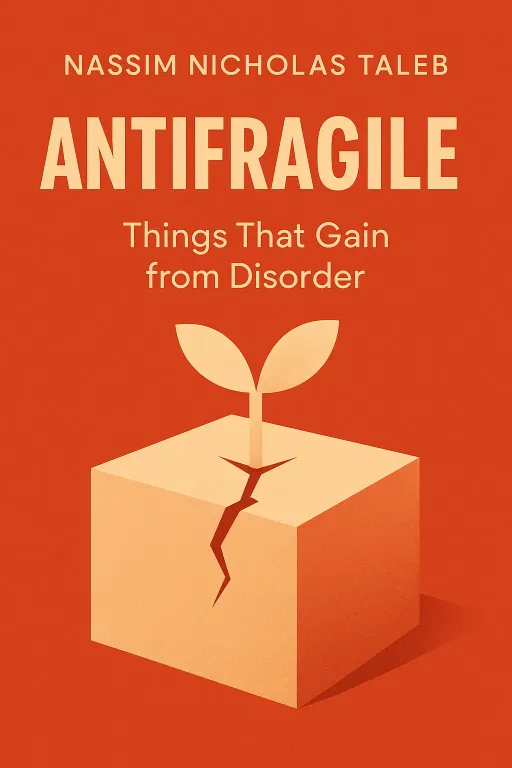
Nova: Exactly! Today, we're not just going to nod; we're flipping that script entirely. We're diving into two incredibly powerful ideas that suggest true strength comes from systems and mindsets that from disorder, growing stronger with every challenge. We're talking about Nassim Nicholas Taleb's groundbreaking work, "Antifragile: Things That Gain from Disorder," and Ryan Holiday's incredibly insightful "The Obstacle Is the Way."
Atlas: Okay, I'm intrigued. "Gaining from chaos" sounds almost too good to be true, but also incredibly powerful for curious learners like our audience, who are always looking for that deeper intellectual edge.
Nova: It is, and it's a game-changer. Taleb, for instance, isn't your typical academic. He's a former options trader turned philosopher of randomness, which gives him this incredibly unique, street-smart yet deeply intellectual perspective on risk, uncertainty, and how the world actually works, not how we wish it would. And Holiday, on the other hand, is a modern Stoic and media strategist who has this incredible knack for making ancient philosophy feel utterly relevant to our contemporary challenges.
Atlas: So, we've got a practical philosopher and a modern Stoic showing us how to not just survive, but truly thrive? This sounds like exactly what many of us need to hear.
Nova: Absolutely. And it starts with Taleb's radical idea: Antifragility.
The Antifragile Mindset: Gaining from Disorder
SECTION
Nova: So, picture this: we have fragile things, which break under stress. Think a delicate glass vase. Then we have robust things, which can withstand stress without breaking, like a sturdy stone wall. Most self-help books aim for 'robustness' or 'resilience' – bouncing back. But Taleb introduces a third category: the antifragile. These things don't just resist stress; they from it. They get stronger, better, more capable when exposed to volatility, randomness, and chaos.
Atlas: That’s a fascinating distinction. So, you’re saying it's not just about enduring the storm, but about actually using the storm to build a better ship?
Nova: Precisely! Think about our own bodies. When you lift weights, you're intentionally stressing your muscles. They don't just 'bounce back'; they tear and then rebuild themselves stronger than before. Or our immune systems—they become more robust, more capable of fighting off future threats, by being exposed to pathogens. That's antifragility in action.
Atlas: Wow, that’s actually really inspiring when you put it like that. It turns daily annoyances or even major setbacks into personal training sessions for our entire being. But what about, say, a business or a career? How does a company become antifragile, or an individual in their professional life?
Nova: Great question. For a company, it might mean having decentralized decision-making, or building in redundancy even if it seems inefficient on paper. It means having options, being able to experiment and fail on a small scale, learning from those failures, and then pivoting. For an individual, it's about cultivating a mindset where unexpected shocks aren't seen as purely negative. They're information. They reveal hidden weaknesses in our plans or assumptions, forcing us to adapt and innovate, leading to better solutions than if things had remained stable.
Atlas: That makes me wonder, if we're always trying to optimize for efficiency, are we actually making ourselves more fragile in the long run? Because we're removing all the buffers, all the optionality you just mentioned.
Nova: Exactly! It's the paradox of optimization. We try to smooth out all the bumps, eliminate all the uncertainty, but in doing so, we often create a system that is incredibly brittle when a truly unexpected shock hits. Antifragility embraces the bumps, it thrives on the messiness of the real world. It's about having skin in the game and learning from every scratch.
Atlas: So, for our curious learners, an antifragile mind might be one that actively seeks out diverse perspectives, even contradictory ones, because that intellectual 'stress' makes their understanding stronger?
Nova: Absolutely. It's about being open to being wrong, to having your assumptions challenged, because that's how true learning happens. It’s a dynamic process of continuous improvement through exposure to variation.
Obstacles as Opportunities: The Stoic Path to Resilience
SECTION
Nova: And this idea of actively benefiting from challenges isn't entirely new; it echoes ancient wisdom. Which brings us to Ryan Holiday and the Stoics, and the powerful message that "The Obstacle Is the Way."
Atlas: I love that title. It immediately flips your perspective. But how does that ancient philosophy connect with Taleb's modern concept of antifragility?
Nova: Well, while antifragility describes the of things that gain from disorder, Stoicism offers a for how we, as individuals, can cultivate that same ability. Holiday, drawing heavily on figures like Marcus Aurelius, Seneca, and Epictetus, shows us that every impediment, every roadblock, every crisis, contains within it an opportunity for growth. It's about seeing problems not as dead ends, but as raw material to be worked with.
Atlas: That sounds like a monumental shift, especially when you're in the thick of a crisis. It's hard to just "reframe" when you're feeling overwhelmed or defeated. What about real, crushing setbacks?
Nova: It absolutely takes practice, but the Stoics gave us a roadmap. Holiday breaks it down into three disciplines: Perception, Action, and Will. First, Perception: how you see the situation. Is it a catastrophe, or is it a challenge? Then, Action: what you choose to do about it, focusing on what's within your control. Finally, Will: your inner strength and acceptance of what you cannot change.
Atlas: I can see how that would be incredibly powerful. It’s like a mental martial art, where you use the opponent’s force against them. Can you give an example of how someone actually this?
Nova: One of my favorite examples from Holiday's book is Demosthenes, the great Athenian orator. He had a terrible stutter. An absolute, debilitating speech impediment for someone who wanted to be a public speaker. Most people would have given up. But Demosthenes saw this as obstacle to overcome. He didn't just cope; he actively used it. He would practice speaking with pebbles in his mouth, run up hills reciting verses to improve his breath control, and practice by the sea to drown out the roar of the crowds.
Atlas: That's incredible. He turned his biggest weakness into his training ground.
Nova: Exactly. He transformed his impediment into the very source of his rigorous training, making him one of history's most powerful speakers. The obstacle wasn't in his way; it the way he became great. It forced him to develop a level of discipline and focus that others, without such a challenge, might never have achieved.
Atlas: That gives me chills. This isn't just about bouncing back; it’s about a fundamental shift in how we view the world and our own potential. It’s seeing the unexpected not as a threat, but as a forge.
Synthesis & Takeaways
SECTION
Nova: So, when we bring Taleb and Holiday together, we see a powerful synergy. Taleb gives us the big-picture understanding that randomness and volatility are inherent to life, and some things are built to thrive in it. Holiday gives us the personal philosophy, the ancient wisdom, to embody that antifragility. It’s not just about coping; it's about actively seeking situations that force us to adapt and evolve, turning potential weaknesses into sources of power.
Atlas: That’s a powerful thought to leave our listeners with, especially those who love diving deep into these kinds of concepts. It sounds like the ultimate form of self-improvement – one that uses life's messiness as its fuel.
Nova: Absolutely. Every challenge isn't just a test; it's an opportunity to become stronger, smarter, more adaptable. It’s about building a life and a mindset that doesn't just survive the unknown, but truly gains from it.
Atlas: So, for our curious learners out there, what's a tiny step, a practical action they can take this week to start exploring this for themselves?
Nova: My suggestion, directly from our core content, is this: Identify one small 'stressor' in your day. It could be a minor inconvenience, a frustrating task, or an unexpected change of plans. Instead of just getting through it, actively ask yourself: How can I not just cope, but actively learn and grow from this? How can I become a little more antifragile, a little more Stoic, today?
Atlas: Love that. It turns daily annoyances into personal training sessions. Embrace the wobble!
Nova: Precisely. Embrace the wobble!
Atlas: Fantastic. This is Aibrary. Congratulations on your growth!