How to Navigate the Unknown Without Losing Clarity
Golden Hook & Introduction
SECTION
Nova: What if everything you thought about making "good" decisions was wrong? What if the very confidence that drives you forward is actually your biggest blind spot, leading you to misinterpret success, misunderstand failure, and miss transformative opportunities hiding in plain sight?
Atlas: Whoa, that's a bold claim, Nova. I imagine a lot of our listeners, especially those who are constantly pushing boundaries and making high-stakes decisions, might be feeling a little called out right now. Confidence is often seen as a prerequisite for pioneering.
Nova: Exactly, Atlas! We're conditioned to believe that high confidence equals good judgment, and that a successful outcome automatically means a brilliant decision. But the reality is far more nuanced, and this misunderstanding can be incredibly dangerous when you're navigating truly unknown territory. We often seek certainty where only probabilities exist, and that's where the trouble begins.
Atlas: So you're saying that unwavering belief can actually be a hindrance? That's a complete flip from conventional wisdom. Where are these radical ideas coming from?
Nova: Well, today we’re diving into the profound wisdom of two incredible thinkers who've mastered the art of thriving in uncertainty. First up is Annie Duke, a former professional poker player who became a World Series of Poker bracelet winner and a renowned decision strategist. Her insights come from a world where every decision is a calculated risk, and outcomes are often beyond your control.
Atlas: A professional poker player? That's certainly not the typical boardroom background. I'm already intrigued. And who's the second architect of this new way of thinking?
Nova: Then we have Nassim Nicholas Taleb, a former options trader, essayist, and scholar whose work challenges us to reconsider our relationship with risk entirely. His perspective is forged in the volatile world of financial markets, where systems either break, resist, or actually from disorder. These aren't abstract theories; they're battle-tested frameworks from people who've lived and breathed uncertainty at its most intense. And they both illuminate how our default settings for decision-making are actually holding us back from true clarity in the unknown.
The Blind Spot & Thinking in Bets
SECTION
Nova: Let's start with this "blind spot." Imagine a CEO who launches a new product with absolute conviction. It succeeds wildly. Everyone praises their brilliant foresight. But what if, behind the scenes, that success was largely due to a fluke market trend that no one predicted, and the decision-making process itself was deeply flawed? Conversely, imagine another CEO who makes a meticulously researched, highly probable decision that, through sheer bad luck, fails. The company loses money, and that CEO is labeled incompetent.
Atlas: That scenario resonates deeply. For our listeners who are building and leading teams, the pressure to deliver results can often overshadow the quality of the process. It's incredibly easy to confuse a good outcome with a good decision, especially when your reputation is on the line. But how do you untangle that? How do you learn from either of those situations effectively?
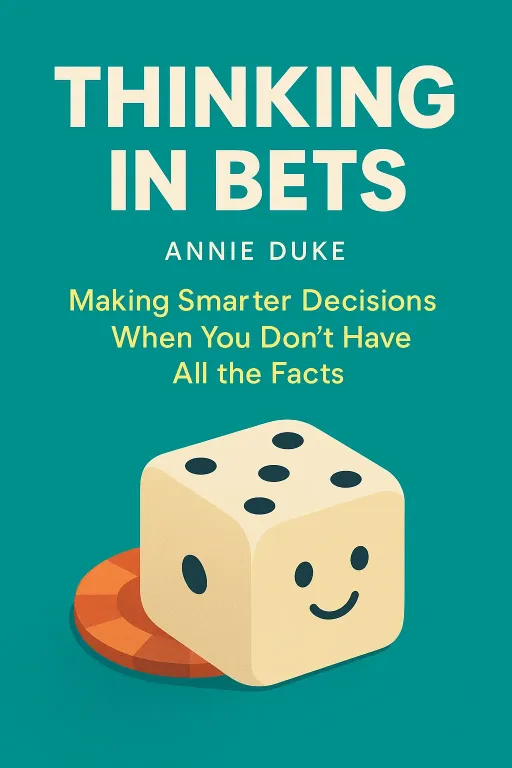
Nova: That's where Annie Duke's "Thinking in Bets" becomes revolutionary. She teaches us to separate the quality of a decision from the quality of its outcome. In poker, a player might make the statistically correct move, putting their money on a 70% chance of winning, but still lose that particular hand. Does that mean it was a bad decision? No, it was a good decision with a bad outcome.
Atlas: So you're saying the poker player, even after losing, should still feel good about their process? That feels incredibly difficult to internalize when the stakes are real, when you've got investors, employees, and your entire vision riding on the results. How does a visionary leader, constantly pushing boundaries with imperfect information, actually this? It sounds great in theory, but the pressure for results is immense.
Nova: It absolutely is difficult, but it's crucial for long-term growth. Duke argues that focusing on the allows you to learn. If you only look at outcomes, you'll misattribute success to skill when it was luck, and failure to incompetence when it was just bad variance. To implement this, leaders can start by intentionally creating "decision journals" – documenting the information available, the probabilities assessed, and the rationale the outcome is known.
Atlas: A decision journal. That's a concrete step. It shifts the accountability from just the result to the rigor of the thought process. I can see how that would force a more objective look at how decisions are actually made, rather than just celebrating wins or mourning losses. This allows a leader to truly evaluate their inner compass.
Nova: Exactly. It’s about cultivating a culture where the team feels safe to analyze the decision process, even when the outcome was negative. This encourages transparency, enables learning, and ultimately leads to better decisions over time. It’s a shift from a results-only mindset to a results-plus-process mindset.
Antifragility: Gaining from Disorder
SECTION
Nova: And speaking of embracing imperfection, what if we could go beyond merely surviving uncertainty? What if we could actually from it? This brings us to Nassim Nicholas Taleb's groundbreaking concept of "Antifragility."
Atlas: Gain from disorder? That sounds almost paradoxical. Most of us are just trying to build robust systems that stress. We want our teams, our strategies, our foundations to be strong enough to withstand shocks. What does "antifragile" even look like in the real world?
Nova: It’s a radical departure from thinking about resilience. Think about the human immune system. When it's exposed to pathogens, it doesn't just resist them; it learns and becomes stronger, more capable of fighting future threats. Or consider a forest after a small fire; it often rejuvenates, with new growth and biodiversity emerging from the ashes. These systems don't just tolerate stress; they it to improve.
Atlas: That’s fascinating. So it's not about being unbreakable, it's about being strengthened by the breaks. How does a 'Catalyst' who wants to create lasting change, cultivate an antifragile culture within their team? It seems like it would require a complete re-evaluation of how we manage risk and encourage innovation. Most organizations try to eliminate risk, not embrace it.
Nova: Taleb argues that antifragile systems are characterized by redundancy, decentralization, and a willingness to embrace small, manageable failures. For a leader, this means empowering teams to experiment, even if it leads to minor setbacks. It means not putting all your eggs in one basket, but having diverse approaches. It means allowing for local, independent decision-making rather than rigid top-down control. Each small stressor, each minor deviation, becomes a data point, an opportunity for the system to adapt and grow stronger.
Atlas: I can see how that would foster a culture of innovation and resilience. It's about designing systems and cultures that don't just bounce back, but actually after a disruption. It requires a profound trust in the team to learn and adapt, which ties into the user's desire to cultivate a strong culture and empower their team to soar.
Nova: Absolutely. It transforms uncertainty from a threat into an accelerant. Instead of trying to predict the unpredictable, you build a system that benefits from it. It’s the ultimate form of thriving in dynamic environments.
Synthesis & Takeaways
SECTION
Nova: So, when we combine "Thinking in Bets" and "Antifragility," we're not just talking about navigating the unknown; we're talking about fundamentally transforming our relationship with it. Thinking in bets helps us make better decisions uncertainty, while antifragility helps us build systems—and mindsets—that actually on that very uncertainty. It’s about shifting our entire paradigm from avoiding chaos to leveraging it for growth.
Atlas: That's incredibly powerful. It's about trading the illusion of certainty for the reality of strategic probability, and then learning to dance with the chaos. That's a powerful framework for someone trying to pioneer new paths, to grasp the big picture with clearer eyes. It makes me think of the deep question you posed earlier: "Did you evaluate a recent decision based on its process or solely on its outcome?" For our listeners, especially those leading teams and charting new courses, what's one immediate thing they can do to start shifting their focus?
Nova: A fantastic question, Atlas. Here's a concrete step: For your next significant decision, before you even make it, try a "pre-mortem." Gather your team and imagine that the decision has already failed spectacularly. Then, work backward to brainstorm all the reasons it failed. This exercise, often used by Annie Duke, forces you to consider potential blind spots, evaluate probabilities more rigorously, and strengthen your decision process you commit. It's about proactively learning from a hypothetical future failure.
Atlas: That's a brilliant way to gain clarity, not by predicting the future, but by preparing for its countless possibilities. It's not just about avoiding losing clarity; it's about gaining a new, more robust kind of clarity in the unknown.
Nova: Indeed. This is Aibrary. Congratulations on your growth!