How to Build Unshakeable Resilience Without Burning Out: The Antifragile Advantage
Golden Hook & Introduction
SECTION
Nova: Atlas, quick question: What's the one thing everyone tells you to avoid if you want to succeed?
Atlas: Oh man, that's easy. Stress. Uncertainty. Volatility. The stuff that makes you want to crawl under a blanket and just wait for it all to pass.
Nova: Exactly. What if I told you the truly successful people, the ones who don't just survive but through chaos, aren't avoiding those things, but actively because they make them stronger?
Atlas: Whoa, really? That sounds… counterintuitive, to say the least. My inner compass is screaming 'danger, avoid!'
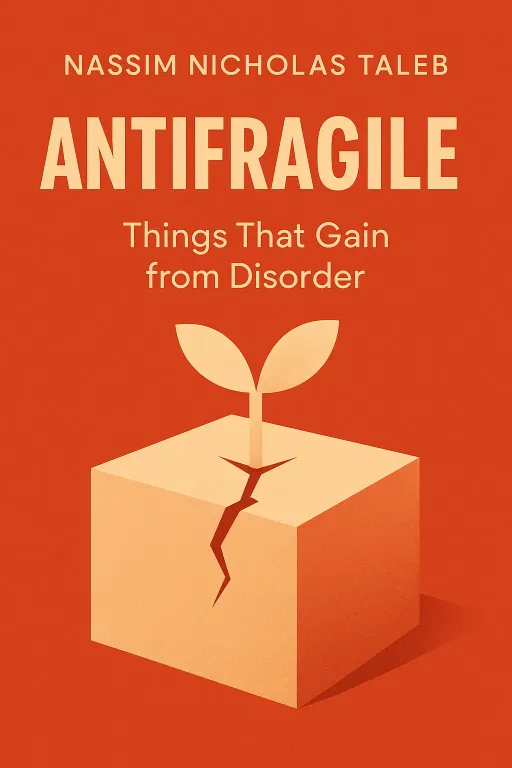
Nova: Well, prepare for a paradigm shift, because today we're diving into two brilliant minds who champion this very idea: Nassim Nicholas Taleb, with his groundbreaking work "Antifragile," and Ryan Holiday, with his modern Stoic masterpiece, "The Obstacle Is the Way." Taleb, a former options trader and statistician, developed his concept of antifragility from observing complex financial systems, completely upending centuries of thought about risk. Holiday, on the other hand, brought ancient Stoic philosophy to a modern audience, making it incredibly accessible for leaders and builders.
Atlas: Okay, so we're talking about not just surviving the storm, but actually building a better boat the storm? That's going to resonate with anyone trying to build sustainable systems in today's unpredictable world. But how do we even begin to wrap our heads around that?
Antifragility: Gaining from Disorder
SECTION
Nova: That's the perfect question, Atlas. Most of us understand 'fragile' – something that breaks under stress. A glass vase, for example. We also understand 'robust' or 'resilient' – something that resists stress and returns to its original state, like a strong oak tree bending in the wind.
Atlas: Right, those are the two options I always thought we had. Try not to break, or bounce back if you do.
Nova: Exactly. But Taleb introduces a third category: the 'antifragile.' This is something that doesn't just resist shocks or return to its original state; it and from disorder, volatility, and stress. Think of a muscle. It doesn't just resist weight; it grows stronger when subjected to controlled stress. Or a complex biological system, like your immune system, which actually strengthens when exposed to pathogens.
Atlas: So you're saying our immune system isn't just resilient, it's antifragile? That's a great way to put it. It sounds like nature figured this out long before we did.
Nova: Precisely! Taleb argues that much of our modern world, in its attempt to eliminate all volatility and risk, inadvertently makes itself more fragile to major, unforeseen shocks. We create systems that are optimized for calm, but then collapse when the unexpected inevitably hits.
Atlas: That makes me wonder about our obsession with 'optimization' and 'efficiency' in business. Are we accidentally building fragile systems by trying to make everything too smooth, too predictable?
Nova: Absolutely. A truly antifragile system has built-in redundancies, allows for small, controlled errors, and even embraces a certain level of randomness. It's about designing things so that when things go wrong, they don't just break; they provide information, trigger adaptations, and ultimately make the whole system stronger.
Atlas: But wait, looking at this from a high-stakes tech environment perspective, isn't that risky? Are you saying we should actively seek out chaos? That sounds like a recipe for burnout for our listeners who are already stretched thin, trying to manage high-pressure teams. How do you differentiate between helpful stress and destructive, overwhelming stress? Because one sounds like growth, and the other sounds like a trip to the emergency room.
Nova: That's a crucial distinction, and it leads us directly to our next insight. Antifragility isn't about inviting overwhelming chaos. It's about recognizing that volatility isn't always an enemy, and then designing yourself and your systems to from it. It's about controlled exposure, small doses of stressors, and having mechanisms to learn and adapt. And that's where the individual mindset comes in, which Ryan Holiday unpacks so brilliantly.
Stoicism & Adversity as Advantage
SECTION
Nova: If antifragility is about the gaining from disorder, then Holiday's Stoicism is about the gaining from adversity. He takes ancient Stoic philosophy, particularly from figures like Marcus Aurelius and Seneca, and applies it to modern challenges.
Atlas: I've always heard of Stoicism, but sometimes it sounds like just 'grinning and bearing it.' Is it really more than that?
Nova: Oh, it's profoundly more than that. Holiday's core premise from "The Obstacle Is the Way" is that our perception of an obstacle determines its power over us. He argues that every single challenge, every setback, every 'obstacle,' contains within it the seeds of an opportunity for growth, learning, or a new path.
Atlas: So it's not about avoiding the obstacle, but changing how you the obstacle? That's a great way to put it.
Nova: Exactly. Think of Amelia Earhart. She faced countless mechanical failures, societal skepticism, and dangerous weather conditions in her pioneering flights. Most people would see those as reasons to quit. But for her, each mechanical issue was a lesson in engineering, each criticism an opportunity to prove her determination. She didn't just 'bounce back' from setbacks; she used them as fuel to refine her approach, strengthen her resolve, and ultimately push the boundaries of aviation.
Atlas: That's incredible. It's not just about mental toughness, then; it's about active transformation.
Nova: Yes, and Holiday emphasizes two key Stoic practices. First, focus intensely on what you control – your actions, your attitude, your effort. Everything else, you learn to let go of. Second, reframe your perspective. See problems not as punishments, but as opportunities to practice virtue, build new skills, or discover alternative solutions.
Atlas: But how does one actually that? It sounds great in theory, but when you're facing a real-world crisis, like a project failing or a team dynamic going sideways, it's hard to just 'reframe.' For our listeners who are trying to trust their inner compass while navigating that real-world uncertainty, what are the tiny steps they can take?
Nova: That's the beauty of it. It starts small. Taleb talks about introducing small, controlled stressors. Holiday suggests daily reflection. When you encounter a setback, instead of immediately reacting emotionally, take a moment. Ask yourself: "What part of this can I control?" and "What lesson is this obstacle trying to teach me?" It's not about loving the pain; it's about loving the that comes from effectively navigating the pain. It's about building a system, both external and internal, that actually gains strength from the very things that would break others.
Synthesis & Takeaways
SECTION
Nova: So, bringing these two powerful ideas together, what we learn from Taleb and Holiday is that true resilience isn't about avoiding stress, uncertainty, or obstacles. It's about cultivating a deep understanding that these are not just challenges to endure, but fundamental ingredients for strength, innovation, and sustained impact.
Atlas: That gives me chills. It's about designing our lives and our work to be antifragile, where every perceived setback actually makes us smarter, more adaptable, and more robust. It's about seeing the chaos not as a threat, but as a forge.
Nova: Exactly. It's about moving beyond simply 'coping' with stress to actively harnessing it, turning every challenge into a source of strength. So, for our listeners, we want to offer a tiny step: identify just one area of your work where you can introduce small, controlled stressors to test and strengthen your process or approach. Maybe it's a new, slightly uncomfortable skill, or a project with a tighter deadline than usual. See how you and your system respond.
Atlas: That's a powerful challenge. Instead of running from the fire, we learn to build with it.
Nova: Absolutely. This is Aibrary. Congratulations on your growth!