Build for Tomorrow: Why Antifragility is Your Ultimate Design Principle
Golden Hook & Introduction
SECTION
Nova: What if everything you've been told about 'bouncing back' from adversity is actually holding you back?
Atlas: Oh, come on, Nova. Resilience is practically a superpower these days. You're telling me it's not enough?
Nova: Well, Atlas, what if I told you there's something resilience? Something that doesn't just withstand shocks, or return to normal, but actually from chaos? That's the radical idea at the heart of our discussion today, inspired by two truly groundbreaking thinkers.
Atlas: Intriguing. You've got my attention. Who are we talking about?
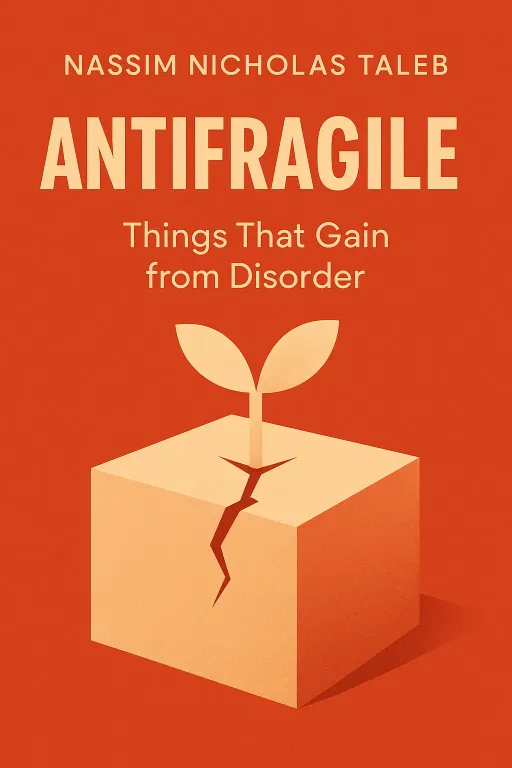
Nova: We're diving into the world of Nassim Nicholas Taleb, specifically his concept of 'antifragility' from his book. Taleb, a former options trader, saw firsthand how traditional financial models catastrophically failed under stress, leading him to question why some systems not only survive volatility but thrive because of it.
Atlas: So, he’s not just theorizing from an ivory tower; he’s seen the market's teeth. That always adds a layer of credibility.
Nova: Exactly. And we're also weaving in insights from Eric Ries's, which, in many ways, provides a practical playbook for building antifragile businesses. Ries completely revolutionized how entrepreneurs approach product development by advocating for constant adaptation and learning from every single feedback loop.
Atlas: That makes sense. I can see how continuous learning could build strength. So, this isn't just about surviving a storm, it's about coming out stronger, maybe even with new sails?
Nova: You've hit it precisely. It's about designing things – be it a product, a company, or even a personal mindset – so they don't just endure uncertainty, they actively it.
Beyond Resilience: Embracing Antifragility
SECTION
Nova: Most of us strive for robustness, right? We want things to be strong, to resist damage. A robust bridge can withstand a hurricane. But then there's resilience. A resilient tree might bend in the storm, lose a few branches, but it springs back. It returns to its original state.
Atlas: Right. That's what we usually aim for: grit, perseverance, bouncing back. It's the ultimate badge of honor for founders, for anyone really.
Nova: Absolutely. But think about something truly antifragile. Take the human immune system. When it encounters a pathogen, a virus, it doesn't just resist it, or bounce back to its pre-exposure state. It learns from that stressor. It produces antibodies, becoming and more capable of handling that specific threat, and often related ones, in the future. It literally gains from disorder.
Atlas: Wow. That's a profound difference. So, it's not just about recovering. It's about evolving, improving of the challenge. I guess that makes sense in biology, but how does that translate to, say, a business or a project? It sounds almost… counterintuitive for an architect trying to build something stable.
Nova: It absolutely is counterintuitive. We're wired to avoid risk and seek stability. But imagine a business that, every time it encounters a market disruption, it doesn't just survive, it identifies a new opportunity, adapts its strategy, and emerges with a better product or a more efficient process. It's like a muscle: you stress it, it tears a little, and then it rebuilds itself stronger.
Atlas: So, are you saying that the traditional focus on minimizing all risks might actually make us fragile in the long run? Like, if you protect a muscle so much it never gets stressed, it just atrophies?
Nova: Exactly. Taleb argues that by constantly trying to eliminate all volatility, we create larger, hidden vulnerabilities that can lead to catastrophic failures. Think of a highly optimized, just-in-time supply chain. It's incredibly efficient in stable times, but one small disruption—a blocked canal, a factory fire—and the whole thing grinds to a halt. It's fragile to unexpected shocks precisely because it was designed for maximum efficiency in predictable conditions.
Atlas: That makes me wonder about all the talk of "future-proofing" and "risk mitigation." Maybe we're just building more elaborate houses of cards? It’s going to resonate with anyone who's seen a meticulously planned project fall apart because of one unforeseen variable.
Nova: Precisely. The goal isn't to predict every possible future; it's to design in such a way that whatever future arrives, you can benefit from it. That's the essence of antifragility. It’s a design principle that actively seeks out small, manageable stressors or sources of disorder because they provide information and opportunities for growth.
Designing for Disorder: Practical Antifragile Strategies
SECTION
Nova: So, how do we move from this fascinating concept to actual design principles? This is where Eric Ries and become incredibly relevant. If antifragility is the ideal, the Lean Startup methodology is a practical way to build it.
Atlas: Okay, so if evolution is antifragile, how do design our businesses or lives to be like that? Because for many of our listeners, the idea of disorder sounds terrifying, not empowering.
Nova: It's all about controlled exposure, Atlas. Ries champions what he calls "validated learning" and the "build-measure-learn" feedback loop. Instead of spending years perfecting a product in secret, you build a Minimum Viable Product, an MVP, and get it into the hands of users as quickly as possible.
Atlas: Ah, the MVP. I’ve heard that term so often. But how does that make something antifragile? Isn't it just a way to launch faster?
Nova: It’s much more than that. The early feedback, the inevitable criticisms, the unexpected ways users interact with your MVP—those are the "disorders," the stressors. Instead of resisting them, you them, you from them, and you your product. Each iteration makes your product stronger, more aligned with actual market needs, and more robust against future changes because it's been stress-tested and improved in real-time.
Atlas: So, it's not about making a perfect product from day one. It's about building a learning machine that gets better with every bump in the road. That sounds like a powerful source of growth for anyone in a high-stakes tech environment, where market shifts happen overnight.
Nova: Exactly. Think of a traditional software company that spends years developing a complex system, only to find on launch day that the market has moved on, or users hate a core feature. That's a fragile approach. A Lean Startup, by contrast, launches small, learns from failures, pivots, and builds a product that has been strengthened by constant interaction with reality. The "failures" aren't failures; they're data points that make the product antifragile.
Atlas: That’s a perfect example. So, it's about embracing small, intentional 'disorders' to avoid catastrophic, system-wide ones. But what does that look like for someone trying to apply this in their personal routine or a smaller project, not just a tech startup? What's the tiny step?
Nova: The tiny step is to identify one area in your current project or routine where you can introduce a small, safe-to-fail experiment. Don't aim for perfection. Aim for a quick, observable outcome. For example, if you're trying a new productivity system, don't overhaul your entire day. Try one new technique for just an hour, measure its impact, and adjust. The feedback, positive or negative, is your "disorder" making your routine stronger.
Atlas: I can see how that would be less daunting. Instead of a huge, risky change, you're just dipping your toe in the water, learning, and letting the unexpected make you better. That gives me chills, actually, thinking about how you could apply that to personal habits or even just learning a new skill.
Synthesis & Takeaways
SECTION
Nova: Ultimately, antifragility isn't about being invincible; it's about strategically interacting with uncertainty. It's a profound shift from a defensive posture to an offensive one, where disorder isn't something to be feared, but a catalyst for growth.
Atlas: It really reframes the whole idea of "failure," doesn't it? It's not a setback; it's an essential part of the strengthening process. It turns unpredictability from a threat into your greatest ally.
Nova: Absolutely. True innovation and leadership don't come from predicting the future perfectly, but from designing for a future that is inherently unpredictable, making disorder your most valuable feedback mechanism. It’s about building systems that, like our immune system, come out of every challenge more robust, more capable, and ultimately, more alive.
Atlas: So, for our listeners, the challenge isn't to build a fortress against the unknown. It's to build a garden that blooms more vibrantly the more it's pruned and tended.
Nova: Exactly. And your tiny step this week? Identify one area in your current project or routine that you can make 'antifragile.' How can you introduce a small, safe-to-fail experiment, a little bit of intentional disorder, to see how it improves from unexpected events or feedback? Don't just bounce back; bounce forward, stronger than before.
Atlas: That’s actually really inspiring. I love that. Let us know what you discover!
Nova: This is Aibrary. Congratulations on your growth!