Beyond the Code: How 'Antifragile' Principles Build Resilient Agent Systems.
Golden Hook & Introduction
SECTION
Nova: Everyone talks about building robust systems, systems that don't break. We laud them for their stability, their unwavering performance. But what if the secret to true innovation, especially in the rapidly evolving world of AI agents, isn't just surviving chaos, but actually getting because of it?
Atlas: Whoa, hold on. Getting from chaos? That sounds almost… counter-intuitive, right? Like, most of us spend our lives trying to chaos. Are you saying we should invite it in, especially when designing something as critical as an AI agent?
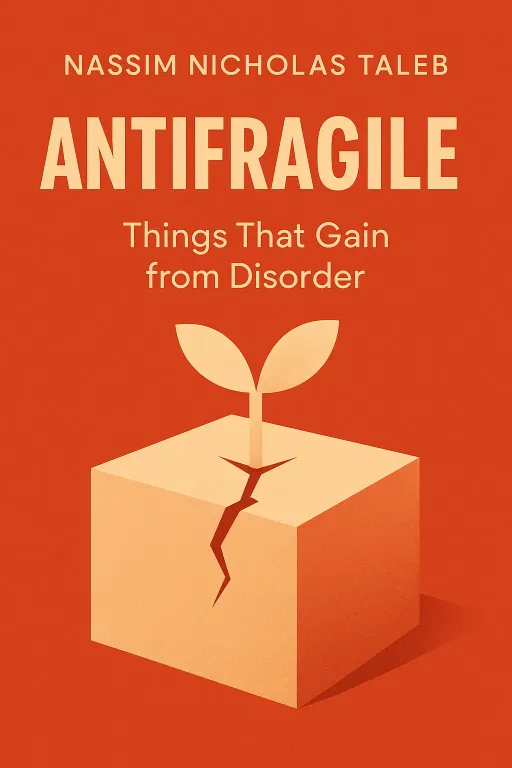
Nova: Precisely, Atlas. And we're not just pulling this out of thin air. Today, we're diving into a concept that radically redefines our relationship with uncertainty, a concept brilliantly articulated by Nassim Nicholas Taleb in his groundbreaking book,.
Atlas: Taleb, okay. I know his name. He's the guy who's always stirring the pot, challenging conventional wisdom. What's his background again, that gives him this unique perspective?
Nova: He's fascinating. Taleb isn't just an academic; he's a former options trader and risk analyst. He developed this entire framework not from an ivory tower, but from observing how financial markets, and frankly, life itself, behave under extreme stress. He saw firsthand that some things don't just resist damage, they on it. It’s that street-smart, real-world experience that makes his ideas so potent, especially for us building the future of agent systems.
Atlas: So, he’s not just theorizing; he’s seen the battlefield. That makes me even more curious. What's the core idea he's putting forward that's so different from our usual focus on just making things tough?
Deep Dive into Antifragility: Defining the Concept & Contrasting with Robustness/Resilience
SECTION
Nova: The core idea is Antifragility. And to truly understand it, we first need to understand what it. Think about system design. When we talk about making systems strong, we usually aim for one of two things: robustness or resilience.
Atlas: Right. Robustness, to me, means it can take a hit and keep functioning. Like a concrete bunker during a storm. It doesn't flinch.
Nova: Exactly. A robust system resists shocks; it stays the same. It's built to withstand. Then you have resilience. A resilient system might bend, it might even break a little, but it recovers. It returns to its original state. Think of a flexible willow tree in a hurricane. It sways, loses some leaves, but it stands back up after the storm.
Atlas: Okay, so a rock is robust, a willow is resilient. But if that's the spectrum, where does antifragility fit in? What does 'benefiting from shocks' actually look like in the real world? This still feels a bit abstract.
Nova: This is where it gets really powerful. An antifragile system doesn't just resist or recover; it from volatility, stress, disorder, and unexpected inputs. It gains from disorder. Imagine that willow tree, instead of just recovering, actually grows deeper roots, develops stronger branches, or even learns to photosynthesize more efficiently of the storm. The stress made it better.
Atlas: Wow. So it's not just about surviving; it's about evolving adversity. That sounds great in theory, but isn't that just a fancy way of saying 'learning'? How is it fundamentally different from a machine learning model that gets better with more data, even noisy data?
Nova: That's a great question, and it's a crucial distinction. Learning is certainly a component, but antifragility is about the that inherently allows for positive transformation randomness. It’s about building in the capacity for growth directly into the system's architecture, not just as an afterthought. It's an evolutionary capacity that's baked in. Think of your own immune system. It doesn't just resist a virus; it gets stronger, develops antibodies, and is better prepared for the next exposure of the previous attack.
Atlas: I see. So it's like… a muscle that gets stronger with exercise. The stress is necessary for growth, and if you don't use it, it atrophies. It needs that varied input, those unpredictable challenges, to truly develop. That makes a lot more sense. It's not just enduring, it's leveraging.
Applying Antifragility to Agent Systems: From Theory to Tactical Insight
SECTION
Nova: Absolutely. And when we consider the dynamic, often chaotic environments AI agent systems operate in, traditional robustness quickly falls short. The world of AI is inherently volatile, with constantly changing data, unexpected user interactions, and unforeseen edge cases. Just being robust isn't enough.
Atlas: That resonates. We're always trying to patch, to predict every single failure mode. But the reality is, new ones pop up every day. So what does an 'antifragile agent system' actually look like in practice? Give me a concrete scenario. Is it an agent that crashes and then somehow reboots itself smarter?
Nova: That's a perfect way to think about it. Imagine an AI agent designed to operate in a highly complex, unpredictable financial market. A robust agent might shut down during extreme volatility to prevent errors. A resilient one might recover after the market stabilizes. An agent, however, would use that extreme volatility, those market crashes or sudden surges, not as a threat to be avoided, but as a rich source of information to refine its predictive models, adapt its trading strategies, or even discover new, previously unknown market patterns. The disorder provides new, valuable information it couldn't get from stable data alone.
Atlas: That's fascinating. So the 'Tiny Step' from the book content – identifying a component in your current agent system that is merely robust, and brainstorming how it could be made antifragile – how would we even begin to brainstorm that? What's the mental shift required for a future architect to start building this way?
Nova: The mental shift is profound. Instead of asking, "How do we protect this component from failure?", you ask, "How can this component from failure or unexpected input?" For example, if you have an agent system where certain types of input errors currently lead to a shutdown or a degraded state, an antifragile approach would involve designing that error-handling mechanism to not just log the error, but to actively generate new training data from it, or trigger an exploratory mode that tries novel solutions based on the unexpected input.
Atlas: So it's about building in optionality, redundancy that isn't just backup but diversification. And maybe even embracing small, controlled failures as a necessary part of the evolutionary process. It means seeing every 'problem' as a potential data point for growth. That's a complete paradigm shift from traditional risk management.
Synthesis & Takeaways
SECTION
Nova: It truly is. Ultimately, building antifragile agent systems means we're not just creating intelligent machines that can withstand the future, but evolving partners that can truly adapt and grow the unpredictable nature of the real world. It's about designing for a future we can't fully predict, by making our systems thrive on that very unpredictability. It’s a profound insight that moves us beyond simply managing risk, to actively gaining from it.
Atlas: This fundamentally changes how I think about system architecture. It's not just about what breaks, but what when things go wrong. It's a powerful shift from a defensive posture to an offensive, evolutionary one. I can already see how this applies to so many areas of agent development.
Nova: For our listeners, the 'future architects' and 'innovation explorers' out there, what's one immediate thing they can do to start thinking antifragile in their own projects?
Atlas: My challenge is this: start by looking at a component in your current agent system that you've designed for robustness. Maybe it's a data validation module, or a specific decision-making algorithm. Then, brainstorm one concrete way it could from a specific type of disorder or unexpected input, rather than just resisting it. Even a tiny step in that direction is a leap forward towards true antifragility.
Nova: That's a fantastic challenge, Atlas. We'd love to hear what antifragile ideas you come up with. Share your thoughts and insights with us on social media. Let's build this future together.
Nova: This is Aibrary. Congratulations on your growth!