Architecting Resilience: Overcoming Obstacles
Golden Hook & Introduction
SECTION
Nova: What if everything you thought you knew about resilience was actually holding you back?
Atlas: Hold on, Nova. Are you saying 'bouncing back' isn't the goal? I thought that was the gold standard, the ultimate badge of honor for anyone navigating a tough situation. Like, if you're not bouncing back, you're doing it wrong.
Nova: Exactly! That's the common wisdom, isn't it? To endure, to recover, to return to baseline. But what if there's an entirely different level of engagement with adversity, one where you don't just recover, but you actually become? Not just coping, but thriving because of the very things that tried to break you.
Atlas: That sounds a bit out there. Stronger of the shock? I’m intrigued, but also a little skeptical. What kind of magic are we talking about here?
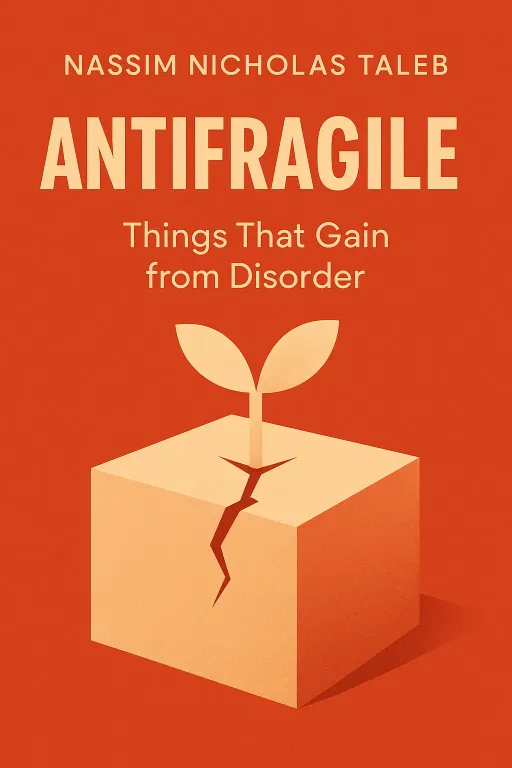
Nova: No magic, Atlas, just profound insight from two incredible thinkers. Today, we're diving into a concept that redefines our relationship with challenges, drawing inspiration from Nassim Nicholas Taleb's groundbreaking work, "Antifragile: Things That Gain from Disorder," and Ryan Holiday's incredibly practical guide, "The Obstacle Is the Way."
Atlas: Ah, Taleb. The mind behind "The Black Swan." He’s known for challenging conventional wisdom and making us rethink randomness. What’s his angle on this?
Nova: Taleb, a former options trader, statistician, and philosopher, has this unique ability to see patterns in chaos. His work often explores how systems behave under uncertainty. "Antifragile" came out of his observations that some things don’t just resist shocks; they actually when exposed to volatility, stress, and disorder. It's a truly paradigm-shifting idea that has influenced everyone from economists to entrepreneurs.
Atlas: That makes me wonder how Holiday's Stoicism ties into this. Holiday, with his background in marketing and media, has a knack for making ancient philosophy feel incredibly relevant and actionable. Is he talking about the same kind of 'gaining from disorder'?
Nova: Absolutely. While their approaches differ, they converge on this core truth: challenges are not deterrents; they are integral components of your journey, offering unique opportunities for learning and fortification. Holiday, through the lens of Stoicism, provides the practical framework for we can cultivate the mindset to achieve this "antifragility." It’s about transforming what seems like a setback into an advantage, a stepping stone to something far greater.
Atlas: So basically you’re saying we’re not just looking at how to survive the storm, but how to build a better ship of the storm.
Antifragility: Growing Stronger from Chaos
SECTION
Nova: Precisely! Let's start with Taleb's concept of antifragility. He argues that we have three categories of things: fragile, robust, and antifragile. Fragile things break under stress – think of a ceramic plate. Robust things resist stress and stay the same – like a sturdy iron block. But antifragile things? They when exposed to stressors.
Atlas: That’s a powerful distinction. For so long, we’ve been conditioned to think 'robust' was the ultimate goal. Just don't break.
Nova: Exactly! Our modern society often tries to eliminate all stressors, all volatility, all risk. But Taleb argues this actually makes us more fragile in the long run, because we lose the ability to adapt and grow. We become like hothouse flowers, beautiful but unable to withstand the slightest breeze.
Atlas: So, like, a muscle? If you don't stress it, it atrophies. But if you lift weights, you create micro-tears, and it rebuilds itself stronger. Is that an antifragile system?
Nova: That’s a perfect everyday analogy, Atlas! Yes, your muscles are antifragile. So is your immune system. When you expose it to a virus, it creates antibodies and becomes stronger, more capable of fighting future infections. Vaccinations work on this very principle – introducing a small stressor to build greater strength.
Atlas: I can definitely relate to that. It’s like when you’re learning a new skill, say coding. You hit frustrating roadblocks, errors, bugs – it feels like you're failing. But each time you push through, you’re not just 'fixing' the problem, you're actually strengthening your problem-solving circuits, your understanding of the language. You become a better programmer because of those frustrating moments.
Nova: That’s it! Consider also the startup economy. Many startups fail, right? But this constant churn, this trial and error, this exposure to market volatility, actually makes the economy more robust and innovative. Each failure provides data, lessons, and often, the founders go on to create even more successful ventures. The individual companies might be fragile, but the of entrepreneurship is antifragile.
Atlas: Wow. That gives me chills. So every 'failure' isn't just a lesson, it's a? It's not just about resilience, it's about active growth beyond the original state. This completely reframes how I think about setbacks, especially when I’m trying to build a foundation for new endeavors or navigate a career transition. It's like, instead of trying to avoid the bumps, we should be seeking out the of bumps.
Nova: Exactly! It's not about seeking out catastrophic events, but understanding that small, manageable stressors, intelligently applied, are essential for growth. It’s about not overprotecting ourselves or our systems from volatility, because that protection itself makes us vulnerable to the truly big shocks.
The Stoic Approach: Obstacles Are the Way
SECTION
Nova: Speaking of leveraging challenges, this brings us to another powerful perspective that beautifully complements antifragility: the timeless wisdom of Stoicism, as articulated by Ryan Holiday in "The Obstacle Is the Way." Holiday has done an incredible job of making these ancient philosophies accessible and actionable for modern leaders and everyday individuals.
Atlas: Okay, Stoicism... that sounds a bit austere, like just gritting your teeth and enduring. How is that different from just 'being resilient,' which you just told me isn't enough? I always pictured Stoics as these emotionless figures.
Nova: That’s a common misconception! Stoicism isn't about suppressing emotions; it's about mastering your to them and to external events. Holiday distills Stoic philosophy into three critical disciplines: Perception, Action, and Will. And the most immediate, practical one for us is Perception.
Atlas: Perception. So, how we see things?
Nova: Precisely. The Stoics believed that we are not disturbed by things, but by the view we take of them. An obstacle isn't inherently good or bad; it's our interpretation that gives it meaning. Holiday uses countless historical examples, from figures like Marcus Aurelius to Amelia Earhart, showing how they didn't just face obstacles, they them.
Atlas: Give me an example of this "perception" in action. Because for someone who's a natural problem-solver, when I hit a wall, my first instinct is often frustration, not philosophical contemplation.
Nova: Think of it this way: a door slams shut on a career opportunity you were certain was yours. Your initial perception might be failure, rejection, a dead end. But a Stoic, applying the discipline of Perception, would immediately reframe this. It’s not a "no," it's a "not this way." It's a signal to reassess, to learn why, to explore alternative paths that might ultimately be better suited for you.
Atlas: So if I'm facing a rejection, it's not a 'no,' it's a 'redirect'? That's a huge shift. It's about seeing the challenge not as a barrier, but as raw material for a better outcome. Like the user who's looking at career transition strategies – a sudden layoff isn't the end, it's the of actively building that new professional path.
Nova: Exactly! It’s the healing moment we talked about in the book's content – recalling a past challenge you thought was insurmountable. Remember how overcoming it made you stronger and better equipped for today's aspirations? That's Stoicism in action, even if you didn't call it that at the time. It’s about taking that initial shock, that perceived setback, and immediately asking: "What is the opportunity here? What is this me to learn? How can I use this to my advantage?"
Atlas: That’s incredibly empowering. It takes the power away from the obstacle itself and puts it squarely back in our hands. It's not about being immune to the problem, but about actively dissecting it and extracting every possible lesson and advantage. For someone grounded and forward-thinking, that’s a game-changer.
Nova: It’s the difference between being a victim of circumstance and becoming the architect of your own growth. And it’s not just about perception. The Stoics also emphasized Action – taking deliberate steps, however small, towards a solution, even if the situation is less than ideal. And Will – cultivating an inner fortress of resolve and accepting what is beyond our control. It’s a complete operating system for turning adversity into advantage.
Synthesis & Takeaways
SECTION
Nova: So, bringing antifragility and Stoicism together, we see a powerful synergy. Taleb gives us the – why exposing ourselves to certain kinds of stress makes us stronger. Holiday gives us the – the philosophical and practical framework for cultivating the mindset and taking the actions that allow us to become antifragile.
Atlas: So it's like we're not just architects of our lives, we're also the engineers of our own growth, using the very problems as building blocks. It’s not about avoiding challenges; it's about embracing them as the essential ingredients for building a stronger, more capable self. That’s a profound shift from merely surviving to actively evolving.
Nova: Absolutely. It means seeing every unexpected problem, every setback, every moment of disorder not as a drain on your energy, but as a potential deposit into your strength account. It’s about trusting your ambition, as we mentioned in the user profile, and recognizing that your desire for more is a strength that can be fueled by the journey itself, including its inevitable bumps.
Atlas: That makes me wonder, for our listeners who are aspiring architects of their lives, practical strategists, and empathetic seekers – what’s one concrete first step they can take to start cultivating this antifragile, Stoic mindset?
Nova: I love that question. Here’s a simple exercise: The next time you encounter an unexpected problem – a project delay, a difficult conversation, a personal setback – pause for just five seconds. Instead of reacting with frustration, ask yourself two questions: First, "What is the lesson here?" And second, "How can this specific obstacle, this specific disorder, actually make me stronger or open a new path?" Even a tiny shift in perception can lead to a monumental shift in outcome.
Atlas: That’s a fantastic, actionable takeaway. It’s about dedicating that specific, uninterrupted time, not just to skill development, but to development, using the challenges themselves as the training ground.
Nova: Exactly. It's about remembering that the journey of self-discovery isn't a smooth, paved road. It's a rugged climb, and every rock, every steep incline, every unexpected detour is there to fortify you for the summit.
Atlas: That’s such a hopeful way to look at it. It truly transforms the narrative of struggle into one of opportunity.
Nova: We encourage all our listeners to reflect on a challenge you're currently facing. How might you apply these principles to turn it from a burden into a building block? Share your thoughts with us online – we'd love to hear how you're architecting your own resilience.
Atlas: This has been an incredibly insightful discussion, Nova. It truly shifts the paradigm.
Nova: It's all about embracing the inevitable bumps, Atlas. This is Aibrary. Congratulations on your growth!