The 'Passive Learning' Trap: Why Active Recall Unlocks Your Memory for HKDSE
Golden Hook & Introduction
SECTION
Nova: You know, Atlas, what if I told you that most of what we've been taught about studying – especially for high-stakes exams like the HKDSE – is actually sabotaging our memory? That the hours we spend 'learning' might be the very reason we forget everything under pressure?
Atlas: Whoa, hold on. Sabotaging? But isn't rereading notes, highlighting, listening to lectures... isn't that just... studying? I mean, that sounds rough, but what else are we supposed to do? What's the alternative to immersing yourself in the material?
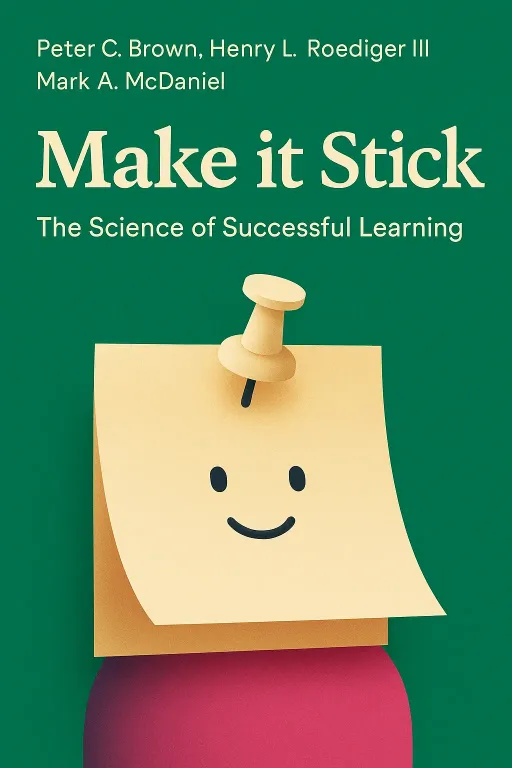
Nova: Exactly the question we need to ask! Because those seemingly diligent habits often create what cognitive scientists call the "illusion of knowing." You feel familiar with the material, so your brain tricks you into thinking you've mastered it. But when the exam comes, that knowledge vanishes like a ghost. Today, we're diving into two groundbreaking books that expose this trap and show us a far more effective path. We're talking about "Make It Stick" by Peter C. Brown, Henry L. Roediger III, and Mark A. McDaniel, and "A Mind for Numbers" by Barbara Oakley.
Atlas: Okay, so all that time I I'm learning, I'm actually just tricking myself? Especially when the HKDSE is looming, that's a terrifying thought. What's even more interesting is you mentioned Barbara Oakley. I've heard she has quite the story.
Nova: She absolutely does! What's fascinating about Oakley is that she started her academic journey as a self-proclaimed "math-hater." She struggled profoundly with technical subjects. Yet, she eventually became a highly respected engineering professor. Her transformation wasn't due to some innate genius she suddenly discovered, but by rigorously applying the very learning techniques she now advocates. It's a powerful testament that these strategies aren't just for the 'naturally smart' but for anyone willing to engage.
Atlas: That’s actually really inspiring. It sounds like she cracked the code for herself, which makes her insights incredibly valuable for anyone facing a tough subject. So, if passive review is an illusion, what's the reality we need to embrace?
The Power of Effortful Retrieval (from "Make It Stick")
SECTION
Nova: The reality is something called 'effortful retrieval.' "Make It Stick" makes a compelling case, backed by decades of cognitive science research, that the act of information from memory is actually what strengthens that memory and makes it more accessible in the future. It's not just testing knowledge; it's knowledge.
Atlas: So you're saying it's not about how much time I spend with the notes, but how much time I spend trying to information out of my brain? Even if it feels harder? Like, if I'm trying to remember a historical date for a HKDSE essay, instead of just looking it up, I should really struggle to find it in my mind first?
Nova: Precisely! Imagine your brain like a vast library. If you just keep stacking books on the shelves, you'll eventually have a huge, unorganized collection. You might even recognize the book covers. But when you need a specific piece of information, you won't know where to find it. Effortful retrieval, on the other hand, is like creating a sophisticated cataloguing system and practicing retrieving those books. Each time you successfully find a book, you're not just confirming it's there; you're also refining the pathways to get to it faster next time.
Atlas: That’s a great analogy. But what if I just can't remember anything? Doesn't that feel like a waste of time, especially when I'm under pressure for an HKDSE deadline? I still struggle with that myself.
Nova: That's the crucial part! The initial struggle, the feeling of "I just can't get it," is actually a sign. It’s what the authors of "Make It Stick" call "desirable difficulty." They conducted numerous studies demonstrating this. For instance, in one classic experiment, students were taught new material. One group re-studied the material multiple times. Another group was tested immediately after learning, even if they felt unprepared, and then re-tested later. Consistently, the group that engaged in frequent, effortful retrieval – the 'testing' group – retained the information far longer and understood it more deeply. The struggle they experienced in recalling actually strengthened those neural connections.
Atlas: That's incredible. So, the very act that feels frustrating or inefficient is actually the engine of true learning? It’s kind of like lifting weights; the muscle only grows when it’s challenged, not when it’s just resting.
Nova: Exactly! Your brain is a muscle in that sense. And this isn't just about rote memorization. Effortful retrieval forces you to make connections, to understand the behind the, which is essential for applying knowledge in complex situations, like those tricky HKDSE problem-solving questions. It moves you beyond surface-level understanding.
Strategic Application & Mindset (from "A Mind for Numbers")
SECTION
Nova: This naturally leads us to "A Mind for Numbers," which takes these cognitive science principles and translates them into incredibly practical, daily strategies. This is where Barbara Oakley, the 'math-hater' turned engineering professor, really shines, showing us to apply effortful retrieval. She introduces concepts like focused and diffused thinking, which are game-changers.
Atlas: Focused and diffused thinking? What does that mean for someone trying to master English comprehension or complex scientific principles for an HKDSE paper?
Nova: Think of focused thinking as using a spotlight. It's when you're intensely concentrating on solving a specific problem, following a formula, or understanding a particular concept. Diffused thinking, on the other hand, is like a floodlight. It's a more relaxed state, where your brain is making broad connections in the background, often when you're not actively thinking about the problem. Oakley's insight is that you need. You focus, then you step away – go for a walk, take a shower, do something completely different – and allow your diffused mode to work its magic.
Atlas: Oh, I see. So you're saying after a really intense study session, I shouldn't just keep pushing through if I'm stuck? I should actually take a break and let my brain process it? That makes me wonder if that's why sometimes the answer just pops into my head when I'm doing something else.
Nova: That’s precisely it! And the "Tiny Step" we mentioned earlier, from our core content, is a perfect example of active recall in action, leveraging both modes. After studying a new topic, close your notes and spend five minutes writing down everything you remember, then compare it to the original material. This simple act is incredibly powerful. You're forcing retrieval, identifying gaps, and then immediately filling them.
Atlas: So, for an HKDSE student, after a chemistry lesson, instead of just re-reading the textbook, I should immediately try to explain the concept of chemical bonding out loud, or draw it from memory? Even if it's messy and incomplete?
Nova: Absolutely! And don't be afraid if it's messy. The messiness is part of the growth. Then, crucially, you compare what you recalled to your notes. That comparison moment is where the learning truly solidifies. It highlights what you know, allowing you to target those weak spots. Oakley also emphasizes the power of interleaved practice – mixing up different types of problems or topics in a single study session – and spaced repetition, which is returning to material at increasing intervals. These together create a robust, resilient memory.
Atlas: That’s a perfect example. It sounds like mastering application for clear communication isn't just about knowing the content, but about it through these active strategies. It's less about passively absorbing and more about actively constructing your understanding.
Nova: Exactly. It's about building strong, interconnected "chunks" of knowledge, as Oakley calls them. You start with small pieces, actively retrieve them, and then link them together. This is how you move from understanding individual facts to grasping complex systems, which is vital for performing well in a demanding exam like the HKDSE. It gives you true intellectual clarity, not just superficial familiarity.
Synthesis & Takeaways
SECTION
Nova: So, to bring it all together, the 'passive learning trap' is real, and it ensnares countless students into an illusion of knowing. But the antidote is clear: active recall, effortful retrieval, and strategic learning. It's about making your brain to remember, not just re-expose it to information.
Atlas: And it’s not just about getting better grades; it’s about cultivating a deeper, more resilient understanding of the world. It sounds like trusting this process, even when it feels difficult, is key. Every step builds mastery.
Nova: Precisely. The "Tiny Step" is your starting point: after studying, close your notes and spend five minutes writing down everything you remember. Compare it. Identify your weak spots. Then, tomorrow, try to recall it again. This small, consistent action, day after day, will fundamentally transform your retention. It’s about being an active architect of your own knowledge.
Atlas: That gives me chills. It's such a hopeful way to look at it – that the struggle isn't a sign of failure, but a sign that you're actually learning more effectively. And for an aspiring academic, that intellectual clarity and ability to express complex ideas effectively is the ultimate goal.
Nova: It is. This isn't just a study hack; it's a fundamental shift in how you approach learning, ensuring that knowledge is truly embedded for confident recall, not just for the HKDSE, but for life. It’s about building a mind that truly understands and can powerfully communicate.
Atlas: Absolutely. This is Aibrary. Congratulations on your growth!