Designing a Revolution: Washington's Leadership Blueprint
Golden Hook & Introduction
SECTION
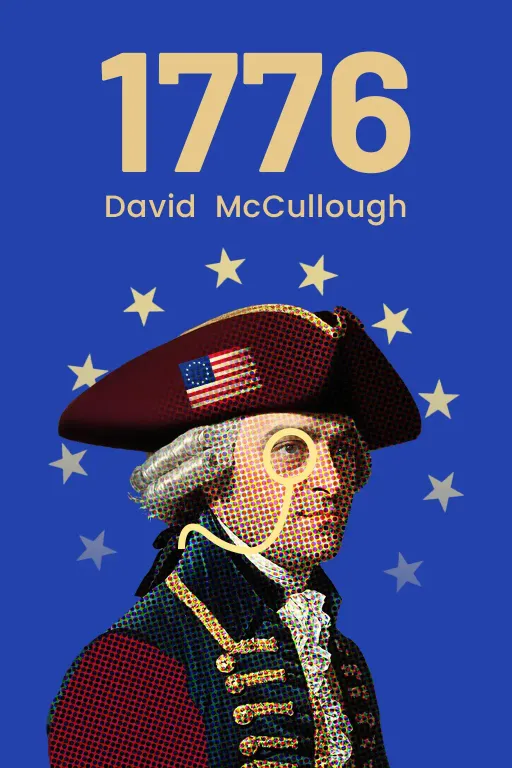
Albert Einstein: How do you design a nation when your team is a 'rabble in arms,' your budget is zero, and your deadline is 'before you're all hanged for treason'? It sounds like the ultimate startup nightmare, but it was the reality for George Washington in 1776. He wasn't just a general; he was the lead designer of a revolution, facing the most terrifying user experience problem in history.
azca: That's a powerful way to frame it. It immediately takes it out of the realm of dusty history books and puts it into a context of creation and problem-solving that feels very modern.
Albert Einstein: Precisely! And that is what we are here to explore today with our guest, azca, a UX and UI designer who knows a thing or two about creating order from chaos. Using David McCullough's incredible book '1776,' we're going to deconstruct Washington's leadership blueprint from two perspectives.
azca: I'm ready.
Albert Einstein: First, we'll explore that daunting 'user experience' problem: how do you motivate a freezing, starving, and divided army? Then, we'll witness the ultimate 'agile pivot'—the stunningly creative plan that forced the world's greatest military power into a humiliating retreat. It’s a story of leadership, design, and sheer will.
Deep Dive into Core Topic 1: The User Experience of Rebellion
SECTION
Albert Einstein: So, azca, let's start with that first, terrifying problem. Before Washington could even think about fighting the British, he had to fight the chaos in his own camp. The book paints a truly brutal picture. What the British saw wasn't an army, but what one of their generals, John Burgoyne, contemptuously called a 'rabble in arms.'
azca: And from the sounds of it, he wasn't entirely wrong. It was a collection of individuals, not a cohesive unit.
Albert Einstein: Not at all. Another observer, Benjamin Thompson, described them as the 'most wretchedly clothed, and as dirty a set of mortals as ever disgraced the name of a soldier.' He said they would rather let their clothes rot on their backs than clean them. There was rampant disease, filth, and incredible tension between the different colonial troops. The Virginians looked down on the New Englanders, the New Englanders were suspicious of everyone else. It was a mess.
azca: That's a designer's worst nightmare. You have a grand vision for a product—in this case, an independent nation—but your users, the soldiers, are completely disengaged. They lack the basic tools to function, and they don't even like each other. It's not about a lack of will, necessarily, but a fundamentally broken system.
Albert Einstein: And the tools... ah, the tools! This is perhaps the most frightening part. In August of 1775, Washington requests a report on his army's gunpowder supply. He's expecting bad news, but what he gets is catastrophic. The report reveals they have less than ten thousand pounds of powder for the entire army surrounding Boston.
azca: How much is that in practical terms?
Albert Einstein: It comes out to about nine rounds per man. Nine bullets. After that, they are throwing rocks. Nathanael Greene, one of his best generals, wrote that they were 'obliged to remain idle spectators' because they simply could not fight. Imagine the psychological weight of that.
azca: It's immense. From a design perspective, you can't ask your 'users' to perform a task they're not equipped for. It leads to frustration, abandonment, and failure. So Washington's first job wasn't to fight, but to solve his supply chain problem. He had to fix the backend before the frontend could work. You can't just tell them to 'be better' or 'be braver.' You have to address their core needs first: food, warmth, supplies, and a reason to trust you.
Albert Einstein: Exactly! And trust was low. Washington, this wealthy Virginia aristocrat, was initially appalled by the 'dirty' and 'mercenary' spirit of the New England troops. He had to overcome his own biases. It's a fascinating problem in human physics, is it not? How do you align so many disparate, repelling forces into a single vector of motion?
azca: It's a classic empathy gap. He had to bridge it. In UX, we spend a lot of time creating 'user personas' to understand who we're designing for. It sounds like Washington had to do that on the fly. He had to understand the 'Yankee Farmer' persona, who was fiercely independent and only signed up for a short term, versus the 'Virginia Rifleman' persona, who came from a more hierarchical culture. They had different motivations, different values, different pain points.
Albert Einstein: A brilliant observation. He couldn't lead them all the same way.
azca: Right. His challenge was to design a single, unifying 'mission' and a system of discipline that could appeal to all of them, or at least function for all of them, despite their differences. That's an incredibly difficult leadership and design challenge. He had to create a user experience for his army that made them want to stay, even when every rational impulse told them to go home.
Deep Dive into Core Topic 2: The Ultimate Agile Pivot
SECTION
Albert Einstein: And somehow, he did. He held that fragile army together through a brutal winter of 1775. But that leads us to the second, and for me, even more amazing part of this story. The stalemate at Boston seemed impossible to break. The British army, the most powerful in the world, was fortified inside the city. The Americans were in a ring outside. And the ground was frozen solid, two feet deep. They couldn't dig trenches. They couldn't mount a traditional siege. So, what do you do when your standard methods are useless?
azca: You innovate. You have to find a workaround. Constraint is the mother of creativity.
Albert Einstein: Precisely! And this is where the story turns into something like a heist film. Washington needs heavy cannons to threaten the British ships in the harbor. But he has none. Then, a 25-year-old, 250-pound bookseller from Boston named Henry Knox comes to him with an insane idea.
azca: I love this part of the book. It's so audacious.
Albert Einstein: Isn't it? Knox says, "General, I will go to Fort Ticonderoga"—a captured British fort 300 miles away in the wilderness—"and I will bring its cannons back to you." Washington, showing incredible faith in this young man, says yes. So Knox and his brother go on this epic journey. Through blizzards, across frozen rivers, and over the Berkshire mountains, they use sleds and oxen to haul 59 cannons and mortars. A total of 120,000 pounds of metal. It was a logistical miracle.
azca: That's the hero engineer delivering the impossible tech. It's the moment in a project where one person's incredible effort unlocks a new possibility for the entire team. But having the cannons is one thing; knowing how to use them is another.
Albert Einstein: Ah, and here is the second stroke of genius! They have the guns, but they still can't dig fortifications on the frozen hills of Dorchester Heights, the one place that overlooks the entire city and harbor. The plan seems doomed. Then, another officer, Rufus Putnam, has a flash of insight. He had seen this method used before. He says, what if we don't dig? What if we build?
azca: The 'chandeliers.'
Albert Einstein: The chandeliers! They were giant timber frames, like massive log cabins, that could be built out of sight. Then, under the cover of darkness, they would haul them up the hill, place them in a line, and fill them with earth and fascines—bundles of sticks. They would prefabricate a fortress.
azca: That is pure innovation born from constraint. It's brilliant. They couldn't use the standard feature—digging trenches—so they invented a workaround that was faster, quieter, and ultimately more effective. It's like finding a brilliant hack in the code that solves a problem you thought was unsolvable. Putnam is the designer who figures out a novel implementation for Knox's new tech.
Albert Einstein: And the execution was flawless. On the night of March 4th, 1776, thousands of American soldiers, in total silence, moved this prefabricated fort onto Dorchester Heights. To cover the noise, Washington ordered a cannon barrage from the other side of the city. And the result! Imagine being General William Howe, the British commander. You go to bed seeing an empty, snow-covered hill. You wake up, and it's crowned with a formidable fortress, bristling with cannons aimed directly at your ships and your headquarters.
azca: The psychological impact must have been devastating.
Albert Einstein: It was total shock. Howe is quoted as saying, "My God, these fellows have done more work in one night than I could make my army do in three months." The game had completely changed. The British position was untenable. Within days, they were forced to evacuate Boston.
azca: It's the power of a well-executed surprise. In the world of UX, we sometimes talk about creating moments of 'delight' for the user. In war, the equivalent is 'shock and awe.' They didn't just build a fort; they delivered a powerful psychological blow. They demonstrated a level of competence, creativity, and speed the British thought was impossible. That single move redefined the enemy's perception of them.
Synthesis & Takeaways
SECTION
Albert Einstein: So in the end, it's a story of two victories, isn't it? First, the internal victory over chaos, which came from Washington's slow, painful process of understanding the human element of his army.
azca: Yes, he had to solve his 'user experience' problem first.
Albert Einstein: And second, the external victory over a superior foe, which came not from brute force, but from sheer, brilliant ingenuity.
azca: Exactly. It wasn't one big, glorious battle. It was a series of smaller, smarter wins. First, you have to win the trust and motivation of your team. Then, with that foundation, you can execute the clever pivot that your opponent never sees coming.
Albert Einstein: A wonderful way to put it. So, for our listeners, perhaps the thought experiment to take away is this: What is the 'frozen ground' in your work or your life right now? The obstacle that seems truly insurmountable?
azca: And instead of trying to just push harder and dig through it, what's your 'Dorchester Heights' move? What's the unconventional, creative solution—the 'chandelier'—that changes the entire landscape? That, for me, is the lesson from 1776 that feels incredibly relevant and motivating today.