The Billionaire's Cadence: Mastering Time, Energy, and Value
Golden Hook & Introduction
SECTION
Nova: LC, have you ever had one of those days, or maybe a whole year, where you feel 'crazy busy,' but not necessarily productive? You're just adding more hours, more tasks, and you end up making mistakes.
L.C. Zhou: Absolutely, Nova. It's a classic trap for anyone in a demanding field. You feel like activity equals progress, but often it's just motion without direction. You end the day exhausted but can't point to the one critical thing you accomplished.
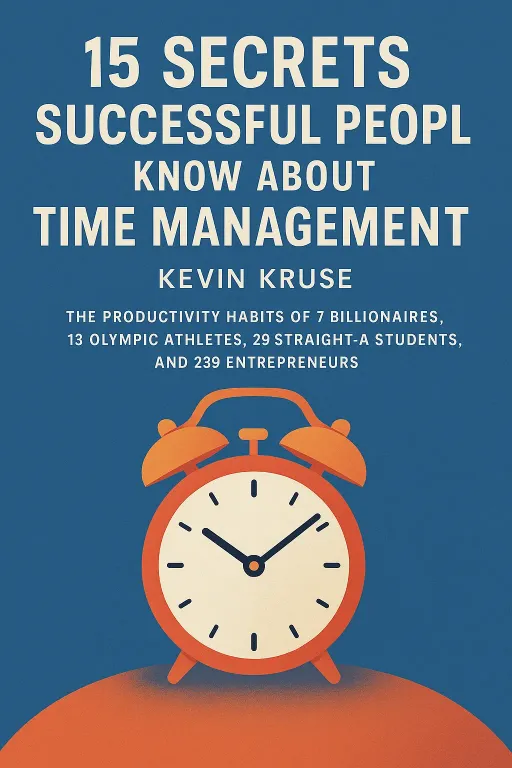
Nova: Exactly. Well, for Kevin Kruse, the author of '15 Secrets Successful People Know,' that moment came at 5:20 AM on a New Jersey highway, when he was pulled over for doing 80 mph, completely zoned out from exhaustion. He realized his to-do list wasn't a tool; it was a trap.
L.C. Zhou: That's a dramatic wake-up call. It forces you to question the very system you're relying on.
Nova: It really was. And that wake-up call led him to uncover what billionaires, Olympic athletes, and top entrepreneurs do. And it's what we're exploring today from two powerful perspectives. First, we'll dismantle the myth of the to-do list and reveal why the world's most successful people live by their calendars. Then, we'll shift gears to discuss the real currency of productivity: not time, but energy, and how to maximize it.
Deep Dive into Core Topic 1: The Calendar Imperative
SECTION
Nova: So let's start with that first big, controversial idea, LC. Kruse argues that the to-do list, the cornerstone of productivity for so many of us, is fundamentally broken. Why?
L.C. Zhou: It's a bold claim. I think most people, myself included, have lived by some form of a to-do list for years. What's the core argument against it?
Nova: Well, Kruse points out three major flaws. First, a to-do list has no sense of time. A task like 'email Bob' looks the same as 'write the quarterly report,' but one takes two minutes and the other takes two days. Second, it actually creates stress. There's a psychological principle called the Zeigarnik effect, which says our brains get fixated on unfinished tasks. Your to-do list is basically a written record of everything you done, constantly nagging you.
L.C. Zhou: That's fascinating. In finance, that's like having a watchlist of 100 stocks you can't possibly analyze or act on—it just creates noise and anxiety. It's a list of unfulfilled potential, which is inherently stressful.
Nova: Precisely. And the third flaw is that it encourages us to do what's urgent, not what's important. We get a little dopamine hit from crossing off easy, quick tasks, so we do those first, while the big, strategic projects languish. In fact, Kruse's research found that a staggering 41% of items on a person's to-do list are never completed at all.
L.C. Zhou: Forty-one percent. That's not a tool; that's a graveyard for good intentions. So, if the to-do list is the problem, what's the solution proposed by the high-achievers he studied?
Nova: They live and die by their calendar. They don't have a to-do list; they have a schedule. If it's important, it gets a time block. Entrepreneur Jordan Harbinger, for example, schedules his entire day in 15-minute blocks. But it's not just about micromanagement. This is the part I think you'll find most interesting. Jeff Weiner, when he was the CEO of LinkedIn, scheduled between 90 and 120 minutes of 'do nothing' time on his calendar.
L.C. Zhou: 'Do nothing' time. That sounds like the ultimate luxury. Most executives I know would see an empty block on their calendar as a problem to be solved with another meeting.
Nova: Right? But Weiner argues it's an absolute necessity. He says that time is for strategic thinking, for processing information, for just… thinking. It's when he connects the dots. He’s not 'doing nothing'; he's doing the most important work of a leader. LC, as someone in a high-stakes industry, what's your reaction to that? Scheduling 'do nothing' time?
L.C. Zhou: It's not a luxury; it's an investment. In finance, the biggest mistakes aren't from operational errors, but from a lack of strategic foresight. You get caught in the daily noise of market fluctuations and client calls. Scheduling that buffer is like a fund manager setting aside 'dry powder'—capital for unforeseen opportunities. It's proactive, not reactive. It's the difference between managing a business and leading it. I imagine that's how someone like Jeff Bezos ensures he's always focused on 'Day 1' and not just the next quarter's earnings.
Nova: So it’s about intentionally creating the space for innovation, rather than hoping it happens between meetings.
L.C. Zhou: Exactly. A to-do list is a list of tasks. A calendar is a statement of priorities. By putting 'thinking time' on your calendar, you're declaring that strategy is a priority, not an afterthought. It's a system design for success.
Deep Dive into Core Topic 2: The Energy Equation
SECTION
Nova: That's a perfect transition, because having that strategic time on your calendar is useless if you show up to it drained and unfocused. This brings us to Kruse's second major secret: productivity isn't about time, it's about energy.
L.C. Zhou: This feels like a more holistic view. We all have the same 1,440 minutes in a day, as the book points out. The variable isn't the amount of time, but the quality of the person showing up for that time.
Nova: You've nailed it. And Kruse shares a fantastic story to illustrate this. It's about a writer named Monica Leonelle. She was tracking her productivity and was frustrated because she was only writing about 500 or 600 words an hour, which is pretty slow for a professional author. She tried all the usual time management tricks—prioritizing, minimizing distractions—and they helped a little, but not much.
L.C. Zhou: She was trying to optimize the system, but the engine was still running inefficiently.
Nova: Exactly! Then she had a breakthrough. She realized her best writing happened in the morning when her energy was high. So she stopped trying to manage her time and started managing her energy. She experimented. Instead of long, grinding sessions, she tried short, 25-minute writing sprints followed by 5-minute breaks. Then, she made a huge change. She switched from typing to dictating her novels... while walking outside.
L.C. Zhou: So she completely changed her physical and mental state. She went from sedentary and focused on a screen to active and engaged with the world.
Nova: Yes! And the result was astonishing. Her output skyrocketed from 600 words an hour to over 3,500. She didn't get more time; she got more energy. She changed her energy state, and that changed everything.
L.C. Zhou: That's a powerful metaphor for any knowledge worker. We think our job is just to sit and think, but our physical state is inextricably linked to our cognitive output.
Nova: It really is. And it's backed by data. Kruse mentions a study by a company called the Draugiem Group. They tracked their employees' productivity and found the top 10% most productive people weren't working longer hours. In fact, they were taking more breaks. The ideal rhythm they found was about 52 minutes of focused work, followed by a 17-minute break. They would 'pulse' between intense focus and real recovery.
L.C. Zhou: That makes perfect sense. It's like interval training for the brain. You can't sprint a marathon. This idea of 'pulsing'—intense focus followed by real recovery—seems counterintuitive to the 'always-on' culture in many industries, especially finance. How do you see this applying to a leadership role?
Nova: That's a great question. The pressure to be constantly available must be immense.
L.C. Zhou: It is, but it's a false economy. We see it in market cycles, and we should see it in our own work. A trader can't be at peak alertness for 8 straight hours. The best ones are masters of managing their cognitive energy—they know when to engage and when to step back. As a leader, my job isn't just to manage my own energy, but to create a system where my team can do the same. Burning them out for short-term gains is a terrible long-term investment. This isn't about being 'soft'; it's about maximizing our most valuable asset: our team's collective brainpower and decision-making quality.
Nova: So you're managing the organization's energy portfolio, in a way.
L.C. Zhou: That's a great way to put it. You're ensuring your key assets—your people—aren't being depleted. You're building in the recovery time needed for sustainable, high-quality returns.
Synthesis & Takeaways
SECTION
Nova: I love that. So, when we put it all together, it's a powerful one-two punch. First, you architect your life on the calendar to protect what's truly important, like that strategic 'do nothing' time. Second, you manage your energy to ensure you bring your best, most focused self to those scheduled blocks.
L.C. Zhou: Exactly. The calendar provides the structure, and energy provides the fuel. One without the other is ineffective. You can have a perfect schedule, but if you're exhausted, it's useless. You can have all the energy in the world, but if it's not directed by a clear plan, it gets wasted on trivialities.
Nova: It's a complete system. So, as we wrap up, what’s the biggest takeaway for you from these ideas, LC?
L.C. Zhou: The takeaway for me, and maybe for our listeners, is to try an experiment. It's something an analytical mind can appreciate. For just one week, abandon the to-do list. Put everything—your Most Important Task, your meetings, your family time, and even your breaks—on your calendar. Treat each one like an unbreakable appointment with yourself, or with your CEO.
Nova: I love that. An appointment with your CEO.
L.C. Zhou: See if you don't just get more done, but feel more in control. It's a small change in habit, but it's a fundamental shift in mindset from being busy to being intentional. It’s about treating your 1,440 minutes a day not as a checklist to survive, but as capital to invest for the highest possible return.