The Ultimate Efficiency Protocol
Golden Hook & Introduction
SECTION
Nova: What if the one tool you rely on most for productivity is secretly draining your energy and holding you back from truly impactful work? The very thing you check multiple times a day, the list you feel you can't live without.
Atlas: Whoa, that's a bold claim, Nova. Are you talking about our phones? Our email inboxes? Because honestly, both feel like black holes for my focus sometimes.
Nova: Even more fundamental, Atlas. I'm talking about the humble, seemingly indispensable, to-do list. The one we meticulously craft, hoping it will bring order to our chaos. Today, we're diving into a powerful framework we call "The Ultimate Efficiency Protocol," which challenges some of our most ingrained productivity habits.
Atlas: Oh, I like that. The to-do list is practically sacred in modern work culture. To suggest it's a productivity villain is… well, it's certainly provocative. What’s the protocol built on?
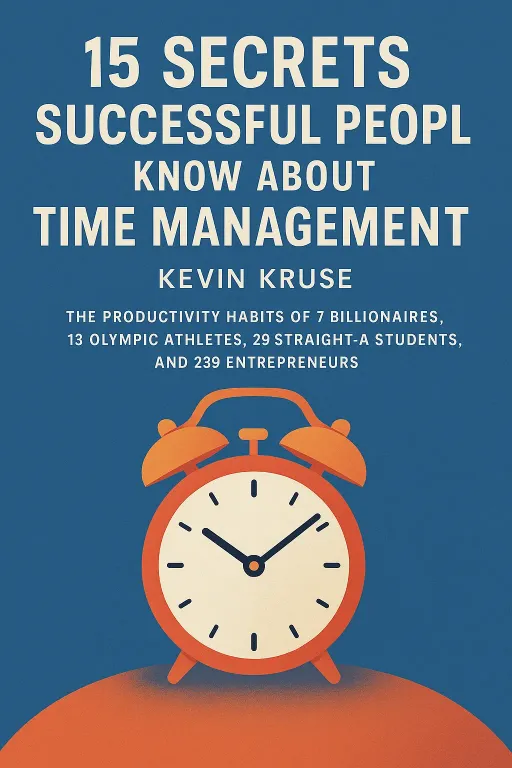
Nova: It’s a synthesis of insights from some of the sharpest minds in the productivity space. Specifically, we're drawing heavily from Kevin Kruse, a New York Times bestselling author and entrepreneur who interviewed hundreds of successful individuals to distill their time management secrets for his book, "15 Secrets Successful People Know About Time Management." And then we have Rory Vaden, a renowned speaker and author who penned "Procrastinate on Purpose," which, as the title suggests, completely flips our understanding of procrastination on its head.
Atlas: Kevin Kruse interviewing billionaires, Olympians, straight-A students… that’s a serious empirical base. And "Procrastinate on Purpose"? My inner voice is already saying, "Tell me more!" This sounds like it's going to challenge a lot of conventional wisdom.
Nova: Absolutely. And the first piece of conventional wisdom it dismantles is our reliance on that trusty to-do list.
The Calendar as Your Commander: Defeating the Zeigarnik Effect
SECTION
Nova: Kruse’s research revealed a striking commonality among the ultra-productive: they don't live by to-do lists. Instead, they live by their calendars. Every single task, from a big project to a quick email, gets scheduled.
Atlas: But wait, why? I mean, a to-do list is so flexible. You can add things, cross them off as you go. It feels so satisfying, doesn't it? Like a little pat on the back with every completed item.
Nova: It does feel satisfying in the moment, yes, but that's precisely where the psychological trap lies. It has to do with something called the Zeigarnik Effect.
Atlas: What exactly do you mean by the Zeigarnik Effect? It sounds like something out of a psychology textbook.
Nova: It is! It's a psychological phenomenon where people remember uncompleted or interrupted tasks better than completed tasks. Think about a waiter who can perfectly recall every order at their table until the bill is paid, and then suddenly, it's all gone. Or an author who can't stop thinking about their unfinished chapter. Your brain keeps those open loops active, constantly nagging at you.
Atlas: Oh, I know that feeling! That’s why I can’t stop thinking about that one email I haven’t replied to, even when I’m trying to focus on something else entirely. It’s like a little background process in my mind, humming away, draining mental energy.
Nova: Exactly. A to-do list, by its very nature, keeps almost on it as an open loop. Every item you haven’t crossed off yet is a little mental tap on the shoulder, saying, "Hey, remember me? You still haven't done me!" This constant reminder leads to mental fatigue, decision paralysis, and inefficient context-switching. You’re always subconsciously processing what you done, rather than fully engaging with what you doing.
Atlas: So the act of simply writing something down on a to-do list, without assigning it a specific time, actually the mental load? That’s incredibly counterintuitive. We’re taught that writing things down helps us remember.
Nova: It helps you remember, yes, but it doesn't help your brain. When you schedule a task in your calendar, your brain receives a signal: "Okay, this will be handled at 2 PM on Tuesday. I don't need to keep thinking about it right now." It allows you to mentally "close" that loop until the scheduled time arrives, freeing up valuable cognitive bandwidth. Productive people aren't just remembering; they're allocating mental resources strategically.
Atlas: That makes sense. It’s about giving your brain permission to stop worrying about it. But isn't a calendar too rigid for the unpredictable nature of work? What if something urgent comes up? Or what if a task takes longer than you allotted?
Nova: That's a valid concern, and it's why the approach isn't about rigid adherence to every minute. It's about intentionality. Ultra-productive individuals often schedule "buffer time" or "flex blocks" into their calendars. They build in space for the unexpected. The key is that even the "flexibility" is scheduled. They might block out an hour for "unforeseen issues" or "strategic thinking." It's not about being a slave to the clock, but making the clock a servant to your priorities.
Atlas: So it's not just about putting meetings on your calendar, but literally blocking out time for deep work, for responding to emails, even for thinking? For someone like me, constantly trying to understand market trends and economic shifts, focused thinking time is paramount.
Nova: Precisely. Imagine a CEO who schedules an hour every morning for "no-interruption strategic planning," or a researcher who blocks out two hours for "deep economic modeling." By putting it on the calendar, they're not just hoping it happens; they're committing to it, protecting that time fiercely. It's a declaration of what truly matters, and it forces you to confront the real capacity of your day. If it doesn't fit in the calendar, it doesn't get done, or it gets delegated, or it gets pushed to another day. It stops the endless piling up of "someday maybe" tasks.
The Focus Funnel: Investing Time Today for More Time Tomorrow
SECTION
Nova: Now, speaking of prioritizing and protecting time for those long-term economic research goals, this leads us perfectly into Rory Vaden's truly radical approach to time, the "Focus Funnel."
Atlas: Okay, I’m ready. You mentioned "procrastinate on purpose," which sounds like a dream come true for anyone with a busy schedule. How does this funnel work?
Nova: Vaden argues that traditional time management is flawed because it focuses on efficiency—doing things faster. But true success comes from what he calls "multipliers"—doing things today that create more time tomorrow. It's about strategically investing your time, not just managing it. The Focus Funnel has five key strategies, but the core idea is to ask a fundamental question about every task: "Can this task be eliminated or automated or delegated so that it doesn't have to be done repeatedly in the future?"
Atlas: So it’s not just about getting through my current to-do list, it’s about making sure I don’t the same to-do list next week, or next month? That’s a fundamentally different way of looking at work.
Nova: Exactly. Let's break down a couple of the funnel's components. The first is "Eliminate." Many tasks we do are simply not necessary. Vaden urges us to ruthlessly cut anything that doesn't contribute to our highest priorities. This is where clarity on your long-term goals is absolutely crucial. If a task doesn't move you towards your economic research goals, or your strategic understanding, or your personal growth, then why are you doing it?
Atlas: But how do you decide what creates more time versus what just feels like putting something off? Especially for someone focused on complex market trends, where everything feels important and interconnected. It’s easy to rationalize almost any task as "important."
Nova: That's the critical distinction. It's not about putting things off randomly. It's about procrastination. Vaden's "Procrastinate on Purpose" principle applies to tasks that are important but not urgent, and which, if you do them now, will actually or become irrelevant later. Or, more powerfully, it applies to tasks that you could or instead. The idea is to spend time setting up a system that saves you time.
Atlas: Can you give an example? Because "procrastinate on purpose" still sounds a bit like self-sabotage if misunderstood.
Nova: Absolutely. Think about manually compiling a weekly market report that takes you two hours every Friday. Strategic procrastination would involve doing that report this week, but instead, spending those two hours researching and setting up a script or a dashboard that automatically pulls and visualizes the data for future reports. You "procrastinated" on the manual task, but you invested that time into a system that will save you hours every single week going forward. You multiplied your time.
Atlas: Wow. So it’s like a strategic investment, not just putting things off. It's about building leverage for your future self. That’s a powerful shift in mindset, especially for analysts or strategists who are constantly dealing with recurring data and reports.
Nova: Exactly. Or consider "Delegate." If you're spending time on administrative tasks that someone else could do at 80% of your effectiveness, but at a fraction of your cost or mental energy, you should delegate. That frees up your time to focus on tasks only can do, like high-level strategic planning or deep conceptual analysis. It's about valuing your unique contribution and protecting it.
Synthesis & Takeaways
SECTION
Nova: So, when we bring Kevin Kruse's calendar-driven approach together with Rory Vaden's Focus Funnel, we get a truly powerful efficiency protocol. It’s about being incredibly intentional not just with we schedule our time, but we choose to put into that scheduled time in the first place.
Atlas: That’s a profound connection. The calendar helps us manage those open loops and protect our cognitive energy, and the Focus Funnel helps us filter out the noise and prioritize tasks that genuinely build future capacity. It’s about operating from a place of strategic clarity, rather than just reacting to the urgent.
Nova: Precisely. It’s about moving from a reactive, overwhelmed state to a proactive, empowered one. It’s about recognizing that true productivity isn't about doing more, but about doing the right things, at the right time, with a clear purpose. It’s about embracing that journey of learning and making every moment count, as the protocol suggests.
Atlas: So, for our listeners, especially those who are driven by self-growth, seeking to understand market trends, and aiming to make informed decisions – what’s the tiny step they can take right now to begin implementing this ultimate efficiency protocol?
Nova: It’s surprisingly simple, yet incredibly challenging in its implications: Look at your calendar for tomorrow and delete or delegate one task that does not contribute to your long-term economic research goals. Just one.
Atlas: Just one. That's a powerful challenge because it forces you to define those long-term goals first, doesn't it? It makes you confront what you're truly working towards.
Nova: It absolutely does. It’s about clarity, courage, and a commitment to your most significant contributions. It’s about understanding that your time and mental energy are your most precious resources, and they deserve to be guarded and invested wisely.
Atlas: What a powerful way to reframe productivity. It’s not about endless activity, but about strategic impact. Thank you, Nova, for shedding light on these game-changing ideas.
Nova: My pleasure, Atlas. It's all about equipping our listeners to navigate their goals with greater insight and intention.
Atlas: This is Aibrary. Congratulations on your growth!