The Master Architect of Time
Golden Hook & Introduction
SECTION
Nova: What if I told you your brain has a secret, invisible limit on how much it can focus, and your trusty to-do list is actually a well-intentioned trap setting you up for failure? Today, we're flipping the script on productivity.
Atlas: Whoa, that’s a bold claim, Nova! I mean, most of us live and die by our to-do lists, and we’re constantly told to multitask. Are you saying we’ve been doing it all wrong?
Nova: Absolutely, Atlas. We’ve been operating under some profound misconceptions about how our brains actually work, and how true productivity is achieved. Today, we’re diving into two essential frameworks that challenge those assumptions and offer a path to genuine clarity and impact.
Atlas: I’m definitely curious. For our listeners who are seekers of wisdom and efficiency, this sounds like a must-hear. What are we exploring today?
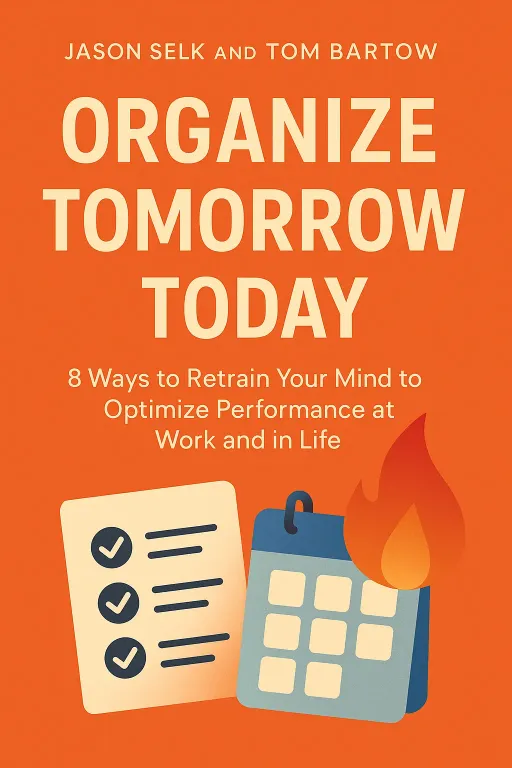
Nova: We’re pulling insights from two remarkable books: "Organize Tomorrow Today" by Dr. Jason Selk, and "15 Secrets Successful People Know About Time Management" by Kevin Kruse. Selk, a former mental toughness coach for professional athletes, brings this incredible sports psychology rigor to our daily habits. And Kruse, a serial entrepreneur who scaled multiple companies, learned to ruthlessly optimize his own schedule out of sheer necessity.
Atlas: So, we’re talking about the mental game the practical execution. That makes sense. Where do we even begin to unpack this?
Nova: We start with the brain itself.
The Brain's Secret Limit: Unpacking the 3 Channel Capacity Rule
SECTION
Nova: Dr. Jason Selk introduces a concept he calls the '3 Channel Capacity' rule. Imagine your brain isn't a supercomputer capable of infinite parallel processing, but more like a highly specialized control tower with three active communication channels. You can only handle three distinct, mentally demanding tasks effectively at any given moment. Try to open a fourth channel, and everything slows down, gets muddled, and you start making mistakes.
Atlas: Oh man, I know that feeling. It’s like trying to have three intense conversations at once, or drive while simultaneously texting and planning dinner. It just doesn't work. But what exactly constitutes a "channel" in this context? Is it literally three emails, three meetings?
Nova: That’s a great question, Atlas. It's not about the of items, but the each item demands. A "channel" is anything that requires significant, sustained mental effort and decision-making. So, for a project manager, one channel might be "strategizing the Q3 launch," another "resolving team conflicts," and a third "deep work on a critical report." Answering emails might seem like one thing, but if each email requires a different context shift and decision, it can quickly open multiple channels.
Atlas: So, it’s about intentional constraint to create meaningful output, not less. I imagine a lot of our listeners who are strategists or high-achievers feel like they to multitask to keep up. This sounds counterintuitive to that "hustle" mindset.
Nova: Exactly! We're conditioned to believe that juggling more tasks means we're more productive, but it's a profound illusion that leads straight to cognitive overload and decision fatigue. Think of Sarah, a project manager I know. She was brilliant, but constantly felt overwhelmed. Her mornings started with checking a hundred emails, then jumping from a budget review to a client call, then trying to draft a proposal, all within an hour. She felt like she was drowning. Her desk was covered in half-finished notes, her calendar a warzone of overlapping commitments. The sheer mental exhaustion was palpable.
Atlas: That sounds rough. I totally know that feeling of having a million tabs open in your brain, and none of them quite loading properly.
Nova: Precisely. Sarah was operating with perhaps ten or twelve "channels" open simultaneously. Once she started applying Selk's rule, she forced herself to identify just three channels for the day. For her, it was "finalize Q3 strategy," "onboard new team member," and "deep-dive into market research." She physically wrote these three down, and consciously pushed everything else to a later, designated time. The difference was immediate. Her focus sharpened. Her decisions became clearer. She wasn't just doing more; she was doing the things with profound intention. She described it as her mental traffic controller finally having enough lanes to work with.
Atlas: That’s actually really inspiring. It's not about being lazy; it's about respecting how our brain actually functions to achieve optimal performance. It's about sustainable growth. But even if you know your three channels, how do you actually to them? How do you stop the endless stream of distractions and the siren call of procrastination?
Nova: And that naturally leads us to the second key idea we need to talk about, which often acts as the perfect counterpoint to understanding our cognitive limits: how we schedule our time.
Beyond To-Do Lists: The Precision of Minute-Based Scheduling
SECTION
Nova: This is where Kevin Kruse steps in with his powerful concept of 'minute-based' scheduling. Forget your endless, daunting to-do list that just sits there, judging you. Kruse advocates for assigning specific time blocks, down to the minute, for every task you intend to complete.
Atlas: Wait, hold on. Minute-based scheduling? For someone who values flexibility and often faces constant interruptions, doesn't that feel incredibly rigid? Like micromanaging your own life to an absurd degree? I mean, who has that kind of control over their day?
Nova: That’s a common reaction, Atlas, and it highlights a core misunderstanding. The goal isn't rigidity; it's clarity and commitment. Traditional to-do lists are graveyards of good intentions because they don't account for two crucial things: time and energy. A list just says "do this," but it doesn't tell your brain or. That ambiguity is precisely where procrastination thrives. It gives your brain an excuse to defer, to wander, to get distracted.
Atlas: So basically, you're saying a to-do list is like having a shopping list without knowing when you're going to the store or how much time you have. It's just a wish list.
Nova: Exactly! Minute-based scheduling transforms that wish list into a concrete appointment with yourself. When you block out 30 minutes at 9:00 AM specifically for "drafting marketing copy" and 15 minutes at 11:15 AM for "reviewing analytics," you've made a commitment. You've given that task a home in your day. This eliminates the mental friction of deciding to start, which is a huge part of procrastination and decision fatigue.
Atlas: I can see how that would be a game-changer for someone driven by purpose and impact, especially if they’re constantly trying to push big projects forward. It’s not just about doing tasks, but about giving them a 'home' in your day, as you said. Can you give an example of how this actually works?
Nova: Think of Mark, an aspiring author who also runs a small business. He had "write book" on his to-do list for years, a colossal item that never seemed to move. Every day it stared back at him, a monument to his unfulfilled ambition. He’d feel guilty, try to squeeze in an hour, get distracted, and give up. It was a cycle of dread and inaction.
Atlas: Oh, I’ve been there with those big, nebulous tasks. They just feel too overwhelming to even start.
Nova: Right? So, Mark started using minute-based scheduling. Instead of "write book," he scheduled 45 minutes from 8:00 AM to 8:45 AM for "chapter outline," then 20 minutes at 1:00 PM for "research historical facts for Chapter 2," and even 10 minutes at 4:30 PM for "edit opening paragraph." By giving each tiny piece of the book a specific, non-negotiable time slot, the task felt manageable. He wasn't trying to "write a book" in one go; he was simply honoring his 45-minute commitment. And the amazing thing is, the cumulative effect was profound. He started seeing consistent progress, which fueled his motivation and chipped away at that feeling of overwhelm.
Atlas: That’s a perfect example. It sounds like it helps you break down those massive goals into digestible, actionable chunks, which ties into the "3 Channel Capacity" rule. You’re not trying to open a "write entire book" channel; you're opening a "45 minutes for chapter outline" channel. It’s about managing your mental bandwidth your time with precision.
Nova: Exactly! The two ideas work in powerful synergy. You limit your cognitive load by focusing on only a few critical channels, and then you use minute-based scheduling to ensure those channels actually get the dedicated, protected time they need.
Synthesis & Takeaways
SECTION
Nova: So, bringing these two powerful ideas together, we see that mastering your time isn't just about working harder; it's about working smarter by respecting your brain's natural limits and then giving your intentions a precise landing strip. It’s about understanding your mental bandwidth giving your intentions a precise home in your day.
Atlas: That makes so much sense. For our listeners who are driven by purpose and want real impact, who strive for growth, it boils down to a clear, actionable step, doesn't it? Something that helps them build that resilient foundation for their future, whether it's in wealth, health, or personal philosophy.
Nova: Absolutely. And this is where the core takeaway from both these brilliant thinkers converges into one tiny, incredibly powerful step: Tonight, identify exactly three tasks for tomorrow. Just three. If you complete only those three, consider the day a professional victory.
Atlas: That’s actually really inspiring. It feels so liberating to define "victory" in such a focused way. It’s not about ticking off a hundred small things; it’s about making progress on the things that truly matter, without the guilt and overwhelm. That’s building a resilient foundation for sustainable impact.
Nova: It is. This isn't just a productivity hack; it's a profound shift in mindset. It trains your brain to prioritize, to focus, and to celebrate consistent, meaningful wins. It reduces decision fatigue, eliminates procrastination, and ultimately, frees up mental space for genuine growth and impact.
Atlas: Wow. The idea of professional victory from just three tasks… I love that. It truly reframes what success looks like daily. What a powerful way to end.
Nova: Indeed. It’s about finding clarity in the chaos and purpose in the planning.
Nova: This is Aibrary. Congratulations on your growth!