Reclaiming Your Day: Strategies for Focus & Flow
Golden Hook & Introduction
SECTION
Nova: If you believe multitasking is the secret weapon of high achievers, then I have some news for you: you're likely sabotaging your own brain. And that constant barrage of "urgent" notifications? It's not just stealing your time; it's systematically eroding your capacity for deep, meaningful work. Today, we're flipping the script on what true productivity looks like.
Atlas: Whoa, Nova, that's quite an opener! I mean, I'm pretty sure my default mode multitasking, and my phone is practically an extension of my hand. But you're right, there's this persistent feeling that despite being incredibly busy, the truly impactful work often gets pushed aside. It’s like being caught in a perpetual state of reaction.
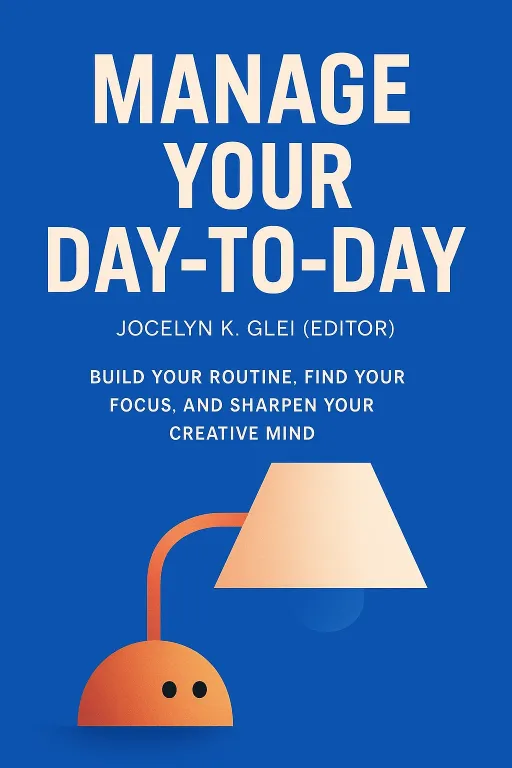
Nova: That feeling of constant reaction, Atlas, is precisely what we're here to dismantle. We're diving into two brilliant books that offer a roadmap out of that reactive cycle: Jocelyn K. Glei's insightful "Manage Your Day-to-Day" and Kevin Kruse's eye-opening "15 Secrets Successful People Know About Time Management."
Atlas: Two titans of productivity wisdom! What's the thread connecting these two, especially if they're promising "secrets" and a way to "manage your day"?
Nova: Glei's book, part of the acclaimed 99U series, is a masterclass in cultivating focus and building sustainable routines, drawing heavily from the practices of leading creatives who understand that true innovation requires uninterrupted thought. It’s about creating the mental space for your best work.
Atlas: So, it's less about "hacks" and more about an intentional architecture of your day. That resonates with the idea of strategic planning – building something deliberately.
Nova: Exactly. And then Kruse's work complements this perfectly by revealing counter-intuitive productivity hacks. These aren't theories from an ivory tower; they're distilled from interviews with over 200 billionaires, Olympians, and entrepreneurs. He unveils the often-surprising habits of people who achieve extraordinary things.
Atlas: Billionaires and Olympians, you say? I'm imagining some esoteric rituals or exclusive club secrets. But if it's "counter-intuitive," does that mean our conventional understanding of time management is actually holding us back? Because for many of our listeners, especially those leading teams, the challenge isn't just personal productivity, but fostering an environment where everyone can thrive without burning out.
Nova: That's the core insight, Atlas. What we've been taught about productivity, particularly the glorification of busyness and multitasking, is often fundamentally flawed. It leads to exhaustion, not impact. Both Glei and Kruse offer pathways to reclaim not just our time, but our mental clarity and creative energy. Let's start by exploring Glei's powerful approach to building that essential mental space.
The Art of Deep Work & Taming Distractions (Jocelyn K. Glei)
SECTION
Nova: Glei's central argument revolves around the concept of "deep work," a term popularized by Cal Newport. It's the ability to focus without distraction on a cognitively demanding task, pushing your cognitive capabilities to their limit. Think of it as intellectual heavy lifting. She emphasizes that in our hyper-connected world, this skill is not just valuable; it's becoming increasingly rare and therefore incredibly powerful.
Atlas: A lot of our listeners are visionary leaders, constantly engaged in strategic planning or developing future leaders. These are tasks that demand intense cognitive engagement. But how does one even begin to cultivate that kind of focus when your day is a constant stream of meetings, emails, and unexpected demands? It feels like trying to meditate in the middle of a rock concert.
Nova: It absolutely can feel that way. Glei argues that the first, most crucial step is to actively "tame the digital beast." This isn't about ignoring your responsibilities; it's about setting boundaries. She advocates for scheduled email checks, turning off all non-essential notifications, and creating physical or digital "do not disturb" zones. Her research into leading creatives—artists, writers, designers—revealed a consistent pattern: they fiercely protect their prime creative hours. They don't react to the world; they proactively carve out space for their most important work.
Atlas: So, it's not about being available 24/7, but strategically unavailable during specific, critical windows. That’s a radical thought for many who feel they must be constantly responsive to their team or clients for effective communication. I imagine a lot of leaders would worry about missing something critical or appearing disengaged.
Nova: That fear of missing out, or FOMO, is precisely what the digital beast feeds on. Glei points out that true emergencies are rare, and many "urgent" interruptions are actually just someone else's poor planning or an expectation of instant gratification that we've inadvertently enabled. She urges us to be proactive: literally "calendar your focus." Block out time in your schedule for deep work, just as you would a high-priority meeting. This tells your brain, and your colleagues, that this time is sacred.
Atlas: Calendar your focus. I like that. It moves the intention from a vague "I hope to get this done" to a concrete "I am committing to this task at this time." It's like building a mental fortress around your most valuable resource – your attention.
Nova: Exactly. And this isn't just about personal discipline. It's about understanding the profound cognitive cost of context-switching. Imagine you're deeply immersed in a complex strategic problem. Then, a notification pings: an email, a message, a news alert. You glance at it. Even if you don't fully engage, your brain has now shifted context. Glei, drawing on cognitive science, explains that it takes a significant amount of time and mental energy to fully re-engage with your original task. These tiny, seemingly innocuous interruptions don't just steal minutes; they fragment your thought process, preventing you from ever truly reaching that flow state where breakthroughs happen.
Atlas: Wow, so it’s not just about the time lost, but the of thought lost. It’s like trying to build an intricate sandcastle while someone keeps splashing water on it every few minutes. You never get to finish the turrets. The cumulative effect of those small distractions is far more damaging than we realize.
Nova: Far more. And this is why Glei emphasizes building sustainable routines, not just one-off heroic efforts. It’s about training your brain to expect and enter deep work states. She encourages experimentation to find your optimal "focus rituals"—whether it's a specific time of day, a particular environment, or a pre-work routine that signals to your brain: "It's time to concentrate." It's about making deep work the default, not the exception, thereby fostering genuine self-growth.
Atlas: So, the goal is to make these periods of intense, uninterrupted focus a regular, predictable part of your day. That sounds like a powerful way to enhance clarity and impact, especially when you're navigating complex challenges in strategic planning. But it still feels like swimming upstream against a very strong current. How do we make this practically stick?
Counter-Intuitive Productivity & Single-Tasking (Kevin Kruse)
SECTION
Nova: And that brings us perfectly to Kevin Kruse. While Glei focuses on creating the conditions for deep work, Kruse dives into the most successful people actually execute within those conditions. He reveals that many of their habits are completely contrary to what we've been told about productivity.
Atlas: Okay, tell me these secrets from the billionaires and Olympians! I'm picturing some elaborate morning routine involving cold plunges and kale smoothies, or perhaps a personal assistant for every single task. What's the, actionable secret they all seem to share? I'm betting it's not "work harder," because that just leads to burnout.
Nova: You're right, it's definitely not "work harder." One of Kruse's most striking revelations is the universal embrace of and the almost complete rejection of multitasking among the truly extraordinary. They don't just tolerate single-tasking; they prioritize it. They dedicate their full attention to one thing, and one thing only, at a time. This isn't just a preference; it's a fundamental operating principle for high-impact individuals across all fields.
Atlas: Single-tasking? But I was always told that effective leaders juggle a dozen things at once, that it’s a sign of efficiency to handle multiple projects simultaneously. And avoiding to-do lists? How do you keep track of everything, especially for complex strategic planning or when you’re developing future leaders, without a comprehensive to-do list? That sounds like a recipe for absolute chaos.
Nova: That's the truly counter-intuitive part. Kruse argues that multitasking is a myth. Our brains aren't designed to do two cognitively demanding tasks at once; they rapidly switch back and forth, incurring that mental "tax" we just discussed. He found that the most successful people understand this deeply and actively multitasking. And regarding to-do lists, he provocatively states: "Your to-do list is a wish list. Your calendar is your commitment."
Atlas: "Your to-do list is a wish list." That's a mic drop! So, the alternative to the overwhelming, ever-growing to-do list is... a meticulously planned calendar? Instead of a random collection of tasks, it's about intentional allocation of time for thing at a time?
Nova: Precisely. He advocates for "time blocking" everything that truly matters, including your "most important task" for the day. You identify the 1-3 critical things that get done, and you block out specific, non-negotiable time for them in your calendar. This ensures that your valuable time is spent on high-impact activities, not just reacting to whatever comes your way. It forces a ruthless prioritization that a simple list never can.
Atlas: So, it's not just about putting appointments on your calendar, but blocking out time for actual work, for thinking, for planning. For someone deeply invested in strategic planning, this means scheduling the time, not just the time.
Nova: Exactly. And Kruse also emphasizes the "90-minute rule." He found that many top performers naturally gravitate towards intense, focused work blocks of about 60-90 minutes, followed by a short break. This aligns with our natural ultradian rhythms, where our brains can maintain peak focus for roughly that duration before needing a rest. It's about sprinting, then recovering, rather than a continuous, diluted jog that leads to mental fatigue and diminished returns.
Atlas: That makes so much sense. It’s like a micro-cycle of deep work and recovery, ensuring you’re bringing your best energy to each focused block. It’s not just about doing more, but doing what truly matters, deeply, and with sustained energy. It sounds like both Glei and Kruse are essentially telling us to be more intentional with our most valuable, finite resource: our focused attention.
Synthesis & Takeaways
SECTION
Nova: Absolutely, Atlas. It's all about intentionality and protecting that precious resource. So, let's bring Glei and Kruse together for our listeners. Considering that 20-minute daily commitment many of us strive for—perhaps for focused learning, personal growth, or a key strategic task—how can we integrate one 'deep work' block from Glei's principles and one 'single-tasking' secret from Kruse into that routine to maximize output?
Atlas: That's the ultimate deep question, isn't it? For our listeners who are visionary leaders, strategic navigators, and empathetic catalysts, who value self-growth and are driven by developing others, that 20 minutes isn't just a slot in the day; it's an investment. How do we ensure it truly pays dividends?
Nova: Here's the simple, powerful fusion: First, identify your single Most Important Task for the day – your MIT – that aligns with your strategic goals, your personal growth, or a critical step in developing your team. Then, block out just 20 minutes in your calendar, ideally first thing in the morning or during a natural lull. During those 20 minutes, apply Glei’s principle of creating an impenetrable "fortress of focus." Turn off notifications, close unnecessary tabs, silence your phone, and dedicate your entire, undivided attention to that MIT.
Atlas: So, it’s not about 20 minutes, it’s about 20 minutes. And within that scheduled time, it’s about absolute, ruthless single-tasking. No checking email, no quick glances at Slack, no "just one more thing." Just pure, unadulterated focus on that one vital task. That’s a powerful commitment.
Nova: Exactly. It could be outlining a critical strategic plan, drafting that key email for effective communication, or dedicating time to learning a new skill that will empower your team. The magic isn't in the length of time, but in the of attention you bring to it. This tiny, focused block builds momentum, trains your brain for deeper, longer stretches of work, and ensures that even in a chaotic day, you've made tangible progress on what truly matters.
Atlas: That sounds like a powerful micro-habit. It’s about quality over quantity, even in small bursts. It fundamentally shifts the mindset from "I have so much to do" to "I will deeply focus on right now." It’s not just about doing more, but doing what truly matters, deeply, with intention.
Nova: Precisely. It's about designing your day, not just reacting to it. It’s about reclaiming your attention, one focused, single-tasked 20-minute block at a time. This isn't just a productivity hack; it's a philosophy for maximizing impact and fostering deep, sustainable growth.
Atlas: It's about creating pockets of intentionality and profound focus in a world that constantly tries to pull us in a million directions. I'm taking that to heart. What a game-changer for anyone looking to truly lead and make a difference!
Nova: This is Aibrary. Congratulations on your growth!