

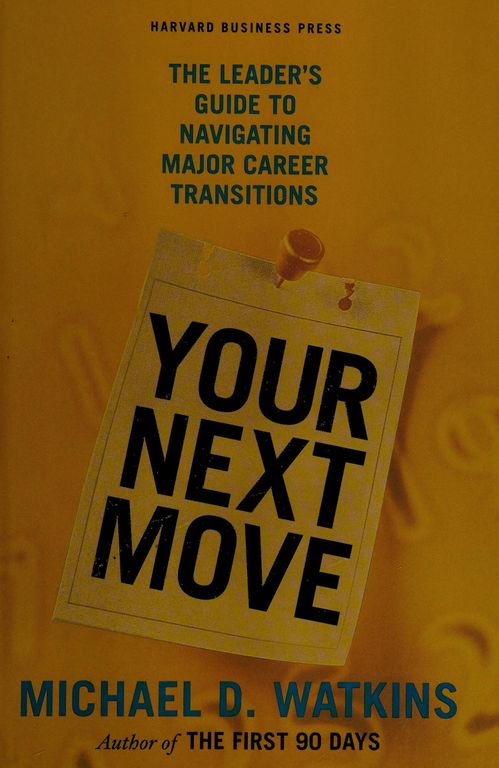
Your next move
the leader's guide to navigating major career transitions
Introduction: The Career Ladder is Now a Jungle Gym
Introduction: The Career Ladder is Now a Jungle Gym
Nova: Welcome back to the show! Today, we are diving deep into the often-overlooked art of career change—not the job search, but the actual, messy, in-between phase. Think about it: most of us spend years mastering one role, only to jump into a new one where all our old rules suddenly don't apply.
Nova: : That’s the perfect setup, Nova. We’re so focused on landing the new title or the bigger salary, we forget that the transition itself is a performance review. If you fail the transition, the new job fails, no matter how qualified you were on paper. Who are we talking about today?
Nova: We are talking about the master of this domain, Michael D. Watkins, and his essential guide, "Your Next Move." While many know him for "The First 90 Days," this book is the advanced course. It acknowledges that career progression isn't just about starting fresh; it’s about navigating the eight crucial transitions that define a leadership life.
Nova: : Eight? That sounds like a lot. I always thought it was just about getting promoted. What makes these transitions so uniquely challenging that they require a whole book dedicated to them?
Nova: That’s the key insight! Watkins argues that every single move—a promotion, a lateral shift, leading former peers, or even an international assignment—requires a fundamentally different strategy. The skills that got you the new role are often not the skills that will make you in it. It’s a shift from tactical execution to strategic navigation.
Nova: : So, this isn't just a checklist for your first week. This is about fundamentally retooling your leadership operating system for the new environment. I’m ready to learn how to stop stumbling and start thriving in these moments of change. Let's map out this terrain.
Nova: Exactly. We’re going to break down the landscape of these moves, the seismic shifts that happen internally, and the strategic approach Watkins insists we must adopt. Get ready to audit your own career trajectory, because this is where the real growth happens.
Key Insight 1: Contextualizing Your Change
The Eight Crucial Transitions: Not All Moves Are Created Equal
Nova: Let's start with the landscape. Watkins identifies eight major transition challenges. This is where he separates his work from a generic 'how to start a new job' guide. He’s looking at moves that fundamentally alter your scope and relationships.
Nova: : Eight is a big number. Can you give us the highlights? I imagine 'getting promoted' is on the list, but what are the curveballs that really trip people up?
Nova: Absolutely. The obvious ones are the promotion up the ladder, or moving into a new organization entirely—the classic 'First 90 Days' scenario. But then you have the trickier ones. Think about moving from being an individual contributor to a manager, or perhaps the most awkward: leading former peers. That requires a complete social and political reset.
Nova: : Leading former peers! That’s a minefield. You have to establish authority without alienating the people who used to be your equals. What’s the specific danger there, according to Watkins?
Nova: The danger is perceived favoritism or, conversely, overcompensating by being overly harsh. Watkins stresses that you must quickly establish a new, fair baseline for performance and decision-making. You can't rely on old friendships; you must build new professional credibility based on your current mandate. He suggests you need to spend extra time aligning expectations with this specific group early on.
Nova: : That makes sense. It’s about managing the history you share with them. What about the international move? That seems like a massive cultural and logistical challenge on top of the job itself.
Nova: It is. The international move transition forces you to deal with cultural fluency, regulatory differences, and often, managing a team that doesn't share your native business context. Watkins points out that leaders often underestimate the sheer cognitive load of operating in a new language or cultural framework while simultaneously trying to execute a business strategy.
Nova: : So, the core message here is diagnosis. Before you even think about your first 30 days, you need to correctly label which of these eight transitions you are in, because the playbook changes dramatically based on that label.
Nova: Precisely. If you treat a 'turnaround' situation—where the business is failing—with the same strategy you use for a 'build' situation—where you are establishing something new—you are setting yourself up for failure. The context dictates the required pace, the necessary stakeholders, and the acceptable level of risk.
Nova: : It sounds like the first step in his methodology is a rigorous self-assessment: 'What kind of transition am I actually in?' It’s a necessary moment of humility before action.
Nova: It is. And he also covers the 'realignment' transition, where you stay in the same role but the company’s strategy shifts beneath you. You might be the same person, but the job description has been secretly rewritten by the market. That requires a different kind of internal political maneuvering and strategic pivot.
Nova: : So, to summarize this chapter: Watkins forces us to categorize our move. Is it a promotion, a lateral shift, a turnaround, or something more nuanced? Because the category determines the entire subsequent strategy. It’s a powerful framework for avoiding the common trap of 'one size fits all' leadership.
Nova: It is the foundation. If you misdiagnose the transition type, every subsequent action, no matter how well-intentioned, will be miscalibrated. It’s the difference between prescribing the right medicine and just guessing.
Key Insight 2: Changing Your Internal Operating System
The Internal Earthquake: Mastering the 7 Seismic Shifts
Nova: Now that we’ve identified the external context—the transition type—Watkins moves us inward. This is where we hit the core of the internal transformation required. He outlines what he calls the '7 Seismic Shifts' that occur when you move up the leadership ladder, especially into general management.
Nova: : Seismic shifts—that sounds dramatic! What’s the most common shift leaders fail to anticipate? I’m guessing it has something to do with getting your hands dirty.
Nova: You hit the nail on the head. The first and most brutal shift is often from Specialist to Generalist. As a specialist, your value is deep expertise in one area. As a general manager, your value is breadth, integration, and delegation. You have to stop being the best coder, the best salesperson, or the best engineer, and start being the person who ensures the coders, salespeople, and engineers are all working toward the same goal.
Nova: : That’s tough because expertise feels safe. It’s tangible proof of your worth. How do you stop deriving satisfaction from the technical work you used to excel at?
Nova: Watkins suggests you have to consciously re-anchor your sense of accomplishment. You move from being an 'Analyst' to an 'Integrator.' Your success metric shifts from solving the hard problem yourself to ensuring the team has the resources, clarity, and alignment to solve it collectively. It’s a shift in ego as much as it is a shift in responsibility.
Nova: : I see. It’s a psychological hurdle. What about the shift in time horizon? I imagine that’s another big one.
Nova: Absolutely. That’s the shift from 'Tactician to Strategist.' Tacticians focus on the next quarter or the immediate fire drill. Strategists must focus on the next three to five years. In a fast-moving transition, it’s easy to get sucked into putting out daily fires, but Watkins warns that if you spend 100% of your time on tactics, you are failing in your strategic mandate.
Nova: : So, how do you force yourself to look up when the inbox is screaming? Is there a practical trick for this?
Nova: He advises creating protected time—non-negotiable blocks on your calendar dedicated solely to strategic thinking, reading industry reports, or meeting with external advisors. You have to schedule strategy, or it simply won't happen. It’s about building the 'Architect' role into your week, not just being the 'Bricklayer' who lays the immediate material.
Nova: : That’s powerful. The 'Bricklayer to Architect' analogy is perfect. And I assume the shift in influence is also key—moving from being the expert voice to being the diplomatic consensus-builder?
Nova: Exactly. The shift to 'Warrior to Diplomat.' In a specialist role, you argue based on data and technical superiority. In a senior role, you often have to persuade stakeholders who don't share your technical background, or who have competing priorities. You must learn to frame your technical needs in terms of business outcomes—revenue, risk mitigation, market share—not just technical purity.
Nova: : So, these seven shifts—Specialist to Generalist, Analyst to Integrator, Tactician to Strategist, Problem-solver to Agenda-setter, Bricklayer to Architect, Warrior to Diplomat, and one more I suspect—are the internal roadmap. If you haven't consciously addressed these seven internal changes, you haven't truly transitioned, even if you’ve moved offices.
Nova: You’ve nailed it. The seventh shift often relates to managing complexity and ambiguity. The higher you go, the less clear the answers become. You must become comfortable making high-stakes decisions with only 70% of the information, which is terrifying for someone trained to seek 100% certainty.
Key Insight 3: The Contingent Approach to Success
Strategy Selection: The Art of Matching Your Approach to the Situation
Nova: We’ve established the external context—the transition type—and the internal changes—the seismic shifts. Now, Watkins brings it all together with the most critical element: selecting the right transition strategy. He emphasizes that there is no single path to success; your strategy must be contingent on the situation you inherited.
Nova: : This is where the rubber meets the road. If I’m in a turnaround situation, I need to move fast and make cuts. If I’m in a 'build' situation, I need to hire slowly and focus on culture. How does Watkins categorize these strategic imperatives?
Nova: He often frames it around the required pace and focus. For instance, in a turnaround, the priority is stopping the bleeding. You need to secure early wins focused on immediate stabilization. In a 'build' scenario, the focus is on establishing a clear vision and aligning the team around it, which requires a slower, more deliberate cultural integration.
Nova: : What about the concept of 'securing early wins'? That sounds like a tactic from 'The First 90 Days,' but how does it apply differently in, say, a promotion where you’re inheriting an established team?
Nova: It applies differently because the of the win changes. In a new company, an early win might be launching a small, visible project. When inheriting a team, an early win might be publicly and successfully resolving a long-standing internal conflict or championing a team member's success. It’s about demonstrating competence and building trust through action, not just through statements of intent.
Nova: : So, the win has to be visible to the right audience. If I’m trying to prove I can lead former peers, my early win needs to be something that benefits directly and demonstrates my fairness.
Nova: Precisely. And this leads to the crucial step of 'Negotiating Success.' Watkins stresses that you must proactively negotiate the expectations with your boss, your peers, and your direct reports. This isn't just about confirming the job description; it’s about explicitly agreeing on what success looks like in the first six months, given the specific transition type you’re in.
Nova: : Negotiating success sounds like a proactive political move. Are there common pitfalls when leaders try to negotiate these terms?
Nova: The biggest pitfall is assuming alignment. Leaders often assume their boss wants the same thing they do, or that their team understands the new mandate. Watkins suggests creating a formal document or a series of structured conversations to map out these expectations. For example, negotiating with your boss: 'For the first 90 days, my priority is stakeholder alignment; for the next 90, it’s delivering Project X.' This removes ambiguity.
Nova: : That level of formality seems almost excessive, but I can see how necessary it is when the stakes are high. It forces clarity where ambiguity usually thrives.
Nova: It forces clarity, and it builds political capital. When you later need to pivot or ask for resources, you can point back to the negotiated agreement. It transforms your transition from a series of reactive moves into a deliberate, strategic campaign. This strategic approach, tailored to the eight transition types and informed by the seven seismic shifts, is what separates those who merely survive a move from those who truly accelerate their careers because of it.
Nova: : It’s about treating the transition not as an interruption, but as the job for the first year. I appreciate how Watkins connects the internal self-awareness with the external political strategy.
Conclusion: Making Every Move Your Best Move
Conclusion: Making Every Move Your Best Move
Nova: We’ve covered a tremendous amount of ground today, moving from the external context of the eight crucial transitions to the internal earthquake of the seven seismic shifts, and finally, to the strategic imperative of matching your approach to the situation.
Nova: : If I had to boil down the essence of Watkins' message, it’s this: Stop winging it. Every significant career move is a high-stakes project that requires its own dedicated, structured plan. The skills that got you here won't get you there, because 'there' is a fundamentally different operating environment.
Nova: Exactly. The actionable takeaway for our listeners today is to pause before accepting that next big role, or even that lateral move, and ask three critical questions based on this book. First: Which of the eight transition types am I entering? Second: Which of the seven seismic shifts will be the hardest for me personally? And third: What is the single most important early win I need to secure to signal my new strategic intent?
Nova: : Those three questions force a level of introspection that most people skip entirely. They jump in, try to be the hero they were in their last job, and end up burning out or failing to gain traction. Watkins gives us the tools to be deliberate architects of our own integration.
Nova: And remember, this isn't just for the C-suite. These principles apply whether you’re moving from Senior Analyst to Manager, or from one department to another within the same company. Every time the scope of your influence changes, the transition clock starts ticking.
Nova: : It’s a powerful reminder that leadership development isn't a destination; it’s a continuous series of successful navigations. Thank you, Nova, for guiding us through Watkins' essential framework.
Nova: My pleasure. The goal isn't just to survive your next move, but to leverage it as a springboard for exponential growth. This book provides the blueprint for making sure that happens. This is Aibrary. Congratulations on your growth!