

The Structural Mechanics of Financial Independence
Golden Hook & Introduction
SECTION
Nova: The average professional is currently paying for the privilege of their own job. If you account for the commute, the wardrobe, the dry cleaning, and the mental recovery time required just to function after a shift, most people are actually working for a fraction of their hourly rate.
Atlas: That is a harsh reality check. Most of us look at our salary and think we are trading hours for dollars, but you are suggesting that the trade is actually lopsided.
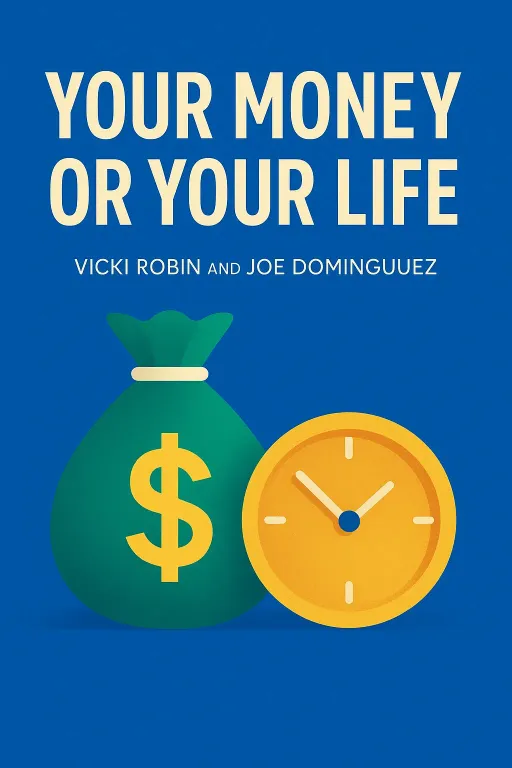
Nova: Exactly. We are leaking value in every direction. Today we are dismantling that leak. We are diving into the philosophy of Life Energy from Vicki Robin and Joe Dominguez’s classic, Your Money or Your Life, and pairing it with the mechanical precision of JL Collins’ The Simple Path to Wealth.
Atlas: I have been looking at these two books for a while. Robin and Dominguez essentially wrote the manifesto for the modern financial independence movement back in the nineties. It is fascinating because, despite being written in that era, their core premise about the true cost of work feels more relevant in our digital, always-on world than it did back then.
Nova: It really is the foundational text. And when you layer the mechanical, no-nonsense advice from JL Collins on top of that, you get a complete system. Collins cuts through the noise of the financial industry with surgical precision, showing that you do not need to be a Wall Street wizard to build a fortune. You just need to be a disciplined machine.
Atlas: That sounds like a blueprint I can get behind. Let us start with the philosophy. If I am not just trading hours for money, what exactly am I trading?
The Philosophy of Life Energy
SECTION
Nova: You are trading your life energy. That is the term Robin and Dominguez use, and it is the most accurate description of what happens when you clock in. Think about your life as a finite bucket of hours. When you work, you are dipping into that bucket. The money you receive is just the placeholder for that time.
Atlas: That makes me look at my paycheck differently. It is not a reward for my labor; it is compensation for a portion of my life that I can never get back. But how do I actually calculate that? Because on paper, my salary looks solid.
Nova: You have to audit the hidden costs. Start with your gross hourly wage. Then, subtract every expense that exists solely because you work. The commuting costs, the gas, the maintenance on your car, the professional clothes you would not buy if you were not going to an office, the lunches you grab because you do not have time to cook, and even the cost of the alcohol or the streaming services you use to decompress after a stressful day.
Atlas: The decompression cost. That is a brilliant way to frame it. Most people view their downtime expenses as entertainment, but you are saying that if the job is so draining that you need to spend money to recover from it, that cost belongs to the job, not to your lifestyle.
Nova: Precisely. When you strip away those costs, your real hourly wage is almost always lower than you think. And here is the kicker: once you realize your real wage is lower, you start to see that you are working longer and harder to fund a lifestyle that is, in part, a reaction to the work itself. It is a closed loop of inefficiency.
Atlas: I can see how that would change everything. If I realize I am earning, say, twenty dollars an hour instead of forty, suddenly that impulse purchase or that expensive convenience meal looks very different. It is not just about the price tag of the item; it is about how many hours of my life I have to sacrifice to earn the money to buy it.
Nova: That is the shift. You stop asking, Can I afford this? and start asking, Is this worth the hours of my life I had to trade to get it? That is the core of the Robin and Dominguez approach. It is not about deprivation; it is about intentionality. You are building a value system where your spending aligns with what actually brings you joy, rather than just consuming to maintain the status quo of a job you might not even like.
Atlas: That feels like the difference between being a consumer and being an architect. A consumer just buys what is in front of them, but an architect builds a structure where every component serves a purpose. But I have to ask, does this not lead to a kind of paralysis? If I overanalyze every dollar, do I not risk becoming a miser who never enjoys the present?
Nova: That is the danger, but the solution is in the mechanics. And that is where JL Collins comes in. Once you have the mindset that your money is your life energy, you need a system to ensure that energy is working for you, not just sitting in a bank account losing value to inflation.
The Mechanical Engine of Wealth
SECTION
Atlas: Okay, I am ready to move from the philosophy to the machine. I have done the audit. I know my real hourly wage. I am motivated to save. What is the next logical step in this system?
Nova: The next step is to stop trying to outsmart the market. JL Collins is famous for his argument that the stock market is the greatest wealth-building engine in history, but people ruin it by trying to pick winners, time the dips, or chase the next big trend. He advocates for the simple path: total stock market index funds.
Atlas: I have heard this advice a dozen times, but I think people struggle with it because it sounds too boring. It sounds like doing nothing. Is the argument that doing nothing is actually the most active strategy?
Nova: You nailed it. Complexity is the enemy of wealth. When you try to pick individual stocks, you are essentially gambling against professionals who have more data, faster algorithms, and more time than you. With a total stock market index fund, you are buying the entire haystack. You own a tiny slice of every major company. When the market goes up, you go up. When the market goes down, you hold.
Atlas: The holding part is where people panic. I imagine a lot of listeners are thinking about the last time the market took a nosedive. It is easy to say, Buy and hold, when the graph is going up. It is much harder when your net worth drops by twenty percent in a month.
Nova: That is where the mindset from the first part of our discussion saves you. If you have calculated your life energy, you know that money is just a tool. It is not your identity. When the market dips, the person who knows their real hourly wage and has a clear sense of their financial independence goals sees a dip in the market as a sale, not a crisis. You stay the course because you have a system, not a speculation strategy.
Atlas: It is a shift from emotional investing to systemic investing. Instead of checking the portfolio every day and reacting to headlines, you are just feeding the engine.
Nova: Exactly. Think of it like a river. You do not need to build a dam to stop the water; you just need to dig a channel so the water flows where you want it. Your income is the water. The index fund is the channel. You automate the flow—twenty percent of your net income—and you let the compounding power do the heavy lifting.
Atlas: Let us talk about that twenty percent. For someone who is just starting, or who is currently living paycheck to paycheck, twenty percent sounds impossible. How do they bridge the gap?
Nova: You start by reclaiming the money you were losing to the hidden costs we discussed earlier. If you cut out the commute-related expenses, the expensive lunches, and the random retail therapy you engage in to escape the stress of work, that money suddenly becomes available. It was already leaving your pocket; you are just redirecting it.
Atlas: That is a great way to frame it. You are not finding new money; you are recapturing lost resources. So the system is, first, audit the life energy to stop the leaks, and second, automate the index fund contribution to build the engine.
Nova: That is the entire architecture. It is simple, yet it is rarely done because it requires the one thing most people refuse to cultivate: patience.
Synthesis & Takeaways
SECTION
Atlas: It really comes down to discipline. I am thinking about our listeners who are high-performers, the people who are used to solving complex problems with brute force. They might find this almost too simple. They might want a more sophisticated strategy.
Nova: And that is exactly where they get into trouble. The most sophisticated thing you can do is keep it simple. The complexity of the financial industry is designed to make you feel like you need an expert, but the best strategy is to be your own expert. By reclaiming your life energy and funneling it into the total stock market, you are essentially buying your freedom in small, automated increments.
Atlas: It is a long-game strategy. I like that. It moves the focus from the daily grind to the long-term horizon. If I am automating twenty percent of my income into a total market fund, I am not just saving for a rainy day. I am buying my future time.
Nova: That is the ultimate takeaway. Every dollar you invest is a chunk of your future self that you have liberated. You are taking the hours you traded for money today and transforming them into hours you will not have to trade for money in the future. You are buying back your own life.
Atlas: That is a powerful way to end it. It is not just about the math. It is about the autonomy.
Nova: It is entirely about autonomy. We have laid out the blueprint. The philosophy of Life Energy gives you the awareness to stop the leaks, and the mechanics of the Simple Path give you the engine to build the wealth. The rest is just execution.
Atlas: I am ready to start the audit. It is time to see where the real hourly wage actually lands.
Nova: That is the first step of a much larger journey. Take that hour today, do the calculation, and set up that automation. Your future self is already waiting for the results.
Atlas: This has been a great dive into the architecture of independence. Thank you for walking me through this.
Nova: It was a pleasure to break it down. This is Aibrary. Congratulations on your growth!









