

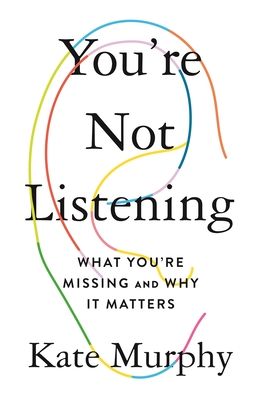
You're Not Listening
What You're Missing and Why It Matters
Introduction
Nova: When was the last time someone really listened to you? I mean truly listened — no glancing at a phone, no waiting for their turn to talk, no mentally drafting a grocery list while you poured your heart out. If you have to think hard about that question, you are not alone.
Nova: And that reaction is exactly what journalist Kate Murphy discovered when she spent two years researching her book "You're Not Listening: What You're Missing and Why It Matters." She asked people a simple question: who listens to you? Most people couldn't answer. Some paused for a long time. Only a lucky few could name one or two people. Many said they paid professionals — therapists, coaches, even hairdressers — to listen to them.
Nova: It is. And it reveals something profound about modern life. We are surrounded by more communication tools than any generation in history, yet we feel profoundly unheard. Murphy's book is a deep dive into why we have lost the art of listening, what that's doing to us, and how we can get it back.
Why No One Is Listening Anymore
The Silent Epidemic
Nova: Let's start with the scope of the problem. Murphy cites a striking statistic: over the past century, the average time people devote to listening to one another during waking hours has fallen from 42% to just 24%. That is nearly cut in half.
Nova: A perfect storm. Murphy describes how we now live in a culture of what she calls "aggressive personal marketing." At work, at parties, on social media, it's all about defining yourself, shaping your narrative, staying on message. Value is placed on what you project, not what you absorb. The very image of success today is someone miked up on a stage giving a TED Talk — not someone sitting quietly and taking in someone else's story.
Nova: Exactly. And then there's the phone. Murphy writes that at cafes, restaurants, and family dinner tables, rather than talking to one another, people look at their phones. Even when they are talking, the phone is on the table like part of the place setting, picked up as casually as a fork, implicitly signaling that the present company is not sufficiently engaging.
Nova: We all have. And the consequences are staggering. In a 2018 survey of 20,000 Americans, almost half said they did not have meaningful in-person social interactions. Suicide rates in the United States are at a thirty-year high, up 30% since 1999. A study by health insurer Cigna found that loneliness increases the risk of premature death as much as obesity and alcoholism combined.
Nova: And it's hitting young people especially hard. Murphy reports that eighth graders who are heavy users of social media increase their risk of clinical depression by 27% and are 56% more likely to say they are unhappy. Generation Z, the first generation raised on screens, self-reports being in worse health than any other generation, including the elderly.
Nova: That is Murphy's core argument. Technology does not so much interfere with listening as make it seem unnecessary. Our devices indulge our fear of intimacy by fooling us into thinking we are socially connected even when we are achingly alone.
What Happens in Your Brain When Someone Truly Listens
The Neuroscience of Being Heard
Nova: So let's get into the science, because this is where Murphy's book really shines. Hearing and listening are not the same thing. Hearing is passive — sound waves hit your eardrums. Listening is active. It requires engaging multiple senses, setting aside your own agenda, and genuinely trying to understand.
Nova: This is incredible. Neuroscientist Uri Hasson at Princeton conducted studies showing that when someone truly listens to a speaker, their brain patterns actually start to synchronize. The listener's brain shows the same neural patterns as the speaker's. It's visible, measurable proof of the transmission of thoughts, feelings, and memories. Listening literally syncs brains.
Nova: It's neurologically real. And the more you listen to someone, the more alike your brains become. Murphy also explains the "speech-thought differential" — a concept from listening research pioneer Ralph Nichols. The average person speaks at about 120 to 150 words per minute, but we can think at a much faster rate. That spare mental bandwidth is where the trouble starts.
Nova: Right. And here's the counterintuitive twist: Murphy suggests that smarter people are often worse listeners. They come up with more alternative things to think about while someone else is talking, and they are more likely to assume they already know what the person is going to say.
Nova: There is also fascinating biology at play. Murphy describes the "right ear advantage." Our language comprehension is generally better and faster when we hear speech in the right ear versus the left. The left ear, however, is better at recognizing emotional aspects of speech, music, and sounds in nature. So if you are in an emotionally demanding conversation, you might want to lend them your left ear.
Nova: But here is the deeper neuroscience: when someone truly listens to you, it triggers the same brain regions associated with reward and pleasure. To be heard is to feel valued. Murphy puts it beautifully: "Listening is about the experience of being experienced. It's when someone takes an interest in who you are and what you are doing." The lack of being known and accepted in this way leads to feelings of inadequacy and emptiness.
How Assumptions and Biases Block Real Listening
The Earplugs We Wear
Nova: One of Murphy's most provocative chapters is called "I Know What You're Going to Say: Assumptions as Earplugs." And here's the uncomfortable truth she presents: we are often worse listeners with the people we are closest to than with strangers.
Nova: You would think so. But Murphy explains the "closeness-communication bias." When we have known someone for a long time, we assume we already know what they are thinking, what they are going to say, what they mean. We lose curiosity. A research study she cites showed that close friends dramatically overestimated how well they understood each other.
Nova: Precisely. And this connects to the anthropologist Robin Dunbar's famous research. Dunbar's number — about 150 — is the cognitive limit on how many meaningful social connections we can maintain. Within those 150, there are layers. The top layer has just one or two people, like a spouse or a best friend. The next layer holds about four people. Without consistent, attentive contact, people fall from one layer to the next. Listening is what maintains those bonds.
Nova: Yes. Murphy writes: "Staying in touch or keeping up with someone is nothing more than listening to what's on that person's mind. The frequency with which you check in determines the longevity and strength of the relationship."
Nova: Confirmation bias and expectancy bias. Murphy explains that to make sense of a vast and complex world, we create mental file folders into which we drop people, usually before they even start talking. Categories based on stereotypes, culture, past experiences. These shortcuts can be helpful, but they also diminish our understanding and distort reality. We listen selectively, hearing only what confirms our existing categories.
Nova: And that is the opposite of listening. Murphy's mantra is that "everybody is interesting if you ask the right questions. If someone seems dull or uninteresting, it's on you." True listening requires setting aside what you think you know and approaching every conversation with genuine curiosity.
The Hidden Dynamic That Makes or Breaks Conversations
Shift Versus Support
Nova: Let's talk about one of the most practical frameworks in the book: the difference between a shift response and a support response. This concept comes from sociologist Charles Derber, and Murphy brings it to life brilliantly.
Nova: A shift response moves the focus of the conversation away from the speaker and toward you. It is self-referential. If someone says, "I just got a new dog," a shift response would be, "Oh, my dog is absolutely terrified of thunderstorms, it's a whole thing." You have shifted the spotlight to yourself.
Nova: That is the trap. We think we are connecting, but we are actually redirecting. A support response, by contrast, encourages elaboration. Same scenario — "I just got a new dog" — a support response would be, "What kind? How did you choose them? How are you liking it so far?" You are keeping the focus on the other person and inviting them to go deeper.
Nova: Murphy calls it "conversational narcissism." It is the urge to make every exchange about ourselves. And here is the shocking data: Murphy reports that listeners' responses are emotionally attuned to what speakers are saying less than five percent of the time. That means 95% of the time, we are missing the emotional point of what someone is telling us.
Nova: Murphy illustrates this with a powerful example from Gary Noesner, who was the FBI's lead hostage negotiator for ten years. Noesner thinks of a person's story as a doughnut with two concentric rings: the facts are on the inside, but the feelings and emotions are on the outside. Most of us only listen to the facts. Great listeners hear the emotional ring — why the person is telling you this, what it means to them.
Nova: And here is the kicker from Murphy's research: people are far more likely to feel understood if a listener responds with descriptive and evaluative information — not by nodding, not by parroting back their words, but by genuinely interpreting what they heard. Your dog can "listen" to you. Siri can "listen" to you. But they cannot respond in a thoughtful, feeling way. That is what makes a human listener irreplaceable.
Lessons from Spies, Comedians, and Talking Sticks
What the Best Listeners Do
Nova: Murphy spent two years interviewing some of the world's best listeners — and her cast of characters is fascinating. She spoke with a CIA agent, a focus group moderator, a bartender, a radio producer, a top furniture salesman, and even improv comedians.
Nova: First, curiosity. The CIA agent explained that the agency recruits good listeners rather than trains them, because genuine curiosity is hard to teach. He described how, rather than interrogating a nuclear scientist about Osama bin Laden's whereabouts, he listened for things they had in common and gradually built rapport. That's how he got the information.
Nova: Exactly. Second, the best listeners possess what the poet John Keats called "negative capability" — the ability to cope with contradictory ideas and gray areas. Murphy connects this to cognitive complexity, which research shows is positively related to self-compassion and negatively related to dogmatism. Great listeners are comfortable with uncertainty. They know there is usually more to the story.
Nova: Third, improv comedians taught Murphy that listening is essential to being funny. Successful humor requires accurately reading your audience — you cannot do that if you are not listening. Google's famous Project Aristotle found that the highest-performing teams had members who spoke in roughly the same proportion and scored high on social sensitivity. In other words, the best teams listen to one another.
Nova: Absolutely. And Murphy describes indigenous traditions like the talking stick — practiced by some Native American and African tribes — where only the person holding the stick may speak while everyone else listens. It is a physical reminder that listening requires restraint and respect.
Nova: One more thing the best listeners do: they listen to opposing views without feeling like they are being chased by a bear. Murphy explains that when our beliefs are challenged, our brains go into fight, flight, or freeze mode. The amygdala hijacks our ability to hear. Great listeners train themselves to stay curious and calm even when they disagree. They listen to find evidence that they might be wrong, rather than listening to poke holes in the other person's argument.
Practical Strategies from the Research
How to Become a Better Listener
Nova: So how do we actually get better at this? Murphy is clear that listening is more of a mindset than a checklist, but she offers plenty of actionable strategies.
Nova: First, manage your distractions. Put the phone away — not face down on the table, but away. A Microsoft study found that since the year 2000, the average human attention span has dropped from twelve seconds to eight seconds. We are fighting a neurological battle, and the environment matters. Choose quiet places for important conversations. Restaurants now average eighty decibels — louder than a typical conversation at sixty decibels.
Nova: It is. Second, embrace silence. Murphy notes that a pause following someone's comments can work to your advantage — it is a sign of attentiveness. You can even say, "I'd like to think about that." Silence gives people space to elaborate and reveals what words conceal.
Nova: Third, when someone shares something difficult, do not jump to fix it. Do not say "I know how you feel" or immediately offer solutions. Murphy writes that if you jump in to fix, advise, correct, or distract, you are communicating that the other person does not have the ability to handle the situation. Instead, ask open and honest questions that communicate: "I am interested in hearing more."
Nova: Fourth, Murphy emphasizes the 5:1 ratio. Research shows that good interactions must outnumber bad ones by at least five to one for a relationship to succeed. Every time you fail to listen, you are chipping away at that ratio.
Nova: Fifth, listen to yourself. Murphy has a whole chapter on what she calls "the voluble inner voice." How you talk to yourself affects how you hear other people. If your inner voice is harsh and judgmental, you will project that onto others. One of her friends named her critical inner voice "Spanky" — and learned to stop listening to Spanky when it piped up during times of stress.
Nova: And finally, remember that listening is a gift you choose to give. Murphy writes: "Listening is your gift to bestow. No one can make you listen." It is an act of generosity that costs nothing but attention, and the return is deeper connection, better understanding, and a richer experience of being human.
Conclusion
Nova: Kate Murphy's "You're Not Listening" is ultimately a wake-up call wrapped in science, storytelling, and deep humanity. The book reminds us that listening is not passive, not weak, and not optional. It is how we engage, understand, connect, empathize, and grow as human beings. It is the difference between loneliness and belonging.
Nova: And the statistics Murphy marshals make clear that the cost of not listening is equally enormous — rising suicide rates, an epidemic of loneliness, health impacts comparable to heavy smoking and alcoholism. We are literally making ourselves sick by failing to hear one another.
Nova: I think it's this: the next time you are in a conversation, ask yourself — am I about to give a shift response or a support response? Am I redirecting this toward myself, or am I inviting this person to go deeper? That single awareness could transform your relationships.
Nova: Definitely put the phone in another room. As Murphy writes, "To really listen is to be moved physically, chemically, emotionally, and intellectually by another person's narrative." That is not going to happen while you are scrolling Instagram.
Nova: That is the heart of it. Everybody you meet is carrying a story. The question is whether you are curious enough to listen. This is Aibrary. Congratulations on your growth!