Navigating the Technological Frontier
Golden Hook & Introduction
SECTION
Nova: We are currently living through a period where the barrier between our physical bodies, our digital tools, and the biological world is effectively vanishing. It is not a future event; it is the current reality of our daily workflow.
Atlas: That sounds incredibly overwhelming. If the walls between those worlds are coming down, I feel like I am standing in the middle of a construction site without a hard hat. I think a lot of people feel that same sense of vertigo when they look at their inbox or the latest software updates.
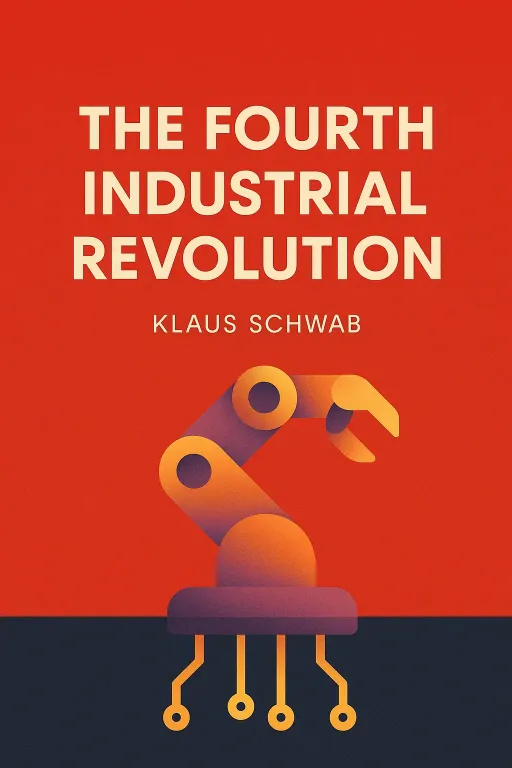
Nova: That vertigo is exactly what we are here to unpack. Today we are looking at two essential perspectives on this shift. First, we are diving into The Fourth Industrial Revolution by Klaus Schwab, which frames this era as a systemic change in how we build and lead. Then, we are going to pivot to Artificial Intelligence by Melanie Mitchell, who brings us back to earth by demystifying what these machines are actually doing, and more importantly, what they are not doing.
Atlas: I like that pairing. Schwab gives us the bird’s-eye view of the landscape, and Mitchell gives us the map of the terrain itself. It is the difference between seeing the storm and understanding how the wind works.
The Fourth Industrial Revolution and Systemic Change
SECTION
Nova: Precisely. Klaus Schwab, who founded the World Economic Forum, wrote this book to argue that we are not just seeing new gadgets. He suggests that the Fourth Industrial Revolution is a fundamental shift in the operating system of society. He talks about the fusion of technologies across the physical, digital, and biological domains.
Atlas: When you say fusion, are you talking about things like smartwatches that track our heart rate, or is it deeper than that?
Nova: It is much deeper. Think about it as a system where your biological data, your digital behavior, and your physical environment are constantly talking to each other. In the past, these domains were separate. You went to the doctor for biological issues, you went to the office for digital work, and you lived in your house for physical rest. Now, those lines are blurred. Schwab’s core argument is that leaders—and really, anyone who wants to be effective today—must build adaptive systems that can handle this constant, high-speed integration.
Atlas: That makes sense, but I have to push back a little here. If everything is integrated, doesn't that just lead to total system failure for the individual? If I am constantly connected to my biological, digital, and physical inputs, I am not an adaptive system. I am just a distracted human being. How does Schwab suggest we actually manage this without burning out?
Nova: You hit on the central tension. Schwab does not advocate for being a human server that processes all this data. Instead, he argues that the winners in this new era are the ones who can build what he calls highly adaptive systems. For an individual, that means you have to be the architect of your own integration. You cannot let the technology integrate you; you have to design how it serves your goals.
Atlas: So, instead of being a passive recipient of all this technological noise, you have to curate the inputs. That sounds like a massive shift in mindset. It moves the responsibility from the software developers to the person sitting in the chair.
Nova: Exactly. It is about reclaiming agency. If you are a Strategic Seeker, as many of our listeners are, you have to look at this revolution not as something happening to you, but as a set of tools you are arranging. Schwab’s perspective is that we are in a transition phase. The old way of working—linear, siloed, predictable—is gone. The new way is circular, interconnected, and requires a high degree of cognitive resilience.
Atlas: I like that term, cognitive resilience. It implies that the brain is a muscle that needs training to handle this level of complexity. But I think there is a hidden danger here. When we talk about these massive shifts, it is easy to assume the technology is smarter than us. It is easy to assume that because the machine is fast, it is also wise.
The AI Reality Check
SECTION
Nova: That is the perfect bridge to Melanie Mitchell’s work. Her book, Artificial Intelligence, is essentially the antidote to the hype. While Schwab talks about the systemic changes these technologies create, Mitchell looks under the hood of the machines themselves.
Atlas: I have read some of her work, and she has this incredibly grounded way of explaining neural networks. She essentially dismantles the myth that AI is a kind of digital brain.
Nova: She does. She makes it clear that current machine learning is mostly advanced pattern matching. It does not have human-level understanding. It does not have common sense. It does not know what a cat is; it just knows the statistical probability of pixels forming the shape of a cat based on millions of previous examples.
Atlas: That is such a vital distinction. When I use a tool that is AI-powered, I often find myself projecting intelligence onto it. I start to think, "Oh, it knows what I want." But what you are saying is that it is just playing a game of statistical "hot or cold." It is guessing based on patterns, not understanding the intent.
Nova: Precisely. Mitchell’s work at the Santa Fe Institute really highlights this gap between processing power and conceptual understanding. She points out that these systems are fragile. If you change the context slightly—if you show the AI a cat in a strange, non-cat-like position—it can completely fail. A human child, however, understands the concept of a cat regardless of the angle or the lighting.
Atlas: So, for the person listening to this, someone who is trying to be a Purposeful Catalyst in their career, what is the takeaway? Do we stop using these tools?
Nova: Not at all. We stop treating them like oracles. We start treating them like very fast, very capable, but very dim-witted interns. You would not ask an intern to make a strategic decision for your life, right? You would ask them to organize your files, summarize your notes, or draft a basic schedule. You use them for the pattern matching, and you keep the conceptual understanding, the values, and the strategy for yourself.
Atlas: That is such a relieving perspective. It takes the pressure off. If AI is just a pattern matcher, then my job is not to compete with it on processing speed. My job is to be the one who provides the context, the nuance, and the "why" behind the work.
Nova: Exactly. And that brings us back to the idea of cognitive load. If you are using your human brain to do the pattern matching that a machine could do, you are wasting your best asset. Mitchell’s book helps us identify exactly where the machines excel, which allows us to reclaim our mental energy for the things that machines cannot do: genuine creativity, deep empathy, and complex, values-based decision-making.
Synthesis and Practical Application
SECTION
Atlas: Okay, so we have the macro view from Schwab—the world is integrating and becoming a complex, interconnected system. And we have the micro view from Mitchell—the machines we are using to navigate this system are powerful but lack real understanding. How does the listener bridge that gap? We have this profile of a Strategic Seeker who wants to align their output with their values. How do they start?
Nova: We start with the "Tiny Step" we mentioned earlier. It is about applying the mindset of an architect to your own workflow. Dedicate 15 minutes this week to map out one repetitive task in your daily life. Just one. Ask yourself: Is this a task that requires human intuition, or is it a task that relies on pattern recognition?
Atlas: I love that. If it is pattern recognition—like sorting emails, formatting data, or scheduling appointments—that is where the automated tools shine. If it is human intuition—like negotiating a partnership, mentoring a team member, or developing a long-term strategy—that is where the human belongs.
Nova: Exactly. And by offloading the pattern recognition, you are not just saving time; you are reducing your cognitive load. You are preserving your mental bandwidth for the work that actually matters. This is the essence of building your own adaptive system. You are using the tools to build a moat around your deep work.
Atlas: It sounds like essentialism, honestly. It is about pruning the non-essential, automated parts of your life so you can focus on the high-value, high-humanity work.
Nova: It is absolutely essentialism. And it connects directly to the growth recommendation for our listeners: focus on application over accumulation. Stop accumulating more tools, more apps, and more data. Start applying the ones you have to build a more resilient, focused daily routine.
Atlas: I have been guilty of the accumulation trap. I download the new AI tool, I play with it for an hour, I feel like I am being productive, but I am actually just procrastinating with technology. I am not building anything.
Nova: That is a common trap. The shift is to stop being a collector of tech and start being an architect of your output. If you spend 30 minutes a day applying these tools to streamline your workflow, you are not just getting faster; you are changing your relationship with work. You are moving from being a cog in a machine to being the designer of the system.
Atlas: I can see how that would change the trajectory of someone’s career. If you are the person who can harness these tools to clear the clutter, you become the person who is actually free to innovate.
Nova: And that is the ultimate goal. The Fourth Industrial Revolution is not about the machines taking over; it is about the humans who learn to lead the machines stepping up. It is about using the tools to clear the path so you can do the work that truly aligns with your purpose.
Atlas: That is a powerful note to end on. It is not about fighting the future or hiding from it. It is about building a system—a personal operating system—that allows you to thrive in it.
Nova: Precisely. We have covered a lot today—from the systemic shifts in our global environment to the inner workings of our digital assistants. But the most important thing is what you do in the next 15 minutes. Take that time. Map the task. Reclaim the energy.
Atlas: I am going to do that this afternoon. I have a report that is mostly pattern matching, and I have been doing it manually for years. Time to automate.
Nova: That is the spirit. Keep building that cognitive resilience. It is your most valuable asset in this new frontier.
Atlas: We have been navigating the technological frontier today. If you enjoyed this conversation, take a moment to reflect on your own workflow. What is one repetitive task you can reclaim today? And as always, we want to hear how you are building your own adaptive systems.
Nova: Thank you for joining us on this journey of growth. This is Aibrary. Congratulations on your growth!