

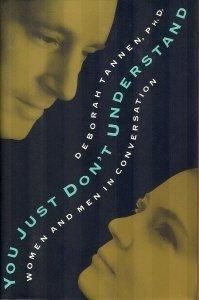
You Just Don't Understand
women and men in conversation
Introduction
Nova: Picture this: a married couple is driving down the highway. The wife turns to her husband and asks, "Would you like to stop for a coffee?" He says, "No thanks," and keeps driving. Minutes later, she's fuming. He's completely baffled. Sound familiar?
Nova: : Oh, I have absolutely been in that car. Both seats, actually. What is happening there?
Nova: That is the opening anecdote from Deborah Tannen's 1990 blockbuster, You Just Don't Understand: Women and Men in Conversation. And what's happening, according to Tannen, is that they are speaking two entirely different conversational languages.
Nova: : So the book's argument is that men and women literally talk differently?
Nova: Exactly. Tannen, who is a professor of sociolinguistics at Georgetown University, argues that from childhood, boys and girls are socialized into what she calls "genderlects" — different communication styles that are as distinct as two cultural dialects. Women use conversation to build intimacy and connection. Men use it to negotiate status and preserve independence. Neither is wrong, neither is right — but when they collide, it creates a perfect storm of misunderstanding.
Nova: : And the book clearly struck a nerve, right?
Nova: It was a phenomenon. Four years on the New York Times bestseller list — eight months at number one. Translated into 30 languages. Readers wrote to Tannen saying the book saved their marriages. Today we're going to unpack the key ideas, the most memorable examples, and even the controversies, because this book has sparked decades of debate. I'm Nova.
Nova: : And I'm. This is Aibrary. Let's get into it.
Nova: Welcome to Aibrary.
Nova: : Congratulations on your growth!
Rapport-Talk and Report-Talk
Two Languages, One Conversation
Nova: Let's start with Tannen's central framework: rapport-talk versus report-talk. She argues that for most women, conversation is primarily about rapport — establishing connections, negotiating relationships, creating intimacy. Talk is the glue of friendship.
Nova: : So for women, talking is the point. The talking itself is the relationship.
Nova: Exactly. She describes how, in studies, when researchers asked pairs of best friends to have a conversation, girls of all ages would face each other, immediately start talking, and often end up discussing one person's problems. The talking was the activity. But for boys, sitting face-to-face and just talking felt deeply uncomfortable.
Nova: : What did the boys do instead?
Nova: They sat parallel — side by side — and jumped from topic to topic, usually centered around a time when they would do something together. For boys, Tannen says, activities and doing things together are central. Friendship is built through shared action, not shared confidences.
Nova: : That explains so much about why my guy friends want to watch a game together while my women friends want to sit and catch up over coffee.
Nova: Right. Now, for men, Tannen says conversation serves a different purpose: report-talk. It's about conveying information, establishing status, and preserving independence. Men use talk to negotiate where they stand in a social hierarchy. This is why men tend to dominate public conversation — giving speeches, telling stories, holding forth on subjects — but often go quiet in private, intimate settings.
Nova: : So the paradox is, the guy who's the life of the party might come home and have nothing to say to his partner.
Nova: That's exactly the dynamic Tannen describes. She tells the story of Rebecca and Stuart. Rebecca pours out her thoughts, and Stuart listens silently. When she asks what's on his mind, he says, "Nothing." Rebecca has spent her whole life practicing verbalizing feelings with friends and family. Stuart has spent his whole life practicing keeping his innermost thoughts to himself. To him, talk is for information exchange. If there's no information to convey, why talk?
Nova: : Ouch. I feel seen and also slightly attacked.
Nova: The key insight is that both styles are valid. Women are not "too emotional" and men are not "emotionally unavailable." They are simply operating with different conversational goals. Tannen's point is that if we can recognize these different goals, we can stop taking each other's styles as personal rejection.
Nova: : I want to push back a little though. Isn't this a massive generalization?
Nova: It is, and we'll get to the criticisms later. But Tannen herself says upfront that she's not claiming every man or every woman fits these patterns. She's describing tendencies that appear across large populations. And her research base is extensive — she analyzes transcripts of real conversations, videotapes of children interacting, and decades of sociolinguistic studies. The patterns are real, even if individuals vary.
Status, Support, and the Art of Asking for Directions
The Battlefields of Misunderstanding
Nova: Let's go deeper into some of the specific misunderstandings Tannen identifies. She breaks them into several key tensions. The first is status versus support.
Nova: : This is the idea that men see conversation as a contest?
Nova: Exactly. Tannen shares a personal example. She and her husband both had academic jobs, but in different cities, so they lived apart during the week. When people would say to her, "That must be so rough, how do you stand it?" she'd accept their sympathy and even elaborate on the difficulties.
Nova: : Makes sense. She's building connection through shared troubles.
Nova: Right — classic rapport-talk. But her husband reacted totally differently to the same comments. He would explain all the advantages: four-day weekends together, long vacations, four months in the summer. Tannen was initially puzzled. Then her husband told her: he perceived those sympathetic comments as a put-down, like someone was saying, "Yours isn't a real marriage. I'm superior to you."
Nova: : So where she heard support, he heard a status challenge.
Nova: That's it. And that fundamental difference — women operating in a world of connections and support, men operating in a world of hierarchy and status — creates ripple effects everywhere. Another big one is independence versus intimacy.
Nova: : Let me guess. This is the classic "should I ask my partner before making plans" fight.
Nova: You've read the book! Tannen tells the story of Josh, who invites an old friend to stay for the weekend without consulting his wife Linda first. Linda is furious. She says, "Why don't you tell your friend you have to check with your wife?" Josh is horrified. He says, "I can't tell my friend I have to ask my wife for permission!"
Nova: : Both of their reactions make total sense from their own perspectives.
Nova: That's the tragic beauty of it. For Linda, saying "I have to check with Josh" feels good — it shows her life is intertwined with her husband's. For Josh, the same phrase feels like admitting he's not a free, independent adult. Neither is wrong. But neither understands why the other is upset.
Nova: : And then there's the thing Tannen is now famous for popularizing: men not asking for directions.
Nova: Yes! She argues this isn't about stubbornness or ego in a simple sense. It's that asking for directions, in the male conversational framework, puts you in a one-down position. You're admitting you don't know something that someone else does. It's a status loss. For women, asking for help and exchanging information is a way to connect. It doesn't threaten their sense of self.
Nova: : So the guy driving in circles for twenty minutes isn't just being difficult. He's protecting his status in a system that may be invisible to his partner.
Nova: And the woman getting frustrated isn't being unreasonable. She's operating in a system where asking for help is natural and even relationship-building. Both are logical within their own frameworks. The problem is the frameworks don't match.
Why Good Intentions Go Wrong
Solutions vs. Sympathy
Nova: Now let's talk about what might be the most painfully relatable dynamic in the entire book: the advice versus understanding mismatch.
Nova: : I'm already cringing.
Nova: Tannen tells the story of Eve, who had a benign lump removed from her breast. She tells her husband Mark that she's distressed because the stitches changed the contour. Mark immediately says, "You can always have plastic surgery."
Nova: : Oh no. Oh, Mark. No.
Nova: Eve is hurt. She says, "I'm sorry you don't like the way it looks, but I'm not having more surgery!" And Mark is completely bewildered. He says, "I don't care about the scar. It doesn't bother me at all." She says, "Then why are you telling me to get plastic surgery?" And he says, "Because you were upset about the way it looks."
Nova: : This is the most perfect encapsulation of that dynamic I've ever heard. He thought he was being helpful.
Nova: He thought he was being wonderfully supportive. To Mark, a complaint is a problem to be solved. Eve was presenting a problem, so he found a solution. But what Eve actually wanted was empathy. She wanted him to say, "That sounds really hard. I'm sorry you're going through that."
Nova: : And Tannen says this plays out constantly in small ways too, right?
Nova: Every day. She describes her own mother telling her father she doesn't feel well, and he invariably offers to take her to the doctor. And she's invariably disappointed. He's focused on what he can do — action. She wants sympathy and connection. Neither is wrong, but the mismatch leaves both feeling unfulfilled.
Nova: : It's like they're playing two different games with the same ball.
Nova: Beautifully put. And this connects to another key tension: information versus feelings. Tannen notes a famous cartoon of a husband opening a newspaper and asking his wife, "Is there anything you'd like to say to me before I start reading?" We all know there isn't — but the moment he starts reading, she'll think of something.
Nova: : Because the newspaper isn't just a newspaper. It's a signal that he's disengaging from the relationship space.
Nova: Exactly. For women, Tannen argues, talk is the ongoing maintenance of the relationship. Silence can feel like withdrawal. For men, talk serves a purpose and then ends. No information to convey? No need for talk. The newspaper isn't a rejection — it's just reading the news.
Nova: : So what does Tannen actually suggest we do about all this?
Nova: This is crucial. She doesn't say one style needs to win. She says awareness is the first step. A woman can learn to see her partner reading the paper and not interpret it as rejection. A man can learn to see his partner's desire to talk and not interpret it as a demand or manipulation. And both can make small adjustments — men listening without immediately jumping to solutions, women being more direct about what they need rather than hinting.
What the Critics Say
The Controversy
Nova: So far we've been pretty sympathetic to Tannen's framework. But the book has attracted significant criticism, and we should talk about that.
Nova: : I was hoping we'd get to this. Because while I recognize so many of these patterns, something about them also makes me uncomfortable.
Nova: That discomfort is at the heart of the academic pushback. At a 1992 conference on women and language, linguistics professor Alice Freed from Montclair State University gave a scathing critique. She said the book's popularity was both "astonishing and troubling."
Nova: : What was her core complaint?
Nova: Freed argued that Tannen's book "simultaneously perpetuates negative stereotypes of women, excuses men their interactive failings, and distorts by omission the accumulated knowledge of our discipline." That's a pretty comprehensive indictment.
Nova: : So she's saying the book actually reinforces the problems it claims to solve?
Nova: That's one argument. Freed pointed out that Tannen uses research findings about children's linguistic development to support notions of intrinsic gender difference, when the actual research emphasizes similarities between boys and girls far more than differences. The anecdotes, Freed says, support unjustified generalizations that ignore cultural, ethnic, and individual variation.
Nova: : And Freed gave a personal example, right?
Nova: Yes. Freed said, "As an American Jewish woman married to an Irish American man, the constellation of conversational traits that I live with is completely at odds with those described by Tannen." She also made a sharp observation: men and women seem to communicate perfectly well when they're courting each other. If these differences were as fundamental as Tannen suggests, dating would be impossible.
Nova: : That's a really good point. When people are falling in love, they seem to understand each other just fine.
Nova: There's another fascinating criticism. Freed noticed that Tannen used the same anecdote — about a man interrupting his wife's joke to finish it for her — in both a scholarly article and in the book. In the scholarly article, Tannen explained the man's behavior as a display of dominance. In the book aimed at a popular audience, she simply suggested the two had different but equally valid understandings.
Nova: : So she softened the analysis for the mass market? That's concerning.
Nova: It suggests she was more willing to critique power dynamics in academic spaces than in a book designed to reassure couples. Other critics have pointed out that Tannen's framework can inadvertently let problematic behavior off the hook. If a man interrupts and dominates conversations, is that really just a different but equally valid style, or is it a power move?
Nova: : I think that's what bothered me. There's a difference between saying "we communicate differently" and saying "all communication styles are equally valid." Sometimes interrupting is just rude.
Nova: Tannen's defenders would say she does acknowledge power dynamics — she has an entire chapter on interrupting and dominance. But the criticism is that the book's overall framing of "different but equal" downplays real power imbalances between men and women. It's a tension the book never fully resolves.
What We Can Actually Use
Legacy and Takeaways
Nova: So with all that said — the insights, the criticisms, the controversies — what should we actually take away from this book?
Nova: : That's the question. Because clearly millions of readers found something valuable here.
Nova: They absolutely did. And I think the book's enduring value lies in a few key insights. First, the meta-message concept. Tannen teaches us that every utterance has two levels: the message, which is the literal meaning of the words, and the meta-message, which is what the speaker is really communicating about the relationship. "Would you like to stop for coffee?" carries the meta-message: "I want to connect and negotiate together."
Nova: : And most of us are only hearing the message level.
Nova: Exactly. Second, the book gives us permission to stop pathologizing our partners. When someone responds differently than we expect, our first instinct is often to judge: they're selfish, they're cold, they're illogical. Tannen's framework invites curiosity instead. What if they're not broken — they're just operating with a different conversational style?
Nova: : That does feel more generous.
Nova: Third, the book offers genuinely practical strategies. Men can practice listening without immediately offering solutions. Before jumping in with "you should," try "that sounds really hard." Women can practice being more direct when they want something, rather than couching requests as questions or suggestions.
Nova: : And I think the most important takeaway is simply: talk about how you talk.
Nova: That might be the best summary of the whole book. Meta-communication — communicating about communication — is Tannen's ultimate prescription. Instead of fuming silently when your partner doesn't respond the way you hoped, try saying: "I don't need a solution right now. I just need you to listen." Or: "When you ask if we should do something, are you actually making a suggestion?"
Nova: : The book came out in 1990, over three decades ago. Does it still hold up?
Nova: Parts of it feel dated — it relies on a fairly rigid gender binary, and it doesn't account for same-sex relationships or non-binary identities. But the core insight — that different people bring different conversational goals to the same interaction — is arguably more relevant than ever in a world where we're communicating across more channels and with more diverse people than ever before.
Nova: : It also explains why text messages cause so many fights.
Nova: Absolutely. A period at the end of a text can feel aggressive to one person and perfectly normal to another. That's Tannen's framework, just updated for the digital age. The technology changes, but the fundamental differences in how we use language to connect, to assert, to negotiate — those remain.
Nova: : So the book's title really says it all, doesn't it? You just don't understand. But maybe now we can start to.
Conclusion
Nova: Let's bring it all together. Deborah Tannen's You Just Don't Understand gave us a vocabulary for something millions of people felt but couldn't name: the sense that men and women are often having two completely different conversations at the same time.
Nova: : She introduced the ideas of rapport-talk versus report-talk, the distinction between seeking advice and seeking understanding, and the clash between independence and intimacy that shows up in everything from making weekend plans to asking for directions.
Nova: The book spent four years on the bestseller list for a reason. It resonated because it reframed relationship conflict not as a failure of love, but as a failure of translation. It gave couples permission to say, "Maybe you're not a bad partner. Maybe we're just speaking different languages."
Nova: : But we also have to hold the criticism. Tannen's framework can overgeneralize, it can flatten important differences of culture and personality, and it risks excusing genuinely problematic behavior as just a "different style." The book is a starting point for understanding, not the final word.
Nova: And yet, the practical wisdom is real. Next time you're in a frustrating conversation, ask yourself: what is this person's conversational goal right now? Are they seeking connection or information? Do they want empathy or a solution? And maybe most importantly, are you responding to what they actually said, or to the meta-message you assumed was underneath?
Nova: : Because here's the hopeful part. Tannen's research shows that when people learn about these differences, when they get curious instead of defensive, when they talk about how they talk — things actually improve. Not because anyone has to change who they are, but because understanding the other person's conversational language makes their behavior legible instead of infuriating.
Nova: You might still sometimes think, "You just don't understand." But now you have better tools to figure out why — and what to do about it.
Nova: : This is Aibrary. Congratulations on your growth!