

Rebuilding Boundaries After Toxic Dynamics
Golden Hook & Introduction
SECTION
Nova: You are not a magnet for broken people. You are simply a magnet for people who recognize that you are willing to abandon yourself.
Atlas: That is a heavy way to start, but I suspect it is the truth. Most of us spend our lives analyzing the characters in our drama instead of looking at the script we are writing for ourselves.
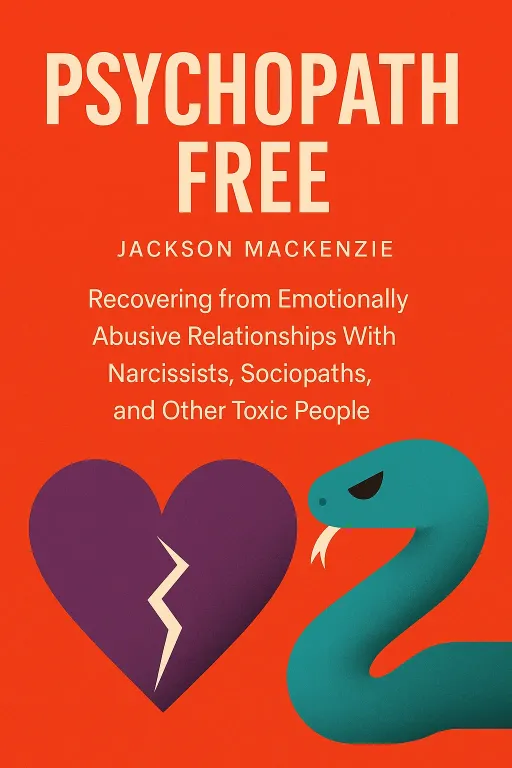
Nova: Exactly. We often treat toxic relationships like a bad weather event—something that just happens to us. But today, we are going to look at the architecture of those dynamics and, more importantly, how to rebuild your internal foundations so they never collapse again. We are diving into the mechanics of emotional abuse and the path to real recovery, pulling from two powerful perspectives. First, there is Psychopath Free by Jackson MacKenzie, which really laid the groundwork for understanding the tactical stages of emotional manipulation. And then, we are balancing that with You Can Thrive After Narcissistic Abuse by Melanie Tonia Evans.
Atlas: I have heard the name Jackson MacKenzie often. He has become a bit of a touchstone for this topic. What is the one thing that separates his work from the countless other books on toxic relationships?
Nova: It is his focus on the specific, insidious stages of the cycle. MacKenzie was actually one of the first to clearly map out the progression of idealization, devaluation, and discard. He wrote this from the perspective of someone who had lived through it, and his work gained massive traction because it validated what so many people felt but could not articulate—that these were not just random arguments, but a systematic dismantling of their reality. It shifted the conversation from wondering if you were crazy to understanding the mechanism of the abuse.
Atlas: That makes sense. It provides a framework. And Melanie Tonia Evans adds the second half of that equation, right?
Nova: Precisely. While MacKenzie helps you identify the pattern, Evans focuses on the internal wounds that allow these patterns to take root in the first place. Her method, which she calls Quanta Freedom Healing, is about shifting the focus away from the abuser and back onto the internal landscape. It is about the realization that you cannot control the chaos outside, but you can definitely fortify the walls inside.
The Anatomy of the Toxic Cycle
SECTION
Atlas: Let us start with those stages MacKenzie outlines. Idealization, devaluation, and discard. It sounds like a formula. If it is a formula, does that mean it is predictable?
Nova: It is highly predictable. That is the haunting part. In the idealization phase, you are given this overwhelming attention. It feels like you have finally met someone who sees you, who understands your potential, who mirrors your values. It is intoxicating. But the key thing to understand is that this is not a genuine connection. It is a mirror. They are reflecting back to you exactly what you want to see so that you drop your defenses.
Atlas: I can see how that would be dangerous for a high-achiever. If you are someone who is building a career, or working on a big project, you are already looking for validation. You are already looking for someone to say, I see what you are doing.
Nova: You hit the nail on the head. And that is exactly when the trap snaps shut. Because once you are hooked, once your identity is partially tied to this person seeing you, they move to the devaluation phase. This is where the goalposts start moving. One day you are the perfect partner, the next day you are the source of all their problems. It is a psychological whiplash.
Atlas: I have seen this in professional settings, too. Someone who is brilliant, who is doing great work, suddenly starts second-guessing every decision because their manager or their mentor has started this subtle, drip-feed devaluation. It is not always a romantic partner. It can be a colleague or a boss.
Nova: That is a profound observation. The dynamic is the same. It is about destabilization. If you can make someone doubt their own perception of reality, they become dependent on you to define that reality for them. And that leads to the discard. Once you have been drained of the energy or the utility they were looking for, they leave. They discard you like you never existed.
Atlas: That brings up a question I have been chewing on. If this is a formula, why do smart, capable, and otherwise logical people fall for it? Is it just that the predator is that good at manipulating?
Nova: It is partly the manipulation, but it is also the blind spot. We tend to view the world through the lens of our own integrity. We assume that because we would never treat someone that way, they would never treat us that way. We project our own logic onto them. When they act irrationally, we try to explain it with logic. We say, maybe they are stressed, maybe they had a bad childhood, maybe they just need to see my perspective. We try to solve their behavior like a puzzle.
Atlas: So the effort we put into understanding them is actually the very thing that keeps us stuck in the cycle.
Nova: Exactly. We are spending our intellectual capital trying to solve a problem that is not ours to solve. MacKenzie’s point is that the moment you try to rationalize their behavior, you have already lost the battle. You are trying to find a reason in a process that is designed to be unreasonable.
The Internal Architecture of Vulnerability
SECTION
Atlas: That is a tough pill to swallow. It essentially means that the more empathetic or analytical you are, the more susceptible you might be. So, how do we pivot from being the victim of this cycle to being the architect of our own safety? This is where Melanie Tonia Evans comes in, right?
Nova: She does. And she argues that we have to stop looking at the abuser and start looking at the internal wounds. This is not about victim-blaming. Let me be very clear about that. It is about empowerment. If you can identify the wound that made you vulnerable, you can heal it. And once you heal it, you stop attracting the same type of dynamic.
Atlas: I am curious about how that works in practice. If I have a wound—let us say, a deep-seated need for external validation or a fear of abandonment—how do I fix that? It feels like trying to repair a foundation while the house is still standing.
Nova: That is a great analogy. You have to do it in sections. You start by recognizing that your internal boundaries are not walls to keep people out; they are the guardrails that keep you on your own path. Evans talks about the importance of shifting focus. When you are in the middle of a toxic dynamic, you are constantly scanning the other person. What are they thinking? What will they do next? What can I do to keep the peace? Your entire energy is directed outward.
Atlas: Right. You are living in their reality.
Nova: Exactly. The shift happens when you reclaim that energy. You ask yourself, what internal boundaries have I compromised here? Did I ignore my gut feeling when they crossed a line? Did I apologize for something I did not do just to avoid a fight? Did I sacrifice my personal goals to accommodate their chaos?
Atlas: I imagine that for a lot of our listeners, the answer is a resounding yes. It is almost like a habit. We get used to compromising small things—a hobby, a boundary, a preference—and suddenly we wake up and we realize we have compromised our entire self.
Nova: It is the boiling frog scenario. You do not notice the water getting hotter because you are the one turning up the dial on yourself. You are the one justifying the compromises. Evans suggests that the healing starts when you stop trying to fix the other person and start fixing your relationship with yourself. You have to become the person who is not willing to abandon themselves.
Atlas: That sounds like a powerful shift. But I want to push back a little bit. Is it really that simple? Can you just decide to stop compromising? What if you are in a situation where you are financially or professionally tied to this person?
Nova: That is the practical challenge. And the answer is that you start with small, non-negotiable boundaries. You test the system. You say, I am not available for this conversation right now. Or, I am not going to accept this tone of voice. And you watch what happens.
Atlas: That is the test.
Nova: Yes. Because if they are a toxic person, they will react with hostility or more manipulation. They will push back against that boundary. And that is your data. That is the information you need to make your next decision. If they respect the boundary, they might be capable of growth. If they explode, you have your answer. The boundary is not just for protection; it is a diagnostic tool.
Rebuilding and Future-Proofing
SECTION
Atlas: I love that. It takes the emotion out of it and turns it into a diagnostic process. It is like running a stress test on a bridge. You apply a little pressure, and you see if it holds or if it crumbles.
Nova: Precisely. And this is where the Stoic Seeker mindset comes in. You are not reacting to their behavior; you are observing it. You are the architect of your own experience. You are not saying, I hope they treat me better. You are saying, I am the kind of person who requires this level of respect, and I will observe who is capable of meeting that standard.
Atlas: It changes the power dynamic completely. Instead of waiting for them to change, you are just selecting for people who are already at the level you require.
Nova: And that is the ultimate freedom. When you realize that you do not need to fix anyone, you do not need to convince anyone, and you do not need to justify your existence to anyone, you become untouchable. You are no longer a target for that idealization-devaluation-discard cycle because you are not participating in it.
Atlas: I have been thinking about the long-term impact of this. If we do this work, if we really heal those internal wounds, does that mean we become less empathetic? I worry that the cost of being protected is becoming closed off.
Nova: That is a common fear, but the opposite is true. When you have strong boundaries, you actually have more capacity for genuine connection. You are not constantly defending yourself, so you can be more present. You are not constantly scanning for threats, so you can be more vulnerable in a safe way. Boundaries are not the opposite of connection; they are the prerequisite for it. You cannot have a healthy relationship with someone else if you do not have a healthy relationship with yourself.
Atlas: That makes perfect sense. It is like having a sturdy house. You can open the windows and invite people in because you know the roof will not collapse.
Nova: Exactly. You are not worried about the house falling down, so you can actually enjoy the company.
Synthesis & Takeaways
SECTION
Atlas: This has been a really clarifying conversation. We went from the tactical, almost mechanical nature of how toxic cycles work, to the profound, internal work required to break free. If we had to summarize this for someone listening who is currently in the middle of this, what is the single most important action they can take today?
Nova: I would say this: Start by validating your own intuition. If something feels off, it is off. You do not need a court of law to prove it. You do not need them to admit to it. You do not need to convince them that you are right. Your perception is your reality. Trust it. Stop trying to solve the puzzle of their behavior and start looking at the gaps in your own boundaries.
Atlas: That is powerful. Trust the data of your own experience.
Nova: And remember, you are not failing because you got caught in a cycle. You are succeeding because you are now waking up to it. The fact that you are even asking these questions, that you are looking for a way out, that is the first step of the rebuild.
Atlas: And that leads us back to our deep question: What internal boundaries have you historically compromised to keep the peace, and how can you gently but firmly re-establish them today? I would encourage everyone listening to take fifteen minutes—just fifteen minutes—without any distractions, and write down the answer to that. Not for anyone else to see. Just for you.
Nova: It is the most important blueprint you will ever draft. Because once you know where the cracks are, you can start the work of filling them in, not with the approval of others, but with the strength of your own self-respect.
Atlas: I think that is a perfect place to leave it. Thank you for walking us through this, Nova. It feels less like a conversation about abuse and more like a conversation about reclaiming our own power.
Nova: That is exactly what it is. And for everyone listening, remember that this is a process. Be patient with yourself as you rebuild. You are the architect of your future, and you get to decide what stays and what goes.
Atlas: This is Aibrary. Congratulations on your growth!









