

High-Stakes Resilience and Cosmic Perspectives
Golden Hook & Introduction
SECTION
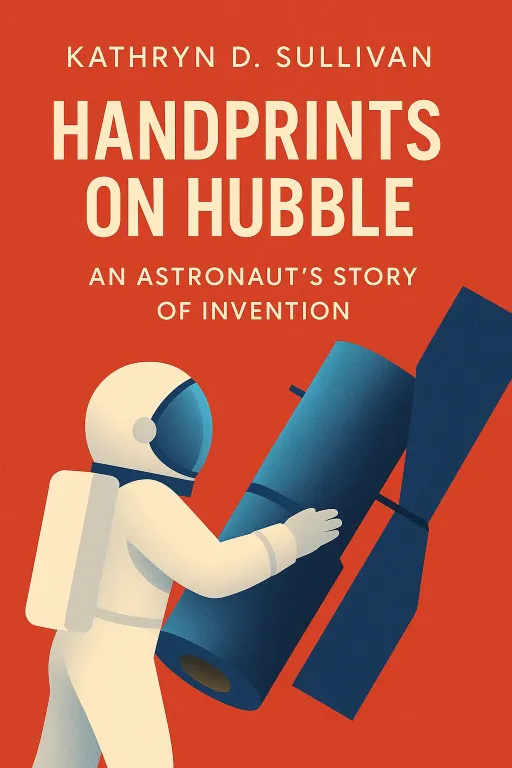
Nova: A billion-dollar telescope is floating in the void, and for a long time, it was essentially blind. It was the most expensive, sophisticated eye humanity had ever built, yet it was staring into the universe with a blurry, distorted lens. The fix wasn't a software patch or a digital update. It required human hands to go up there, into the vacuum, and physically install corrective optics. It is the ultimate high-stakes repair job.
Atlas: That is a staggering visual. It feels like the perfect metaphor for a professional life that has hit a wall. We spend years building our internal "telescope"—our expertise, our career, our reputation—and then, suddenly, everything looks blurry. We are still looking at the same stars, but the data coming back is distorted.
Nova: Exactly. And that brings us to two very different, but strangely complementary, ways of handling that distortion. We are looking today at the work of Kathryn D. Sullivan in Handprints on Hubble, which is all about the mechanics of high-stakes precision, and Melanie Tonia Evans in You Can Thrive After Narcissistic Abuse, which tackles the internal, systemic repair of the human operator.
Atlas: Right. On one hand, you have the external, technical, mission-critical approach of an astronaut. On the other, you have the internal, psychological, often messy work of rebuilding your own foundation. It is a fascinating juxtaposition for someone who operates in high-stakes environments. You cannot fix the telescope if your own hands are shaking.
Nova: That is the core of it. Kathryn Sullivan, the first American woman to walk in space, gives us the blueprint for the external mission. She isn't just an astronaut; she is a geologist, a scientist who understands the earth. She writes about the Hubble repair with this incredible, granular focus. It is not about heroics; it is about the checklist. It is about the absolute, unwavering precision required when the cost of failure is the loss of a multi-billion dollar asset.
Atlas: Most people hear "space mission" and think of the drama, the explosions, the countdown. But the reality, as Sullivan describes, is almost boring in its meticulousness. It is about the prep. It is about knowing exactly where your hand goes, what tool you grab, and what the contingency is if that tool slips. There is a deep, almost meditative utility in that level of preparation.
Nova: It is the ultimate expression of the "Strategic Architect" mindset. You don't leave things to chance. You design the outcome by designing the process.
The Mechanics of High-Stakes Resilience
SECTION
Atlas: That approach makes total sense to me. When I am in the middle of a high-pressure project, the only thing that keeps me sane is the process. If I start focusing on the "what if we fail" anxiety, I lose. So, when Sullivan talks about this repair mission, is she suggesting that we can apply that same level of space-grade checklist thinking to our own personal or professional setbacks?
Nova: She is. And the beauty of her perspective is that she strips away the ego. In space, ego is a liability. You don't walk into a spacewalk thinking about how great you are. You walk in thinking about the procedures. She emphasizes that the "handprints" on the Hubble are not just literal marks left by astronauts; they are the human element in a machine-driven environment. She argues that the most sophisticated technology in the world is useless without a human who is calm, prepared, and capable of executing a plan under extreme duress.
Atlas: That is a critical distinction. We often think that "resilience" is just grit, or willpower, or "toughing it out." But Sullivan is describing something more technical. She is describing resilience as a system. If your system for handling stress is just "try harder," you will eventually crash when the pressure exceeds your capacity.
Nova: Precisely. Think about the Hubble repair. It was complex. It was dangerous. But they didn't just "try harder." They trained. They rehearsed until the procedures were muscle memory. They treated the mission like a series of discrete, manageable tasks. When you are facing a massive setback—a career pivot, a project failure, a personal crisis—the panic comes from the sheer size of the problem. We look at the "blurry lens" and think the whole telescope is ruined.
Atlas: So, the lesson here is to stop looking at the "blurry lens" and start looking at the individual bolts that need tightening.
Nova: Exactly. You break it down. You don't try to "fix your career" in a day. You fix the lens, then you calibrate the sensors, then you test the output. You use the checklist to manage your cognitive load. When you are under fire, your brain wants to go into fight-or-flight mode. The checklist acts as an external brain. It tells you what to do next so you do not have to waste precious mental energy deciding what to do next.
Atlas: I love that. It turns the overwhelming into the actionable. But, here is the catch. What happens when the problem isn't just a technical failure? What happens when the "blurry lens" isn't a mechanical issue, but a psychological one? Sullivan’s approach works for the machine, but what about the human operator who is burnt out, or who has been through a toxic environment that has fundamentally changed how they perceive their own worth?
The Internal Foundation
SECTION
Nova: That is the perfect segue to Melanie Tonia Evans. This is where the "Strategic Architect" needs to pivot. You can have the best checklist in the world, you can be the most prepared person in the room, but if your internal foundation—your psychological architecture—has been compromised by systemic trauma, you are building on sand.
Atlas: I have seen this in professional settings. You have incredibly talented people, high performers, who sabotage themselves. They have the "checklist," they have the skills, but they are operating from a place of fear or hyper-vigilance. They are trying to repair the telescope while their own internal sensors are screaming that the sky is falling.
Nova: Evans calls this "narcissistic abuse," but let’s reframe that for the professional world. Think of it as "systemic emotional depletion." It happens in toxic workplaces, in long-term high-stress roles, or through sustained professional gaslighting. It leaves you feeling like you are constantly in survival mode. You are not thinking about the mission; you are thinking about the threat.
Atlas: That sounds like a corrupted operating system. You are trying to run high-level software, but the kernel is compromised.
Nova: That is the best analogy I have heard. Evans introduces the Quanta Freedom Healing method. And while the name sounds abstract, the principle is very practical. It is about identifying where that "systemic trauma" lives in your body and your subconscious, and then performing the equivalent of a hard reset. You cannot "think" your way out of a visceral, nervous-system-level response. You have to shift the energy.
Atlas: This is where I struggle, though. As a strategist, I want a step-by-step. I want a manual. This sounds like it requires... feeling things. How do you combine that with the high-stakes, analytical approach we were just talking about with Sullivan?
Nova: You treat the internal work with the same cold, analytical precision you would apply to a space mission. That is the synthesis. You don't have to choose between the two. You use the analytical mind to the internal state. You start tracking your triggers. You start observing your reactions to stress as if you were a scientist observing a specimen.
Atlas: So, instead of getting swept away by the anxiety, I treat the anxiety as a data point.
Nova: Exactly. That is the power of the combination. Sullivan teaches you how to structure the external world so you have the bandwidth to do the internal work. Evans teaches you how to clear the internal clutter so you can actually use that bandwidth. If you are constantly fighting your own internal "noise," you have no processing power left for the mission.
Atlas: It makes me think about the "handprints" concept again. We leave handprints on our work, but we also carry the handprints of our past experiences. If we are carrying the handprints of trauma—the fear, the hesitation, the need for approval—that will show up in the work. It will distort the lens.
Nova: That is profound. And that is why the "Strategic Architect" must be a master of their own interiority. You cannot build a masterpiece if the architect is living in a house that is constantly under threat. You have to secure the site.
Synthesis & Takeaways
SECTION
Atlas: So, if I am listening to this, and I am in a high-stakes role, and I feel like my lens is blurry—what is the first move? Do I go full-checklist mode, or do I go into the internal work?
Nova: You do both. And you start by acknowledging that they are not separate. The "tiny step" approach is the bridge. Sullivan’s work shows us that even the most complex space mission is just a sequence of small, manageable tasks. Evans’s work shows us that even the deepest psychological shift is just a sequence of small, intentional choices to regulate your nervous system.
Atlas: So, when I hit a setback, my first move is to create the "Mission Checklist." I define the external steps I need to take to stabilize the situation. That gives my brain safety.
Nova: Yes. That handles the "fight-or-flight" response by giving your brain a concrete task. And then, in the quiet moments—the "off-mission" time—you perform the internal maintenance. You check in with your nervous system. You ask, "Am I reacting to the current reality, or am I reacting to a past experience?"
Atlas: I see. You use the structure of the mission to keep your hands busy and your mind focused, and you use the internal work to keep your heart clear and your intuition sharp. It is about creating a "resilience architecture."
Nova: That is exactly it. You are building a system that can withstand pressure because it is rigid on the outside—the procedures, the goals, the checklists—and flexible on the inside—the ability to heal, to adapt, to let go of old patterns.
Atlas: It is the difference between a building that cracks under high winds and a building that sways. The rigid structure breaks. The flexible, well-engineered structure survives.
Nova: And that is the ultimate goal. We are all trying to get a clearer view of the universe, whether it is through a telescope in space or through our own eyes in our daily lives. The blurriness isn't the end of the story. It is just a sign that it is time for a repair.
Atlas: I love that. It takes the shame out of the setback. It is not a failure; it is just a maintenance cycle.
Nova: Exactly. And you have the tools for the maintenance. You have the external blueprint and the internal methodology. The only thing left is to start the work.
Atlas: That is a powerful place to land. It is not about avoiding the pressure; it is about being the kind of operator who can handle it without losing their humanity.
Nova: Well said. To everyone listening, remember that your resilience isn't a fixed trait. It is a system you build, one handprint at a time. This is Aibrary. Congratulations on your growth!









