From Toxic Dynamics to Emotional Rebirth
Golden Hook & Introduction
SECTION
Nova: The most dangerous people in your life usually don't show up with a villain mask. They show up as the answer to your prayers. They are the person who understands you better than anyone else, who validates your ambitions, and who mirrors your deepest values.
Atlas: That is a terrifying thought, but it is exactly why these dynamics are so hard to spot until you are already in the thick of it. It feels like you have finally met your match, not like you are walking into a trap.
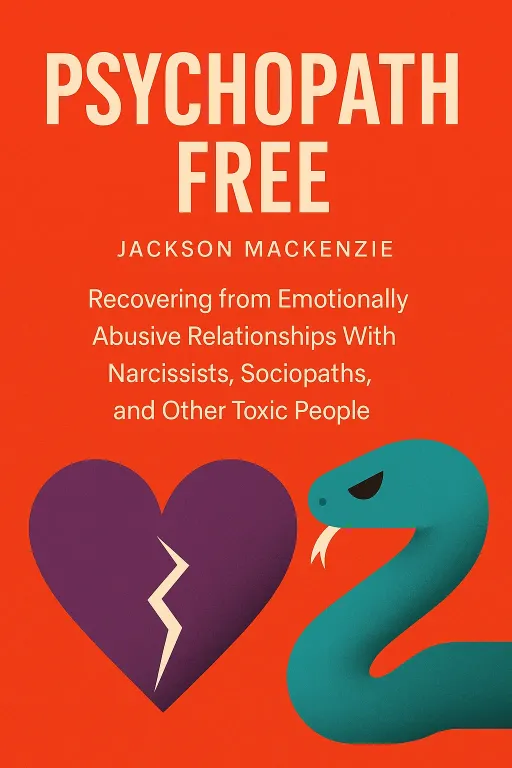
Nova: Exactly. And that is why we are looking at two essential works today that help us decode this experience and, more importantly, get out of it. We are diving into Psychopath Free by Jackson MacKenzie, which provides the blueprint for understanding the cycle of manipulation, and You Can Thrive After Narcissistic Abuse by Melanie Tonia Evans, which focuses on the somatic, or physical, reality of healing.
Atlas: These two books together seem to cover the full spectrum. MacKenzie gives us the logic—the map of what is happening—and Evans gives us the path to actually feeling better in our own skin. It is the difference between knowing why you are hurt and actually healing the wound.
Nova: That is a perfect way to put it. MacKenzie, who gained a massive following by documenting these patterns online, really excels at demystifying the confusion. He strips away the gaslighting to show the raw mechanics of the relationship. And Melanie Tonia Evans takes that further by arguing that until you address the trauma trapped in your nervous system, you are just thinking your way through a feeling problem.
Atlas: I am ready to break this down. Let us start with the mechanics. How does this cycle actually work? Because from the outside, it looks like a series of random fights, but these authors suggest it is a very specific, repeatable process.
The Architecture of the Cycle
SECTION
Nova: It is not random at all. MacKenzie maps it out with clinical precision. It starts with Idealization. This is the stage where the manipulator mirrors everything you want to be or everything you want to have. If you are an ambitious, purpose-driven person, they are the one who tells you that you are a visionary. They make you feel seen in a way that feels unique.
Atlas: Right, they are essentially holding up a mirror that reflects a version of yourself you really like. But then, the mirror starts to crack.
Nova: That is the Devaluation stage. It is subtle at first. Maybe a backhanded compliment, a weird comment about your friends, or a sudden withdrawal of affection. You start to feel like you are walking on eggshells, constantly trying to get back to that initial version of the relationship. You start working harder to fix things because you think the problem is a misunderstanding.
Atlas: I can see why high-achieving people fall for this. We are trained to solve problems. If something is broken, we fix it. So, when the relationship starts to decline, our natural instinct is to double down, communicate more, and try to optimize the dynamic.
Nova: That is exactly the trap. You think, if I just explain myself better, if I am more supportive, if I work harder, the "good" version of them will come back. But the "good" version was never the reality. It was a performance. And then comes the Discard. This is when they move on, often suddenly and cruelly, leaving you with a massive amount of cognitive dissonance. You are left wondering, who was that person I was with?
Atlas: That dissonance is the worst part. It feels like your brain is trying to process two completely different people at the same time. You have the person who treated you like royalty and the person who treated you like an inconvenience. How are you supposed to reconcile those two?
Nova: You don't. That is the key insight from MacKenzie. You have to accept that the first person was an illusion. The discard is actually the moment the mask slips off completely. It is the most painful part, but it is also the most honest part.
Atlas: It sounds like the process of realizing this is like waking up from a fever dream. But let me ask you this, because this comes up for a lot of people in high-pressure environments: what happens when you try to apply logic to this? Does analyzing the behavior actually help, or does it just keep you stuck in the cycle?
Nova: Analysis is the first step, but it is not the destination. MacKenzie helps you see the pattern so you can stop blaming yourself. That is the primary goal of his work—to remove the self-blame. Once you realize the cycle is a template, you can stop asking, "What did I do wrong?" and start seeing, "This is what they do."
Atlas: That shift from "What did I do?" to "This is what they do" is powerful. It takes the focus off your own perceived failures and puts it onto the objective reality of the situation. It turns you from a victim into an observer.
Nova: Precisely. And once you are an observer, you can start the process of cognitive closure. You stop trying to get answers from the manipulator, because they will never give you a truthful answer. They are not capable of it. You provide the closure for yourself by understanding the cycle.
The Somatic Reality
SECTION
Atlas: So, we have the cognitive map. We know the stages. But I have talked to people who have read all the books, they know the cycle inside and out, they can name the manipulation tactics, and yet, they still feel physically sick when they hear a specific tone of voice or see a certain notification on their phone. That is where Melanie Tonia Evans comes in, right?
Nova: Yes, and this is the crucial missing piece. Evans argues that trauma is not just a story you tell yourself. It is a physiological state. Your body has recorded the stress, the fear, and the hyper-vigilance. You can understand the manipulation intellectually, but if your nervous system is still stuck in fight-or-flight mode, you are not actually free.
Atlas: This makes so much sense. It is like having a computer that is running background processes you cannot see. You might have the latest software installed, but if the processor is overheating, the system crashes anyway.
Nova: That is a great analogy. Evans focuses on the cellular level. She talks about how we store these emotional imprints in our body. When you are in a relationship with a manipulator, you are constantly bathed in stress hormones. Your body learns to expect the worst. After you leave, your body doesn't know the threat is gone. It is still scanning the horizon for danger.
Atlas: So, how does someone actually address that? If the trauma is "cellular," you cannot just talk it out. Do you have to do something different?
Nova: You have to change how you relate to your body. Evans emphasizes somatic healing. This involves things like mindful breathing, grounding techniques, and actually learning to feel your emotions without being overwhelmed by them. It is about teaching your nervous system that you are safe in the present moment.
Atlas: I imagine for someone who is used to living in their head—like an architect or a leader who is used to analyzing data—this feels incredibly uncomfortable. It is much easier to analyze a situation than to sit with the discomfort of a tight chest or a racing heart.
Nova: It is uncomfortable, but it is necessary. Evans suggests that you have to lean into the sensation. Instead of trying to distract yourself from the physical feeling of anxiety, you breathe into it. You acknowledge it. You say, "I am feeling this sensation, but I am safe right now." It is about reclaiming your own body as a sanctuary.
Atlas: That is a beautiful way to put it. A psychological sanctuary. It sounds like the goal is to become a place where you can actually rest, instead of a place where you are constantly defending against an attack.
Nova: Exactly. And that is the difference between surviving and thriving. Surviving is just getting through the day without a panic attack. Thriving is having the capacity to feel, to connect, and to pursue your goals without that constant background noise of fear.
Atlas: I want to dig into the "how" of this for our listeners. If someone is listening to this and realizes, "Okay, I understand the cycle, and I definitely feel that tightness in my body," what is the most direct path forward? Is it a matter of time? Is it a practice?
Nova: It is a practice. Evans advocates for taking small, consistent steps. She talks about sitting in silence and just scanning your body. It sounds simple, but it is profound. You close your eyes, you scan from your feet to your head, and you look for the tension. Where is it stored? Is it in your jaw? Your shoulders? Your stomach?
Atlas: And then what? Just noticing it is enough?
Nova: Noticing is the first step. Then, you consciously breathe into those spaces. It is about sending a signal to your body that you are in control of the environment, not the trauma. You are essentially retraining your nervous system to relax. It is like a muscle. You cannot go to the gym once and expect to be an athlete. You have to train the muscle of relaxation.
Atlas: I love the idea of training the muscle of relaxation. We are so focused on training the muscle of performance, of productivity, of achievement. We rarely think about training the muscle of peace.
Nova: That is the shift. Especially for the purpose-driven seekers who listen to this. You have spent your life training for external success. This is about training for internal stability.
Synthesis & Takeaways
SECTION
Atlas: This has been a fascinating journey through these two books. We have gone from the external, intellectual understanding of the cycle in Psychopath Free to the internal, somatic healing in You Can Thrive After Narcissistic Abuse. It really feels like a complete system.
Nova: It is a system for reclaiming your sovereignty. When you understand the cycle, you reclaim your mind. When you heal your body, you reclaim your energy. You stop being a target for these dynamics, and you start being the architect of your own experience.
Atlas: And that is the ultimate goal. Not just to avoid the bad, but to build a life that is so grounded in your own truth that these dynamics simply do not have a place to land.
Nova: That is the core of it. You are not just avoiding toxic people; you are cultivating a state of being where you are no longer a match for them. When you are fully in your own power, when your nervous system is regulated, and when your mind is clear, the game they try to play simply doesn't work.
Atlas: That is a powerful takeaway. So, for everyone listening, the challenge today is to start that internal audit. Maybe take five minutes to just sit, scan, and breathe. It is not about fixing everything in one day. It is about starting the process of coming back home to yourself.
Nova: Well said. This is not about a quick fix. It is about a foundational shift. And the more you practice this, the more resilient you become.
Atlas: This conversation has been incredibly illuminating. It feels like we have provided a roadmap for anyone who has felt lost in the aftermath of these kinds of situations.
Nova: I hope it provides that clarity. And remember, the goal is not to dwell on the past, but to ensure that the future is built on a foundation of your own choosing.
Atlas: Absolutely. And with that, we are going to wrap up. Thank you for joining us in this exploration of reclaiming your sanctuary.
Nova: Thank you for listening. This is Aibrary. Congratulations on your growth!