Designing Positive Cultures and Restoring Inner Trust
Golden Hook & Introduction
SECTION
Nova: If I told you that starting your next team meeting by venting about the morning traffic or a looming deadline is actually costing you thirty percent of your team's collective problem-solving capacity, would you change your opening line?
Atlas: That is a startling statistic. Most people treat venting as a social lubricant. We think we are bonding by complaining together, but you are saying that habit is actually a massive efficiency leak.
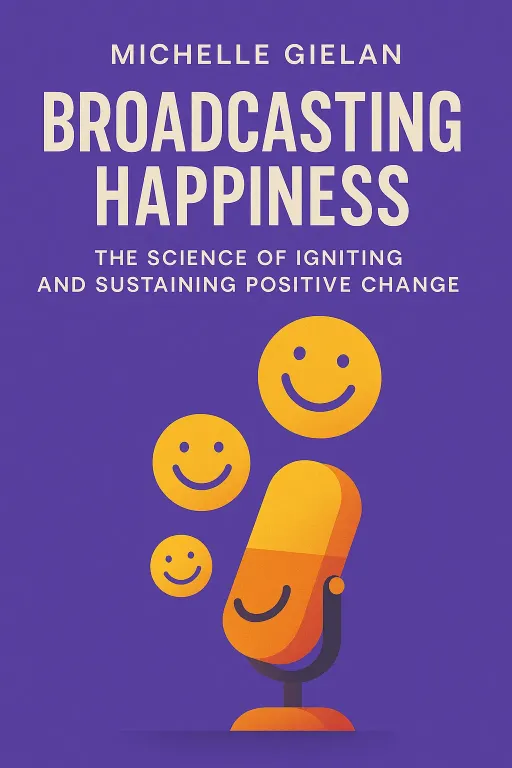
Nova: It is not just a leak; it is a fundamental misfiring of the brain. We are looking at two books today that seem to come from different worlds but are essentially teaching the same lesson about agency. First, there is Broadcasting Happiness by Michelle Gielan. She is a former CBS anchor who spent years watching the news industry prioritize disaster, and she eventually pivoted to study how our communication patterns physically reshape our reality.
Atlas: And then, to contrast that, we are bringing in You Can Thrive After Narcissistic Abuse by Melanie Tonia Evans. Now, the title sounds very specific to a particular kind of trauma, but the core framework she introduces—something she calls Quantum Freedom Therapy—is really about a universal struggle: how to stop letting external environments dictate your internal state.
Nova: Exactly. Gielan teaches us how to shift the external environment, and Evans teaches us how to fortify the internal one. Both are about moving from a state of passive reaction to active creation.
Atlas: So, we are talking about controlling the narrative, both inside and out. I am curious, though. Let’s start with the broadcasting side. How does a single sentence change something as complex as a team’s problem-solving ability?
The Science of the Positive Lead
SECTION
Nova: It comes down to the way the brain processes threat versus opportunity. Gielan highlights a concept she calls the positive lead. When you start a conversation—whether it is with a client, a spouse, or your team—by highlighting a win, expressing gratitude, or pointing toward a potential solution, you are essentially signaling to the brain that it is safe to shift gears.
Atlas: Shift gears from what?
Nova: From the amygdala, the fear center, to the prefrontal cortex, the executive center. When you start with a problem, you are priming the listener's brain to scan for threats. It is a survival mechanism. If I say, "This project is a disaster," your brain immediately goes into defensive mode. It starts looking for ways to protect itself, not ways to innovate.
Atlas: That makes sense. It’s like the "fight or flight" response, but for office politics. But is this just toxic positivity? Are we supposed to ignore the disaster and pretend everything is sunshine and rainbows?
Nova: That is the most common critique, and it is a fair one. But Gielan is very specific: this is not about ignoring reality. It is about sequencing. You can absolutely discuss the disaster. But if you lead with the disaster, you have already handcuffed the prefrontal cortex of everyone in the room. If you lead with a positive anchor—like, "We have solved the logistics issue, now let’s look at the remaining hurdle"—you have primed the brain to be in a solution-seeking mode. That is where the thirty percent boost comes from. You are not changing the problem; you are changing the cognitive environment in which the problem is solved.
Atlas: So, it is about the "order of operations" for the human brain.
Nova: Precisely. Think of it like a computer. If you try to run a high-performance software program while the system is performing a virus scan, everything lags. The threat-detection mode is the virus scan. It consumes all the processing power. When you start with a positive lead, you are essentially telling the brain, "The system is secure, you can now allocate all resources to the complex task at hand."
Atlas: I can see how that would work in a meeting. But what about the person who is naturally cynical? If I walk into a meeting and say, "Great job on the report, everyone," when the report was actually mediocre, aren't I just losing credibility?
Nova: That is a crucial distinction. It has to be a "genuine" positive lead. It cannot be fabricated. If the report was mediocre, you find the one thing that was done correctly, or you express gratitude for the effort put into the process. You are looking for a truthful anchor. The goal is not to be a cheerleader; the goal is to be a strategist. You are strategically placing a piece of information that lowers the cortisol levels of the room so that the subsequent conversation can be productive rather than destructive.
Atlas: It sounds like a form of emotional regulation for an entire room.
Nova: It is exactly that. And it is contagious. If you start with a positive lead, the other person is statistically much more likely to respond in kind. You are setting the tone for the entire interaction.
Internal Authority and Quantum Freedom
SECTION
Atlas: Okay, so Gielan gives us the manual for external interaction. But what about when the external environment is hostile? That is where Melanie Tonia Evans comes in. I have to be honest, when I hear "Quantum Freedom Therapy," my skeptic alarm starts ringing a little bit. It sounds like a buzzword. How do we translate that into something a pragmatic person can actually use?
Nova: I appreciate that skepticism. Let’s strip away the label. What Evans is really talking about is the difference between "cellular trauma" and "internal authority." She argues that many of us carry the emotional residue of past interactions—narcissistic abuse is the extreme end of the spectrum, but we all experience boundary violations—and we store that as a default setting in our nervous system.
Atlas: What does "storing it in the nervous system" mean in plain English?
Nova: It means your body reacts to the present as if it is the past. If you had a boss who belittled you five years ago, and today your current manager gives you constructive feedback, your body might trigger the same physiological response you felt five years ago—racing heart, shallow breathing, the urge to defend yourself or shut down. Evans calls this "cellular trauma." You are reacting to a ghost.
Atlas: Okay, I recognize that. That is not just for abuse victims; that is for anyone who has ever been burned. So, how do we fix that?
Nova: Evans’s framework, which she calls Quantum Freedom Therapy, is essentially about reclaiming your "internal authority." It is the realization that you are the only person who can validate your own reality. When we rely on others to tell us we are safe, or good, or smart, we are essentially outsourcing our internal stability. If that person changes their mind, our stability vanishes.
Atlas: This sounds like the ultimate form of self-reliance. But how do you actually practice this? It’s easy to say "validate yourself," but it’s hard to do when you are in the middle of a high-stakes conversation where someone is pushing your buttons.
Nova: That is where the "Quantum" part—or, if we want to be less mystical, the "Systemic" part—comes in. It is about decoupling your internal peace from external behavior. Evans suggests a process of observing the trigger without engaging with it. When you feel that surge of anxiety or the need to defend yourself, you pause and ask: "Is this feeling coming from the situation in front of me, or is it coming from a past pattern I am projecting onto this moment?"
Atlas: That is a powerful distinction. It is the "pause" between stimulus and response. But does this lead to isolation? If I am constantly checking my own internal state and not relying on others, do I stop connecting with people?
Nova: Quite the opposite. It makes your connections much more authentic. If you are not constantly looking for validation or trying to avoid being hurt, you can engage with people as they are, not as you fear they might be. Boundaries become guardrails, not walls. You are not pushing people away to be safe; you are establishing the conditions under which you can interact healthily.
Atlas: So, Gielan’s positive lead is how you treat others, and Evans’s internal authority is how you protect yourself.
Nova: That is a brilliant synthesis. One is your offensive strategy for building culture; the other is your defensive strategy for maintaining your own sanity.
The Convergence of Agency
SECTION
Atlas: Let’s play this out. Imagine a scenario where these two things collide. Let’s say I am in a difficult work environment. My boss is demanding, the culture is a bit toxic, and I feel like I am constantly walking on eggshells. If I apply both of these frameworks, what does my Tuesday look like?
Nova: That is a great test case. Let’s start with the morning. You walk into that office. The old you—the one operating on autopilot—is already bracing for impact. You are scanning for threats. You are tense. That is the internal state Evans warns us about.
Atlas: Right. And because I am tense, I am probably snapping at colleagues or being overly defensive in emails.
Nova: Exactly. And that creates a feedback loop of negativity. So, step one: you use the internal authority. You check in with yourself. You realize, "I am anticipating a fight because of past experiences, but I can choose to remain calm." You regulate your nervous system. You are not the victim of the environment; you are an observer of it.
Atlas: Okay, I have my internal guardrails up. I am calm. Now, what about the boss?
Nova: Now you use Gielan’s positive lead. You walk into that meeting with your boss. Instead of starting with the list of problems or the defensive explanation of why things aren't finished, you open with: "I want to share a quick win on the project we discussed yesterday, and then I’d love your input on how we can tackle the next phase."
Atlas: That is such a small shift. It changes the entire power dynamic.
Nova: It does. You are taking control of the conversation. You are forcing the brain of the person you are talking to—even if they are a difficult boss—to switch tracks. It is very hard to stay in a state of aggressive criticism when the conversation is anchored in a constructive, positive reality. You have subtly steered the ship.
Atlas: It sounds simple, but I imagine it is exhausting to maintain. Is this something you have to do every single second of the day?
Nova: That is the pragmatic learner’s trap, isn't it? Thinking everything has to be a constant, high-effort performance. The beauty of both these books is that they are about building habits, not performing feats of strength. Once you start doing this, it becomes a default. You stop having to "try" to have a positive lead; you just start conversations that way because you realize it makes your life easier. You stop "trying" to regulate your internal state; you just catch yourself faster when you start to spiral.
Atlas: It is about reducing the friction of life.
Nova: Yes. Think about the energy cost of being in a constant state of threat. It is massive. By using a positive lead, you lower the friction of your interactions. By using internal authority, you lower the friction of your own thoughts. You are essentially clearing the path for your own productivity and peace.
Atlas: I have a question about the "Quantum" terminology again. Because I know some of our listeners might get hung up on that. Is there a danger in viewing this as "manifesting" or "law of attraction" stuff? Because I prefer things that are rooted in biology and psychology.
Nova: That is a valid concern. If we strip away the metaphysical language, what Evans is really describing is neuroplasticity. The idea that we can rewire our responses. When she talks about "Quantum Freedom," she is talking about a quantum leap in your own development—a sudden, non-linear shift in your capacity to handle stress. It is not about magic; it is about the biology of belief and the physiology of emotional regulation.
Atlas: Okay, that lands much better. It is about the speed of change. You don't have to spend ten years in therapy to change a response; you can make a choice to shift your internal authority right now.
Nova: Exactly. The shift happens in the moment of choice. The moment you realize, "I don't have to react this way." That is the quantum leap.
Synthesis & Takeaways
SECTION
Atlas: So, if I am a listener who wants to walk away with a "tiny step," as we like to call it, what is the single, most impactful thing I should do tomorrow morning?
Nova: Start with the "Positive Lead" in your very first interaction. Do not check your email first. Do not check the news first. Find one person—a colleague, a partner, a child—and before you dump a task or a complaint on them, lead with a small win or a genuine expression of gratitude. It can be as simple as, "I really appreciated how you handled that call yesterday," or "I am really glad we got that report done."
Atlas: What if I don't have a win to share?
Nova: Then share a gratitude. "I am really glad we are working on this together." It takes three seconds. It is the cheapest, most effective way to hack the social environment you are walking into.
Atlas: And what about the internal side? If I feel that familiar rush of "I need to defend myself" during the day, what is the Evans-inspired move?
Nova: The move is to pause and acknowledge the feeling without owning it. Say to yourself, "I am feeling triggered right now, but I am not in danger." It is a simple cognitive reframing. You are acknowledging the emotion, which prevents it from being repressed, but you are not letting it drive the bus. You remain the observer.
Atlas: It is about being a scientist of your own life. Observing the data—the triggers, the interactions—without being emotionally hijacked by them.
Nova: That is the ultimate goal. When you combine the ability to shape your external interactions with the ability to maintain your internal peace, you stop being a passenger in your own life. You become the architect.
Atlas: It is interesting because we started by talking about "Broadcasting Happiness," which sounds like something you do for other people, and we ended with "Quantum Freedom," which sounds like something you do for yourself. But they are actually the same thing. You cannot effectively broadcast if your internal signal is scrambled.
Nova: That is the perfect summary. You have to calibrate the transmitter before you can broadcast the signal.
Atlas: I love that. Calibrate the transmitter. That is a great way to think about personal growth. It is not about adding more to your plate; it is about ensuring the plate is stable before you start serving.
Nova: And remember, this is a practice. You will get it wrong. You will walk into a room and start with a complaint. You will get triggered and lose your cool. The goal is not perfection; the goal is awareness. The moment you notice you have slipped, you have already won, because you are now in the driver’s seat.
Atlas: That is incredibly empowering. It takes the pressure off. I don't have to be perfect; I just have to be observant.
Nova: Precisely. And that is where the growth happens. It is in the observation, not the performance.
Atlas: Well, this has been a masterclass in shifting gears, both internally and externally. I feel like I have a much better toolkit for tomorrow morning.
Nova: I am glad to hear that. Just remember: start with a win, and hold your own space. The rest will follow.
Atlas: I am ready. Thank you for this. This is Aibrary. Congratulations on your growth!