

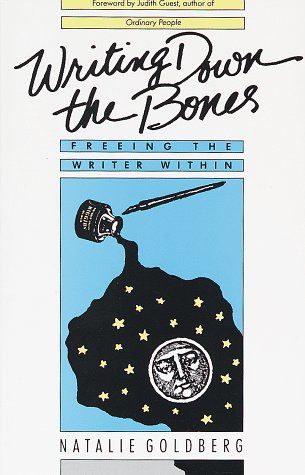
Writing Down the Bones
Introduction
Nova: Imagine sitting down to write and being told to stop thinking. Not "think harder" or "plan better" — just stop thinking altogether. Lose control. Go for the jugular. That's the kind of advice Natalie Goldberg gives in her 1986 classic, Writing Down the Bones, a book that has sold over a million copies and been translated into fourteen languages. And here's the thing — it didn't start as a writing manual at all. It started in a Zen meditation hall in Minnesota.
Nova: Exactly — that's the magic of it. Natalie Goldberg spent over a decade studying Zen Buddhism under a Japanese teacher named Katagiri Roshi. At one point she went to him, frustrated, and he said something that changed her life: "Natalie, make writing your practice." That one line became the seed for an entirely new approach to putting words on the page. Writing Down the Bones isn't a book of grammar tips or plot structures. It's a spiritual practice disguised as a writing guide.
Nova: That's exactly it. And that's why, nearly forty years after its release, it's still one of the most recommended writing books on the planet. Today we're going to dig into what makes it so special — the rules, the Zen philosophy, the battle against your inner critic, and why a cup of tea might just be the most profound writing prompt you'll ever receive.
Key Insight 1: The Writing Practice Method
The Six Rules That Break All the Rules
Nova: So let's start with the practical core of the book — the six rules of writing practice. And I want you to hear these and notice how countercultural they are to everything you've ever been taught about writing.
Nova: Rule one: Keep your hand moving. Rule two: Don't cross out. Rule three: Don't worry about spelling, punctuation, or grammar. Rule four: Lose control. Rule five: Don't think. And rule six: Go for the jugular.
Nova: That's the point. Goldberg designed these rules specifically to bypass what she calls the internal censor — that voice in your head that edits, judges, and second-guesses every sentence before it even hits the page. The method is deceptively simple: you set a timer — ten minutes, twenty minutes, an hour — and for that entire period, you do not stop writing. Ever. Even if you have to write "I don't know what to write" over and over again, you keep that pen moving.
Nova: Goldberg would say: let it be garbage. She explicitly tells writers not to worry about writing well or even making sense. The goal isn't a polished product — it's the act itself. She compares it to sitting meditation, or zazen. When you meditate, you sit and watch your breath, and no matter what storms of emotion or thought sweep through you, you keep sitting. You learn not to be tossed away. Timed writing is the same: you keep writing no matter what, and that discipline — that staying power — is the real transformation.
Nova: Beautifully put. And there's a story I love from the Tricycle interview with Goldberg. She described her Zen teacher Katagiri Roshi standing outside by the curb, waiting for a ride to the airport that was already twenty minutes late. He wasn't pacing or checking his watch. He just stood there — not waiting, not impatient, just standing. That quality of presence is what she's trying to teach writers: to be fully in the act without being tossed around by anxiety about the outcome.
Nova: Precisely. And that's why she calls the chapters "bones" — they're the essential, stripped-down structure underneath all the flesh we usually obsess over. She wants you to get to the skeleton of your own mind.
Key Insight 2: The Deeper Philosophy
Zen, Writing, and the Student Who Creates the Teacher
Nova: Let's dig deeper into the Zen philosophy, because it's not just window dressing. Goldberg spent twelve years studying intensively with Katagiri Roshi at the Minnesota Zen Center. She took lay ordination. She sat through countless hours of meditation. And through all of it, she was wrestling with a question: is writing a valid spiritual path?
Nova: It's nuanced. She went to Katagiri Roshi once and told him, "When I'm at Zen Center, I feel like a writer. When I'm with writers, I feel like a Zen student." He told her that writing and Zen are parallel paths but not the same, and that someday she'd have to choose. But then he also told her to make writing her practice. That tension — between two parallel paths that somehow converge — runs through the entire book.
Nova: I think she resolved it in the doing. She writes in the Tricycle interview: "When I go deep enough with writing it takes me every place that Zen does. But with writing, in the end I have a book, a product, whereas in Zen you have nothing." And she also says something striking: "Good writing is when someone gets out of the way." That's pure Zen — the ego dissolving so something larger can move through you.
Nova: Exactly. Goldberg would love that comparison. She talks about "artistic stability" — a concept she adapted from her teacher's idea of spiritual stability. Artistic stability means a writer lets everything out and runs from nothing. You don't censor the ugly thoughts, the embarrassing memories, the weird associations. You eat everything and use it for writing. That's what gives a writer real groundedness.
Nova: Yes! And she shares this wonderful story. She once went to Katagiri Roshi after a lecture and told him it was really boring, that she had to do everything to keep awake. His face fell — he looked genuinely hurt. She was stunned and said, "Roshi, you look hurt. How can that be? You're enlightened, you don't have feelings." But of course he did. The teacher is human. And that humanity — the willingness to be vulnerable — that's what makes the writing alive too. Goldberg is saying: don't hide behind polished prose. Let your humanity show.
Key Insight 3: The Psychology of Raw Writing
First Thoughts and the War Against the Censor
Nova: Now let's talk about the concept that might be the most influential idea in the whole book: first thoughts.
Nova: Not exactly. Goldberg defines first thoughts as the thoughts that flash across your mind before the internal censor gets a chance to mold them. They're the raw, unvarnished, energetically alive perceptions that haven't been filtered through politeness, expectation, or self-doubt. She says first thoughts have "tremendous energy" because they're the way the mind actually sees and feels, not what it thinks it should see or feel.
Nova: Right. And Goldberg argues that society, school, parents, and work all exert what she calls a gravitational pull toward standardization — this is how you should act, this is how you should think. Writers have to resist that pull because standardization is the enemy of good writing. The best writing is heartfelt, vulnerable, raw, and messy.
Nova: Exactly. Keep your hand moving so the censor can't catch up. Don't cross out because crossing out is the censor in action. Don't worry about spelling or grammar because those concerns belong to the editor, and the editor and the creator must be separated. Goldberg is adamant about this: when you're creating, you're not editing. Editing comes later, with a cold brain. But in the moment of creation, judging is not your job.
Nova: That's exactly her point. And she warns that most of us have the editor turned on by default, which is why we freeze up. Writing Down the Bones is essentially a training manual for turning the editor off. She even says, if those critical voices want to fight, let them fight — meanwhile, the sane part of you should quietly get up, go to your notebook, and begin to write from a deeper, more peaceful place.
Nova: It's wonderfully practical. And she's not naive about how hard this is. She acknowledges the doubt, the loneliness, the fear. She says, "Every time we begin, we wonder how we ever did it before. Each time is a new journey with no maps." That honesty — the admission that it never gets easy, you just get more practiced at doing it anyway — is one reason the book resonates so deeply.
Key Insight 4: Specificity, Detail, and Paying Attention
The Extraordinariness of Ordinary Things
Nova: Here's a Zen puzzle for you, Ari. What does a cup of tea have to do with great writing?
Nova: No, it's not. Katagiri Roshi used to tell Goldberg, "It is very deep to have a cup of tea." And one of the most practical writing lessons in the entire book flows directly from that teaching: be specific. Write what is right in front of you. Use your five senses. Goldberg argues that specificity is the cornerstone of great writing — concrete details rather than vague abstractions. A wooden table, a fallen leaf, a ray of light through the window.
Nova: Exactly. Goldberg says original details are very ordinary — except to the mind that sees their extraordinariness. Everything is ordinary and extraordinary at the same time. It's our minds that either open or close. When we give good attention to a cup, a mesa, the sky, a bobby pin — when we penetrate into their heart — we naturally make the kind of leaps that great poetry makes, because we become aware of the interconnection of all things.
Nova: Right. And she offers concrete exercises for this. One of them is to write about a place you love, including every sensory detail — the smell, the temperature, the quality of light, the sounds. Another is to write about what's happening in the present moment, right now, rather than reaching into the past or future. This keeps writing grounded in lived experience rather than abstract ideas.
Nova: That might be the deepest insight in the whole book. Goldberg believes that our lives are simultaneously ordinary and mythical. We wake up, buy yellow cheese, hope we have enough money to pay for it — and at the same instant, we have these magnificent hearts that pump through all sorrow and all winters. She says, "We are important and our lives are important, magnificent really, and their details are worthy to be recorded." This is how writers must think, how we must sit down with pen in hand. We were here. We are human beings. This is how we lived.
Nova: That's it. That's the book.
Conclusion
Nova: So let's bring this all together. Writing Down the Bones is packaged as a writing craft book — 66 short chapters you can dip into in any order — but at its heart, it's a book about how to live. Natalie Goldberg took the discipline of Zen meditation and transplanted it into the act of putting words on paper. The result is a method that says: show up, keep the hand moving, don't censor yourself, trust the process, and pay deep attention to the ordinary miracle of being alive.
Nova: Exactly. Goldberg explicitly rejects the poverty mentality — the idea that you're empty and need to run to teachers and authorities to learn about writing. She says: we learn writing by doing it. That simple. Capability, she says, is like a water table below the surface of the earth. No one owns it, but you can dig a well and tap that water with your effort.
Nova: And the digging — the practice — is never finished. Goldberg acknowledges this with radical honesty. Writing something good yesterday doesn't mean you'll write something good today. Each time you sit down, it's new. But that uncertainty isn't a bug; it's the feature. It's what keeps writing alive.
Nova: I'd point to Goldberg's own words: "In the middle of the world, make one positive step. In the center of chaos, make one definitive act. Just write. Say yes, stay alive, be awake. Just write. Just write. Just write." The book has sold over a million copies not because it promises success, but because it gives permission — permission to be messy, to be uncertain, to be human on the page. And that permission, it turns out, is what most of us have been waiting for.