

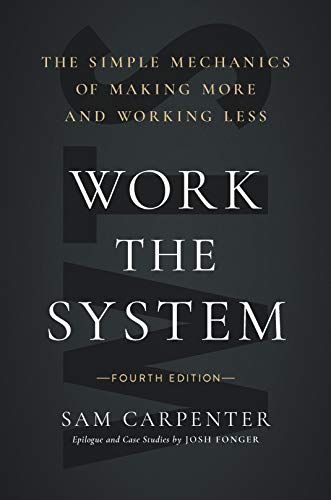
Work the system
Introduction: The Midnight Awakening
Introduction: The Midnight Awakening
Nova: Welcome back to the show. Today, we are diving into a book that promises a radical shift in how you approach work, chaos, and control: Sam Carpenter’s "Work the System." And I mean radical. Imagine spending fifteen years in a business nightmare, working a hundred-hour week, just barely keeping your head above water, only to have a single, midnight insight change everything. That’s the origin story here.
Nova: : That’s intense. Fifteen years of grinding, and the solution comes in a flash of inspiration at 12 AM? It sounds like the plot of a business thriller. What was the core realization that hit him in the dark that suddenly made the next fifteen years of struggle make sense?
Nova: The realization was deceptively simple, yet profound. Carpenter realized he wasn't failing because he was a bad manager, or because the market was wrong, or because his employees were incompetent. He was failing because he was constantly fighting symptoms instead of fixing the underlying structure. He realized his entire business, Centratel, was a collection of broken, undocumented, and poorly connected processes. He wasn't running a company; he was running a perpetual fire drill. The insight was: Stop fighting the fires. Start fixing the furnace.
Nova: : Fixing the furnace. I like that analogy. It immediately frames the problem as structural, not personal. So, this book isn't just about productivity hacks or time management tricks, is it? It’s about a fundamental philosophical pivot.
Nova: Exactly. It’s a manifesto for what Carpenter calls the Systems Mindset. It’s about achieving freedom—the freedom to make more money and work less—by building structures that operate without your constant intervention. It’s the difference between being the mechanic who has to personally tighten every bolt on every car that rolls in, versus being the engineer who designs the assembly line so the bolts tighten themselves perfectly every time.
Nova: : That assembly line analogy really lands. Most of us, especially entrepreneurs or managers, feel like we’re constantly under the hood, covered in grease. So, the promise here is to step back and become the architect. But what exactly constitutes a 'system' in Carpenter's world? Is it just a flowchart, or is it something deeper?
Nova: It’s deeper. We’re going to break down that definition in our first core chapter. But first, let’s set the stage. This book is famous for being brutally practical. Carpenter doesn't offer theory; he offers mechanics. He claims his method is simple, mechanical, and requires no political maneuvering. That’s a huge claim in any organization. We’ll explore if that mechanical approach holds up when dealing with messy human beings. Stay with us, because next, we dissect what a system truly is, according to Sam Carpenter.
Key Insight 1: The Static and Dynamic View
Defining the Machine: What is a System?
Nova: Welcome back. We’re deep into the philosophy of "Work the System." Alex, before we get to the steps, we have to nail down the definition. Carpenter says a system is an enclosed entity with numerous spinning wheels, all contributing to a singular purpose. What struck me most was the dual nature he assigns to it: the static view and the dynamic view.
Nova: : That’s where my brain started to fog a little. The static view seems easy—it’s the process as it exists right now, the flowchart on the wall. But what is the dynamic view? Is that the system in motion?
Nova: It’s more than just motion. The static view is the snapshot: the current documented process, or even the undocumented process that everyone follows by habit. It’s the 'as-is.' The dynamic view, however, is how that system evolves over time, through both planned change—like when you implement a new step—and unplanned adaptations—like when someone finds a shortcut that everyone starts using because it’s faster, even if it’s technically wrong.
Nova: : Ah, so the dynamic view captures the reality of human behavior overriding the ideal documentation. That’s crucial. If you only fix the static snapshot, the dynamic reality will immediately break your fix. It’s like patching a leaky pipe without realizing the water pressure has been slowly increasing for years.
Nova: Precisely! And this is where Carpenter’s background in the telephone answering service, Centratel, becomes relevant. He wasn't just dealing with paperwork; he was dealing with real-time customer interactions. A system failure meant a missed call, which meant a lost client. He found that his company was a 'system of systems.' Every department—sales, billing, dispatch—was its own system, and they all had to interface seamlessly.
Nova: : That concept of nested systems is powerful. If my sales system is perfect, but it dumps unqualified leads into a poorly documented marketing system, the whole thing fails. It’s like having a Formula 1 engine connected to bicycle tires. The weakness is always at the interface.
Nova: It is. And Carpenter emphasizes that every single thing you do, from making coffee in the breakroom to closing a multi-million dollar deal, is a system. The key is recognizing that are also a system of systems. If your personal system for handling email is chaotic, that chaos leaks into your business systems. He argues that freedom comes from well-designed systems, not from working harder.
Nova: : I’m trying to apply this to my own morning routine right now. If I just decide to wake up earlier, that’s a static goal. But if I design a system—laying out clothes the night before, setting the coffee timer, blocking out the first 30 minutes for deep work—that’s working the system. It’s mechanical. But how do you actually fixing the furnace when the furnace is a massive, sprawling company?
Nova: That brings us to the core methodology, the System Improvement Process. It’s the mechanical instruction manual for moving from that chaotic dynamic view to a controlled, efficient static view. It’s a four-step cycle that Carpenter insists must be followed rigorously. It’s where the rubber meets the road, and where the real work—the work—begins. Are you ready to look at the mechanics, Alex?
Nova: : Absolutely. I need the blueprint. Let’s move from the abstract philosophy to the concrete steps that saved Centratel.
Key Insight 2: Identify, Document, Repair, Repeat
The Blueprint: The System Improvement Process
Nova: Okay, let’s talk about the System Improvement Process, or SIP. Carpenter boils down the entire transformation into a repeatable, almost scientific cycle. The first step is critical: Identify Your Key Systems. You can’t fix everything at once. You have to prioritize the systems that cause the most pain or generate the most revenue.
Nova: : So, no trying to document the entire company in a week. It’s triage. If I’m running a software company, maybe the key systems are 'Client Onboarding' and 'Bug Reporting/Resolution.' Is that the right level of granularity?
Nova: That’s exactly the right level. Carpenter stresses that these systems must be critical. Once identified, you move to Step Two: Document the System. This is where many people quit, because documentation feels like administrative busywork. But Carpenter frames it differently: documentation is not about creating a manual for others; it’s about creating a map for so you can see the terrain clearly.
Nova: : I can see the resistance. If I’m a high-performer, I often think, 'I know how I do it.' But Carpenter’s point, I suspect, is that 'how you do it' is often inconsistent, and that inconsistency is the source of errors when you’re not there to supervise. The documentation forces standardization.
Nova: Precisely. And the documentation needs to capture the process as it happens, not as you wish it happened. He emphasizes that systems execute in a sequence—1-2-3-4 steps across time. You must map that sequence. Once you have the map, you move to Step Three: Separate, Dissect, and Repair. This is the active improvement phase.
Nova: : 'Separate and Dissect' sounds intense. What are we separating? Are we looking for bottlenecks, or are we looking for unnecessary steps?
Nova: Both, but primarily, you’re looking for the points of failure, the places where the process relies too heavily on individual memory or judgment rather than clear, mechanical instruction. Carpenter suggests you look for ambiguity. If two people can look at the documented step and execute it slightly differently, that step is broken. You repair it by rewriting the instruction until it is unambiguous and mechanical. For example, changing a step from 'Review the client file for completeness' to 'Check fields A, B, and C on the intake form; if any are blank, return to sender with required fields listed.' See the difference?
Nova: : That’s night and day. The second version is a machine instruction; the first is a suggestion to a human. It removes interpretation. And I imagine the repair process isn't a one-time fix, right? This leads us to Step Four, which I assume is the loop back.
Nova: It is the loop back, and it’s the secret sauce. Step Four is: Implement the New System and Monitor. You roll out the documented, repaired system. But you don't stop there. You monitor its performance against your desired macro result—the 'Making More and Working Less' goal. If the new system doesn't deliver the expected improvement, you go back to Step One, or more likely, Step Three, and dissect the process. It’s a continuous feedback loop.
Nova: : So, the system improvement process is inherently iterative. It’s not a project with an end date; it’s a permanent operational philosophy. This must be why Carpenter mentions that even years after implementation at Centratel, the process continues. It’s about embedding a culture of refinement.
Nova: It is. And this rigor is what separates the chaos fighters from the system builders. The pitfall here, Alex, is the temptation to skip documentation or to declare a system 'fixed' before it’s truly mechanical. Carpenter warns against being paralyzed by the 'should be' state. You must document the messy 'is' first, then iterate toward the ideal 'should be.' It’s a disciplined, almost engineering approach to management, which is why it appeals to people who crave clarity.
Nova: : It sounds like the ultimate antidote to reactive management. Instead of being a hero who solves the crisis, you become the architect who prevents the crisis from ever forming. This mechanical approach seems to offer a real sense of control. Let’s pivot in our next segment to the ultimate payoff: how does this translate into actual freedom and results for the average person or business owner?
Key Insight 3: Freedom Through Structure
The Payoff: Making More and Working Less
Nova: We’ve established the mindset and the mechanics. Now for the promised land: Making More and Working Less. This phrase is the book’s tagline, and it’s the ultimate goal of systemization. How does fixing processes actually lead to more income and less personal involvement?
Nova: : It seems counterintuitive. Usually, when I try to make more money, I have to work hours. Carpenter is suggesting that by building better systems, the revenue stream becomes less dependent on my direct, moment-to-moment labor. Is that the core mechanism?
Nova: That is the core mechanism. Think about it this way: Every time a system fails, you have to step in. That intervention costs you time, focus, and energy—that’s the 'working more' part. If your sales system consistently qualifies leads properly, you spend less time chasing dead ends. If your fulfillment system is flawless, you spend zero time apologizing for late shipments. Each successful, documented system is essentially a reliable, tireless employee working for you 24/7.
Nova: : That’s a fantastic way to frame it. The system becomes a leverage point. I remember reading a review that mentioned Carpenter’s own business turnaround. Can you share a specific example of how this translated into tangible results for Centratel?
Nova: Absolutely. The story often cited is how he tackled customer service issues. Before the system overhaul, every complex query required his personal, expert intervention. After implementing a rigorous system for logging, escalating, and resolving issues—complete with written procedures for the first, second, and third level of support—he drastically reduced the number of issues that ever reached his desk. The system absorbed the complexity. The result wasn't just fewer calls for him; it was faster resolution times for customers, which led to higher retention, which is the 'making more' part.
Nova: : So, the system improves the output quality while simultaneously reducing the input required from the owner or top talent. It’s efficiency creating capacity. But what about the personal application? Carpenter suggests this isn't just for CEOs. How does this apply to someone who doesn't own a company, maybe just manages a team or even manages their own household?
Nova: The application is universal. For a manager, it means documenting the team’s core functions so that if they take a vacation, the department doesn't collapse. For an individual, it means systemizing personal finance, health routines, or even creative workflows. If you have a system for writing, you don't stare at a blank page wondering what to do next; you execute the documented steps. The freedom isn't just about time off; it's about mental freedom from decision fatigue.
Nova: : Mental freedom is huge. The constant low-level anxiety that comes from knowing there are ten things you be doing but aren't sure where to start—that’s the chaos. The system provides a clear path forward, even when you’re tired. But I have to ask about the biggest pitfall I often see with these methodologies: complacency. Once the system is built and working well, people stop monitoring it. They get comfortable. What does Carpenter say about maintaining the dynamic view?
Nova: That’s the eternal challenge, and it speaks to the 'Repeat' part of the cycle. Carpenter is clear: systems decay. Entropy is the natural state of any organization or process. If you stop monitoring, the dynamic reality will slowly drift away from your documented static ideal. The system needs regular check-ups, not necessarily a full overhaul every week, but scheduled reviews where you ask: Is this still the most efficient way? Are we still achieving the macro result? It requires discipline to keep checking the furnace even when the house is warm.
Nova: : Discipline to keep checking the furnace. I think that’s the perfect encapsulation of the entire book. It’s not a magic pill; it’s a commitment to mechanical rigor. It demands that you stop being a hero and start being an engineer of your own life and business. It’s a profound shift from being reactive to being proactive.
Conclusion: The Path to Mechanical Freedom
Conclusion: The Path to Mechanical Freedom
Nova: We’ve covered a lot of ground today, Alex, moving from Sam Carpenter’s midnight epiphany to the rigorous, four-step System Improvement Process. If you take one thing away from this discussion about "Work the System," what is it?
Nova: : For me, it’s the absolute necessity of documentation as a tool for clarity, not just compliance. If you can’t map it, you can’t fix it. And the idea that every single task, no matter how small, is part of a larger system that needs to be optimized for the macro result—that’s the lens I’m going to start applying immediately.
Nova: I agree completely. The macro result is the key differentiator. We often get bogged down in micro-optimizations that don't move the needle. Carpenter forces us to ask: Does this process serve the ultimate goal of making more and working less? If the answer is no, the process must be dissected or eliminated. It’s about ruthless alignment.
Nova: : It’s also a very empowering message, isn't it? It removes the blame. It says, 'Your problems aren't personal failings; they are structural flaws waiting for a mechanical solution.' That shifts the energy from frustration to focused action.
Nova: It truly is empowering. It reframes chaos as solvable engineering problems. The takeaway for our listeners today is this: Identify one area of chaos in your life or business this week. Don't try to solve it with willpower. Instead, try to document the current, messy process. Just map the spinning wheels. That act of mapping, that static snapshot, is the first step toward building the mechanical freedom Carpenter promises.
Nova: : And remember that the system is dynamic. It’s always changing, so your role isn't to build a perfect statue, but to maintain a living, breathing, self-correcting machine. It requires ongoing, disciplined attention to the mechanics.
Nova: Exactly. Stop fighting the symptoms, start working the system. That’s the enduring lesson from Sam Carpenter’s journey from business nightmare to mechanical mastery. This is Aibrary. Congratulations on your growth!