

Scaling Beyond the Founder: How to Build a Business That Runs Itself.
Golden Hook & Introduction
SECTION
Nova: Atlas, I was reading this wild statistic. Apparently, 85% of small business owners consider themselves 'technicians' first. They're the ones who the work, not just manage it.
Atlas: Oh, I like that. So, not visionary leaders, but the folks who are elbow-deep in the actual production, the service delivery? Sounds like a recipe for constant firefighting and, honestly, burnout.
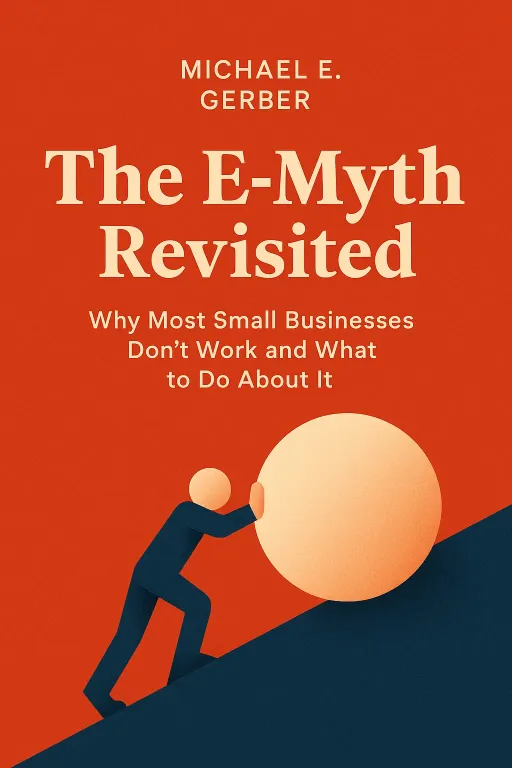
Nova: Exactly! And that's precisely what Michael E. Gerber delves into in his seminal work, "The E-Myth Revisited." It's a book that has profoundly shaped entrepreneurial thought for decades, famously challenging the very notion of what it means to 'own' a business versus 'being' the business. It’s a classic for a reason.
Atlas: And it's not just theory, right? It's about getting out of the weeds, which I imagine resonates with so many of our listeners who are trying to grow beyond their current capacity.
The Founder's Trap: Working In vs. Working On
SECTION
Nova: Absolutely. Gerber’s core argument is that most small businesses are founded by what he calls a 'technician' who suffers from an 'entrepreneurial seizure.'
Atlas: An entrepreneurial seizure? That sounds rather dramatic. What does that even mean?
Nova: It’s when a person who’s great at a particular skill—say, baking, or plumbing, or coding—decides, "Hey, I'm so good at this, I'll start my own business doing it!" They confuse being good at the work with knowing how to run a business. So, our brilliant baker, who makes the most incredible sourdough, opens her own bakery.
Atlas: And suddenly she's not just baking, she's also managing staff, ordering supplies, dealing with customer complaints, marketing...
Nova: Precisely. She’s working the business, doing all the tasks, instead of working the business, designing the systems that the business work. She’s still just a baker, but now she owns the bakery. And she's probably working 80 hours a week, making less money than she did as an employee because she's shouldering all the risk and all the tasks.
Atlas: That sounds rough. I imagine many of our listeners, especially those driven by achievement and expansion, feel that exact pinch. They want to grow, but they're so bogged down in the day-to-day that multi-truck expansion, as we often talk about, feels impossible.
Nova: It is, because the business is entirely dependent on. If she takes a vacation, the bakery grinds to a halt. If she gets sick, same thing. She hasn't created a business; she's created a job for herself, a very demanding one at that. Gerber says this is the cold, hard fact for most small businesses: they're limited by the founder's capacity.
Atlas: But wait, isn't passion good? Isn't that what drives entrepreneurs? Are you saying passion is a trap?
Nova: Not at all. Passion is crucial. But it needs to be channeled into building a that delivers that passion consistently, not just performing the task yourself. The technician's delusion is thinking their personal skill is the business model. The real entrepreneur understands that the business is the product.
Atlas: I see. So, the passion should be for building a machine that bakes amazing bread, not just for baking the bread yourself. That really shifts the emphasis, from personal output to systemic output.
Building the 'Franchise Prototype': Systematization as Liberation
SECTION
Nova: Exactly. So, if being the best baker doesn't scale, what does? Gerber’s answer, and it's a profound one, is to adopt a "franchise prototype" mindset.
Atlas: A franchise prototype? Even if you never intend to franchise?
Nova: Precisely. It means you design your business you were going to sell 1,000 franchises tomorrow. Every single process, every routine task, every interaction is documented, streamlined, and made repeatable. Think McDonald's. Ray Kroc wasn't a master chef; he was a master.
Atlas: Okay, but what does "documented processes" even look like beyond just a checklist? For someone who's already overwhelmed, that sounds like work, not less.
Nova: It's definitely an investment upfront, but it's an investment in liberation. This is where another brilliant author, Sam Carpenter, comes in with his book "Work the System." Carpenter’s own business was on the brink of collapse because he was constantly reactive, putting out fires.
Atlas: Oh, I know that feeling! That sounds like my Monday mornings sometimes.
Nova: He realized he was the problem. So, he meticulously documented in his business. From how calls were answered, how projects were managed, how invoices were sent, to even how the office was cleaned. He wasn't just making checklists; he was creating a detailed, step-by-step operational manual for every function.
Atlas: And the result? Did it actually work?
Nova: It revolutionized his business. He moved from chaos and constant stress to predictable efficiency, increased profitability, and, most importantly, freedom. His business could run perfectly without his constant intervention because the systems were the foundation. This is Nova's Take: these books don't just identify the problem; they provide an actionable blueprint for designing repeatable, scalable operations.
Atlas: That’s actually really inspiring. It means you're building an asset, not just a job. For our listeners who are growth-seekers, dreaming of that multi-truck expansion, this is how you make it happen. It’s about trusting your vision for expansion enough to build the infrastructure for it.
Nova: It’s the difference between being a brilliant chef who cooks every meal and being the owner of a restaurant chain where every meal is consistently excellent, regardless of who's in the kitchen. The system ensures the quality, the efficiency, and the scalability.
Synthesis & Takeaways
SECTION
Nova: So, what we're really talking about today is a profound shift in mindset for any entrepreneur. It’s about recognizing that the greatest barrier to your business's growth isn't usually the market, or the competition, but often the founder's inability to step back and design.
Atlas: Right. It's about moving from being the indispensable cog to being the ingenious architect of the machine. It sounds like a lot of work upfront, this documentation and system building.
Nova: It is. But Carpenter and Gerber both emphasize that this initial investment frees you from the daily grind and allows you to focus on strategy, innovation, and true expansion. It’s about building a business that can run itself. It’s about creating a business that has value independent of your daily presence.
Atlas: That gives me chills. That’s such a hopeful way to look at it – from feeling stuck to feeling truly liberated. So, for someone listening right now, feeling that founder-dependence, what's a tiny, tangible step they can take this week?
Nova: Here's the tiny step from the book content: choose just one routine task you currently do, something you do regularly. Document its steps thoroughly, as if you were writing instructions for someone who has never done it before.
Atlas: And then, imagine someone else doing it perfectly by just following your documentation. That’s a powerful thought experiment. It’s not just about delegating; it's about systematically removing yourself as the bottleneck.
Nova: Exactly. It’s the first step towards building that business that runs itself, freeing you to trust your vision for expansion and truly achieve it.
Atlas: That’s a perfect example. This is Aibrary. Congratulations on your growth!