

The Resilient Blueprint: Designing Your Life's Next Chapter
Golden Hook & Introduction
SECTION
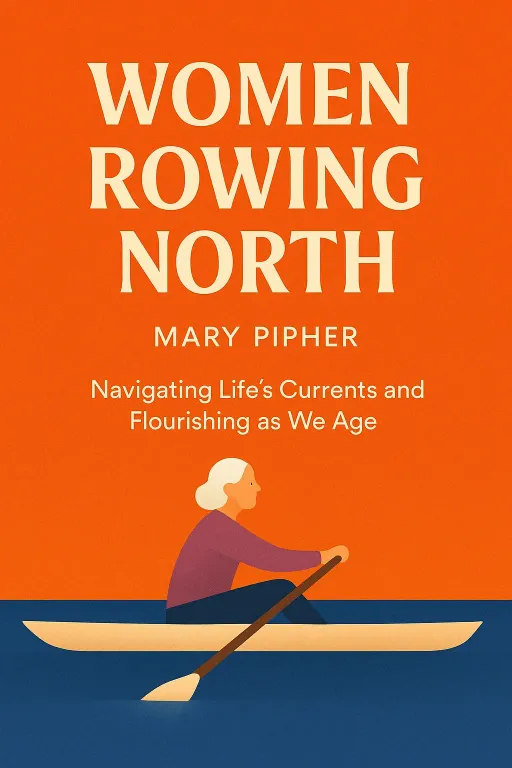
Atlas: As a product manager, you spend your days designing roadmaps for the future, meticulously planning features and user journeys. But what about the most important product you'll ever manage—your own life? What's the roadmap for that? It's a daunting question, but our guide today comes from an unexpected place: Mary Pipher's book, 'Women Rowing North'.
bsmxfzc8s9: It's true, we spend so much time optimizing products, but often leave our own lives to chance. I'm intrigued by how a book on aging could offer a roadmap for someone in their late twenties or early thirties.
Atlas: Exactly. While it's a book about navigating the later stages of life, its core wisdom is a powerful blueprint for anyone at a crossroads. Today we'll dive deep into this from two perspectives. First, we'll explore how to build resilience not as a vague trait, but as a practical, designable skill.
bsmxfzc8s9: I love that. Moving from a passive concept to an active one.
Atlas: Precisely. Then, we'll discuss the art of crafting your life's story, turning personal setbacks into your greatest strengths. We're here with bsmxfzc8s9, whose background in product design and the arts makes her the perfect person to explore this idea of life as an intentional creation. Welcome!
bsmxfzc8s9: Thanks for having me, Atlas. I'm ready to see the blueprint.
Deep Dive into Core Topic 1: Resilience as a Design Skill
SECTION
Atlas: So, let's start with this idea of resilience. We're often told to 'be resilient,' but Pipher argues it's not a personality trait. It's a skill you build. She has this wonderful phrase: 'building a good day.' bsmxfzc8s9, as a builder, what does that phrase spark for you?
bsmxfzc8s9: Oh, that immediately clicks for me. It sounds like agile methodology for your personal life. Instead of a rigid, five-year waterfall plan for happiness, you're focusing on daily sprints. What can I do to build a small, functional, joyful unit of my life? It’s iterative and much less intimidating.
Atlas: Iterative! That's the perfect word. It's about small, conscious choices. Pipher says, "Attitude is not everything, but it is almost everything." And she illustrates this with the story of a woman named Willow. Willow is a high-powered professional, very identified with her career, when her husband, Saul, is diagnosed with aggressive Parkinson's disease.
bsmxfzc8s9: That's a life-altering event. The kind that can completely derail your personal roadmap.
Atlas: Completely. And her first instinct is to manage it, to organize the apartment, to treat it like a problem to be solved. But as his condition worsens, she makes a huge choice. She decides to quit her job to care for him. But here's the key design choice—she doesn't just become a 'caregiver.' She consciously reframes her role. She decides her new job is to be a 'nurturer.'
bsmxfzc8s9: Hmm, that’s a powerful pivot. It's not just changing the tasks; it's changing the 'why.' In product management, we talk about the 'job to be done.' Her 'job' wasn't just to dispense pills or manage appointments; she redefined it as 'to cultivate love and joy in their remaining time.' That changes everything about how you'd approach the day.
Atlas: It changes everything. Pipher writes that Willow starts each day asking, 'What would make us happy today?' She focuses on making him his favorite meals, telling him jokes, playing gin rummy. She chooses her attitude and, in doing so, designs a new, meaningful reality for them both, even in the face of tragedy. She builds good days, one at a time.
bsmxfzc8s9: That's incredibly proactive. It’s not about passively enduring the situation. It's about actively designing the experience within the constraints you're given. That's the essence of good design, really. You don't always have ideal conditions, but you can create something beautiful and functional anyway.
Atlas: And that's the skill of resilience Pipher is talking about. It’s not about ignoring the pain, but about intentionally building moments of joy and purpose right alongside it.
Deep Dive into Core Topic 2: Life as a Narrative Product
SECTION
Atlas: Exactly. It's about changing the 'why.' And that leads perfectly to our second idea, which is that we are the storytellers of our own lives. Pipher says we can't change the past—the facts, the events—but we can absolutely change the stories we tell about it.
bsmxfzc8s9: This feels very connected to self-confidence and motivation. The story you tell yourself dictates how you feel and what you believe you're capable of.
Atlas: Absolutely. Pipher has this stunning metaphor. She talks about an artist who, after Hurricane Sandy, walked along the beaches of New York. The storm had destroyed homes and businesses, leaving nothing but wreckage. But this artist didn't see trash. She saw raw material. She gathered the broken, jagged, splintered pieces of wood from destroyed houses and formed them into these beautiful, intricate, quilt-style works of art.
bsmxfzc8s9: Wow.
Atlas: Right? Pipher's point is that we can do the same with the broken pieces of our lives. We can take the wreckage—the failures, the heartbreaks, the traumas—and craft them into a new, resplendent narrative.
bsmxfzc8s9: That's... everything. It's the ultimate act of creation. You know, it reminds me so much of Taylor Swift, who I'm a huge fan of. In 2016, the public narrative around her became incredibly toxic. She was branded a 'snake,' a manipulator. She could have just disappeared. But she didn't. She took all that 'wreckage'—the snake emojis, the media criticism, the betrayal—and she built the 'Reputation' album and tour. She literally turned the poison into the product. She crafted a new, more powerful narrative of survival and strength.
Atlas: That is a perfect modern example! It’s taking the story that's being told you and seizing the pen to tell the story you. Pipher gives a smaller, more everyday example too. A woman named Linda is writing a summary of her life for her 50th high school reunion. Her first draft is just a list of failures: a divorce, a lost job, struggles. Her husband reads it and says, 'Linda, you've only told half the story. What about your career successes? Your new horseback riding hobby?' He helps her see she can choose which data points to highlight.
bsmxfzc8s9: It's like A/B testing your own life story. Version A is the 'problem-saturated narrative,' as Pipher calls it. Version B includes the data on resilience and growth. Of course Version B is going to perform better for your own mindset.
Atlas: Exactly. It's a conscious choice of what to focus on.
bsmxfzc8s9: This is fascinating, but it brings up a question for me. As a product manager, I have to be honest about the data. I can't just ignore user complaints or bugs. So, where is the line between crafting a positive narrative and just engaging in self-deception or toxic positivity?
Atlas: That is the critical question, and it's one Pipher addresses directly.
Synthesis & Takeaways
SECTION
Atlas: And her answer is that functional, healthy stories are always based in reality. They have to include both the good the bad. Think about the Hurricane Sandy artist—she used the wood. The beauty of her art came from the fact that it was made of wreckage. It's not about pretending the hurricane didn't happen. It's about acknowledging it and creating something new from it.
bsmxfzc8s9: So it's about integration, not erasure. You don't delete the 'bug report' from your life, you add a note about how you fixed it, or what you learned from it. The story becomes richer because of the challenge, not in spite of it.
Atlas: Precisely. So, to bring it all together, we've seen from "Women Rowing North" that we can be the architects of our experience by intentionally building our days, and we can be the authors of our identity by consciously crafting our stories.
bsmxfzc8s9: Right. It's about being both the engineer and the storyteller of your own life. You build the foundation with resilient habits, and you write the story that gives it all meaning. It’s a really empowering framework, no matter what stage of life you're in.
Atlas: Perfectly said. So, for everyone listening, here's the challenge, the takeaway from today. Think about your own life or career. What's one 'problem-saturated' story you tell yourself? Maybe a project that failed, a relationship that ended, or a goal you missed.
bsmxfzc8s9: And once you have that story in your head...
Atlas: Ask yourself: what's one small detail of strength, learning, or resilience from that very same experience that you could add to the story, starting today, to begin crafting a more resplendent narrative?
bsmxfzc8s9: I love that. It's a small, actionable step. The first edit in creating your new story.
Atlas: The first edit. A great way to put it. bsmxfzc8s9, thank you for bringing such a sharp, creative perspective to this.
bsmxfzc8s9: This was so much fun. Thank you, Atlas. It's given me a lot to think about for my own life's 'product roadmap.'









