

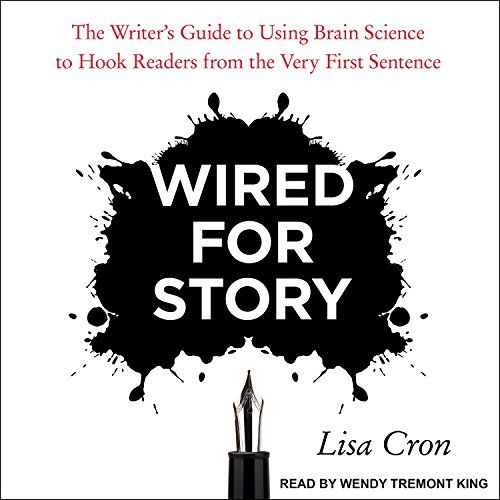
Wired for story
Introduction
Nova: Did you know that we spend nearly half of our waking hours daydreaming? It sounds like a massive waste of time from an evolutionary standpoint, right? But according to Lisa Cron, the author of Wired for Story, those daydreams and the stories we consume are actually essential for our survival. She argues that we are not just fans of stories; we are literally hardwired for them.
Atlas: Wait, half of our lives? That is a staggering amount of time to spend inside our own heads. I always thought of stories as a luxury, like a nice dessert after the real work of living is done. You are telling me my brain thinks a Netflix binge is as important as finding food or shelter?
Nova: In a way, yes. Cron explains that story was the first virtual reality. Before we had computers, we had narrative. It allowed our ancestors to simulate dangerous situations without actually being in danger. If you hear a story about a guy who got eaten by a tiger because he took a shortcut through the tall grass, your brain processes that as a lived experience. You learn the lesson without having to face the tiger yourself.
Atlas: So, it is like a flight simulator for life. That makes a lot of sense. But if we are so naturally wired for it, why is it so hard to write a good story? Why do some books keep us up until 3:00 AM while others make us fall asleep by page ten?
Nova: That is exactly what we are diving into today. Lisa Cron uses neuroscience to break down the specific cognitive secrets that hook our brains. She argues that most of what we are taught about writing is actually wrong because it focuses on the surface level rather than how the brain actually processes information. We are going to look at why the internal journey of a character matters more than the external plot and how you can use brain science to make any narrative unputdownable.
Atlas: I am ready. If there is a secret blueprint in my brain for what makes a story work, I definitely want to see it. Let us get into the science of why we can't look away.
Key Insight 1
The Evolutionary Flight Simulator
Nova: To understand why stories work, we have to look at how our brains evolved. Cron points out that for 99 percent of human history, we lived in a world where a single mistake could be fatal. Information was the difference between life and death. But raw data is hard to remember. If I tell you a list of poisonous berries, you might forget half of them. But if I tell you a story about your cousin who turned purple and died after eating the little blue ones by the river, you will never forget it.
Atlas: Right, because the story gives the data a context. It gives it an emotional weight. I can see the purple face, I can feel the fear. It is not just a fact anymore; it is a memory I haven't even lived yet.
Nova: Exactly. This is what neuroscientists call neural coupling. When you hear a well-told story, the same areas of your brain light up as if you were actually doing the things the character is doing. If the protagonist is running, your motor cortex activates. If they are smelling fresh bread, your olfactory cortex fires. Your brain does not distinguish between a story and reality in terms of the lessons it learns.
Atlas: That is wild. So when I am watching a thriller and my heart is racing, my brain actually thinks I am the one being chased? It is not just empathy; it is a full-on physical reaction.
Nova: It is. And Cron argues that the brain is constantly scanning for one thing in every story: what can I learn from this to help me survive? This is why we get bored when a story is just a series of events. If there is no point, if there is no lesson for our survival, our brain shuts down to save energy. We are cognitive misers. We don't want to spend calories on information that doesn't matter.
Atlas: So that is why those slow-burn movies sometimes feel like a chore. My brain is basically saying, hey, there is no tiger here, can we go do something else? But how does the brain decide what is worth paying attention to? Is it just about danger?
Nova: Not just physical danger, but social and emotional danger too. We are social animals. Losing our status in a tribe was just as deadly as a tiger back in the day. So, stories about betrayal, love, and social navigation are just as vital. The brain is looking for the answer to the question: what would I do in that situation? If a story doesn't present a clear problem that needs solving, the brain loses interest immediately.
Atlas: So the first rule of being wired for story is that the story has to be a problem-solving exercise. It is not about the beautiful descriptions of the sunset; it is about whether the character is going to get home before the sun goes down and the monsters come out.
Nova: Spot on. Cron says that the brain doesn't care about the prose. It cares about the point. She has this great line where she says that if the reader isn't wondering what happens next, they aren't reading, they are just looking at words. The story is the underlying logic, not the decorative language used to tell it.
Key Insight 2
The Third Rail of Storytelling
Nova: One of the biggest mistakes writers make, according to Cron, is focusing too much on the plot. You know, the external stuff. The car chases, the explosions, the big wedding. But she argues that the plot is just the surface. The real heart of a story is what she calls the Third Rail.
Atlas: The Third Rail? Like the high-voltage track on a subway? That sounds dangerous.
Nova: It is dangerous for the character! The Third Rail is the protagonist's internal journey. It is the internal conflict that runs beneath the plot. Cron says that a story is not about what happens; it is about how what happens affects someone who is trying to achieve a difficult goal and how they change as a result.
Atlas: Okay, so if a guy is trying to defuse a bomb, the bomb is the plot. But the Third Rail might be his fear that he is never as good as his father, who was a legendary bomb tech?
Nova: Exactly! If he just defuses the bomb because he is a pro, it is an action sequence. It might be cool for a minute, but we won't remember it. But if he has to overcome his deep-seated feeling of inadequacy to save the city, then we are hooked. We want to see if he can change his mind about himself. Cron calls this the protagonist's wrongheaded belief.
Atlas: The wrongheaded belief. I like that. So every main character starts with a flawed view of the world?
Nova: Yes. Usually, it is a defense mechanism they developed because of something that happened in their past. Maybe they believe that you can't trust anyone, or that they are only valuable if they are successful. The entire plot of the story is actually a series of events designed by the author to force the character to confront that belief and realize it is wrong.
Atlas: That changes everything. So the plot isn't just a random series of obstacles. It is a targeted attack on the character's worldview. It is like the universe is conspiring to make them grow up.
Nova: That is a perfect way to put it. The brain is wired to track change. We want to see how people transform. If the character stays the same from page one to page three hundred, our brain feels cheated. We didn't learn anything. We didn't see a new way of being.
Atlas: I am thinking about some of my favorite stories now. In Jaws, Chief Brody isn't just fighting a shark. He is a guy who is afraid of the water. The shark is just the thing that forces him to get on a boat and face his fear. If he loved the ocean, the movie would be half as interesting.
Nova: Precisely. The external goal is to kill the shark, but the internal goal is to overcome the fear. Cron points out that the internal goal is what creates the suspense. We aren't just worried about the shark's teeth; we are worried about Brody's resolve. When the internal and external goals clash, that is where the electricity comes from. That is the Third Rail.
Key Insight 3
The Logic of Cause and Effect
Nova: Now, let us talk about the structure of a story. A lot of people think a story is just a sequence of events. This happened, then that happened, then this other thing happened. But Cron says the brain hates that. The brain craves cause and effect.
Atlas: You mean like, because this happened, then that had to happen?
Nova: Exactly. She uses the phrase and so instead of and then. If you can say and then between your scenes, you don't have a story; you have a list. A story must be a chain of events where each link is forged by the one before it. If the protagonist makes a choice in chapter two, the consequences of that choice must be what drives chapter three.
Atlas: It sounds like a row of dominoes. If you push the first one, the rest have to fall in a specific order. If one domino is too far away and doesn't get hit, the whole thing stops.
Nova: That is a great analogy. And the reason our brains are so obsessed with this is because we are survival machines. We need to understand the consequences of actions. If the world in a story is random, our brain can't learn anything from it. Randomness is the enemy of story. Even if something unexpected happens, it has to make sense in hindsight. It has to be inevitable but unexpected.
Atlas: I have definitely felt that frustration in movies where a character just gets lucky or a random storm happens to save the day. It feels like cheating. My brain goes, well, I can't use this information because I can't count on a random storm to save me in real life.
Nova: Exactly! That is the cognitive secret. We are looking for the logic of human behavior. Cron also talks about the importance of the Aha! moment. This is when the character finally connects the dots and realizes their wrongheaded belief is holding them back. But for that moment to work, the author has to lay the groundwork through cause and effect.
Atlas: So you can't just have a character wake up and decide to be better. They have to be beaten down by the consequences of their own bad choices until they have no other option but to change.
Nova: Right. And this leads to what Cron calls the So What factor. Every time something happens in a story, the reader is subconsciously asking, so what? How does this affect the protagonist's quest? If the author spends three pages describing a beautiful garden but that garden doesn't change the character's situation or their mindset, the reader's brain will check out.
Atlas: It is harsh, but it makes sense. We have limited attention. Why waste it on a garden if there is no snake in it? Or at least a secret buried under the roses.
Nova: Exactly. Everything in a story must be there for a reason. Cron argues that the brain is a meaning-making machine. We are always looking for patterns. If an author puts a detail in, we assume it is a pattern. If it turns out to be nothing, we feel like the author lied to us. It breaks the trust between the storyteller and the brain.
Key Insight 4
The Power of Specificity
Nova: One of the most famous pieces of writing advice is show, don't tell. But Lisa Cron takes this a step further using neuroscience. She explains that the brain cannot process generalities. If I tell you a character is sad, your brain doesn't really do much with that. It is an abstract concept.
Atlas: Right, sad could mean anything. It could be a single tear, or it could be staying in bed for a week eating ice cream. It is too vague.
Nova: Exactly. But if I tell you that the character's throat tightened and they found themselves staring at the unwashed coffee mug their late husband left on the counter, your brain starts to simulate that. You see the mug, you feel the tightness. This is because the brain processes specific sensory details by activating the same regions it uses to perceive the physical world.
Atlas: So, specificity is the key to that neural coupling you mentioned earlier. The more specific the detail, the more the brain believes it is actually happening.
Nova: Yes, but there is a catch. The details have to be relevant. Cron warns against what she calls window dressing. You shouldn't just add details to be descriptive. You add details that reveal the character's internal state. The coffee mug isn't just a mug; it is a symbol of the character's grief and their inability to move on.
Atlas: That makes the show, don't tell rule much clearer. It is not just about being visual; it is about being emotionally specific. It is about showing the internal through the external.
Nova: Precisely. Cron also talks about the concept of the cognitive secret of curiosity. Our brains are designed to hate an unanswered question. When there is a gap between what we know and what we want to know, it creates a physical itch in the brain. This is why cliffhangers work. We literally cannot rest until that gap is closed.
Atlas: I know that itch well. It is why I say just one more episode at midnight and then suddenly it is 4:00 AM. My brain is demanding that the dopamine hit of the answer.
Nova: And that dopamine is key! When we are curious, our brain releases dopamine to keep us focused. A good writer knows how to open those curiosity gaps and keep them open just long enough. But if you open too many and never close them, the reader gets frustrated and quits. It is a delicate balance of giving the brain enough information to stay oriented but not enough to be satisfied.
Atlas: It is like a trail of breadcrumbs. You have to keep the reader hungry enough to keep walking, but you have to give them a crumb every now and then so they don't starve and give up.
Nova: That is a perfect way to look at it. And the biggest breadcrumb of all is the protagonist's internal struggle. We stay for the plot, but we crave the resolution of that internal conflict. We want to see that character become whole.
Conclusion
Nova: We have covered a lot of ground today. From the evolutionary roots of story as a survival tool to the high-voltage power of the Third Rail and the necessity of cause and effect. Lisa Cron's Wired for Story really challenges us to stop thinking about writing as an art form and start thinking about it as a biological necessity.
Atlas: It has definitely changed how I look at the books I read and the movies I watch. I am going to be looking for that wrongheaded belief in every character now. It makes so much sense that we are looking for lessons in every narrative. We are all just trying to figure out how to be human and how to survive this crazy world.
Nova: That is the ultimate takeaway. Story is the language of the brain. It is how we make sense of the chaos. If you can understand the hardwired expectations of the reader's brain, you can communicate anything. Whether you are writing a novel, giving a presentation, or just telling a joke at dinner, remember that your audience is looking for a problem to solve and a reason to care.
Atlas: And if you don't give them one, their brain will go right back to daydreaming about those purple berries. This has been a fascinating deep dive, Nova. I think I am going to go look at my own life's plot and see if I can find my own wrongheaded belief.
Nova: That is the best kind of story to work on. Thank you for joining us on this journey into the storytelling brain. If you enjoyed this, check out Lisa Cron's book for even more cognitive secrets.
Nova: This is Aibrary. Congratulations on your growth!