The Physics of Balance: Why Overwork is a Bad Prescription for Body and Mind
Golden Hook & Introduction
SECTION
Albert Einstein: Imagine a locomotive chugging along at maximum speed, throwing all its coal into the furnace. It looks magnificent, does it not? Powerful, unstoppable, a triumph of engineering. But what happens when the water in the boiler runs completely dry? The engine does not just gently slide to a halt. No, the metal warps, the pressure builds, and the entire system melts down. Today, my friends, we are that locomotive. We stoke the fire of our careers, but we forget that even the most powerful engine is bound by the laws of thermodynamics.
Büşra Bayıroğlu: That is such a vivid image, Albert. And as a dietitian, I see this exact meltdown happening in people's bodies every single day. We treat our physical selves like machines with infinite fuel tanks, completely ignoring our biological limits. We think we can negotiate with our biochemistry, but biology always wins in the end.
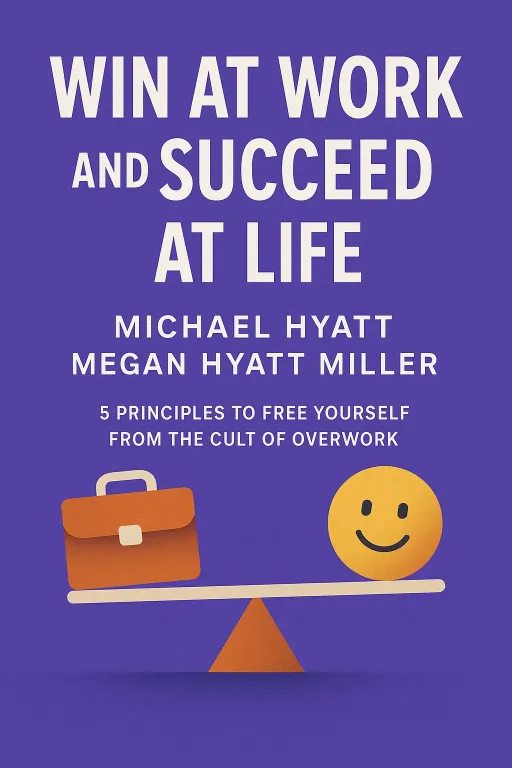
Albert Einstein: Ah, yes! Nature does not take bribes, does she? Today, we are diving into a wonderful book by Michael Hyatt and Megan Hyatt Miller called. We are going to tackle this text from two very distinct perspectives. First, we will explore the biological toll of what the authors call the Hustle Fallacy—why our bodies and minds are simply not built for infinite work. And second, we will discuss the liberating power of constraints, and why rest is actually the ultimate engine of creativity and productivity.
Büşra Bayıroğlu: I love that we are framing it this way. It is not just about time management; it is about energy management and respecting our design. I am so excited to connect these dots with you, Albert.
Albert Einstein: Excellent! Let us begin our thought experiment.
Deep Dive into Core Topic 1
SECTION
Albert Einstein: Let us start with a story from the book that illustrates the extreme end of this locomotive meltdown. The authors introduce us to a man named Kyle. Now, Kyle was a highly successful serial entrepreneur. He led a team of over three hundred people, grew his business to a staggering one hundred million dollars, and was constantly on the move. Fifty percent of his time was spent traveling. He was driven by massive expectations and, deep down, a desire to impress his father. But one evening, while dining at a seafood restaurant in West Palm Beach, the boiler ran dry. Kyle grew dizzy and collapsed.
Büşra Bayıroğlu: Oh, I remember reading this. It was terrifying. His colleagues took him back to his hotel, but later he was found unconscious in a pool of blood. When they rushed him to the emergency room and put him in an MRI machine, his breathing actually stopped. He had to be revived in the intensive care unit.
Albert Einstein: Yes! A literal near-death experience. It was a brutal, sobering wake-up call. Kyle had what we might call a "come to Jesus" moment. He realized that this frantic pace was entirely unsustainable. Now, from a physiological standpoint, Bra, what is actually happening to a person like Kyle before they hit the floor?
Büşra Bayıroğlu: Well, Albert, Kyle was living in a state of chronic sympathetic nervous system dominance—what we commonly call "fight or flight." When you are constantly working, traveling, and stressing, your adrenal glands are pumping out cortisol and adrenaline non-stop. In the short term, cortisol is great; it helps you survive a threat. But chronically high cortisol levels wreck your body. It increases blood pressure, disrupts glucose metabolism, suppresses the immune system, and causes systemic inflammation.
Albert Einstein: Ah, so the body is essentially borrowing energy from its own structural integrity! It is like running a heat engine far past its maximum thermal limit without ever letting the heat dissipate.
Büşra Bayıroğlu: Exactly! And the data in the book backs this up beautifully. They cite research showing that people who work more than fifty-five hours a week raise their risk of a heart attack by thirteen percent, and their risk of a stroke by a whopping thirty-three percent compared to those working a standard thirty-five to forty hours. It is a direct physical correlation.
Albert Einstein: That is a staggering statistic. Thirty-three percent! It makes one wonder why we worship this "Cult of Overwork." The authors define this cult as a pervasive belief system that devalues rest and insists that work must be the primary focus of human existence. But it is a flawed equation. In physics, if you increase the input of energy into a closed system without a mechanism for cooling, you get entropy—disorder, breakdown.
Büşra Bayıroğlu: And it is not just physical breakdown, Albert. It is relational breakdown too. The book shares Michael Hyatt's own personal wake-up call. Years ago, he was rising through the ranks in the publishing industry, working insane hours, arriving at the office at five in the morning, working Saturdays. He received a massive bonus check and came home expecting a celebration. But his wife, Gail, was subdued. She looked at him and said, "Honestly, I feel like a single mom." She told him that even when he was physically home, he was not truly present for their five daughters.
Albert Einstein: That is a different kind of entropy, is it not? The decay of our most precious human connections. Michael was suffering from the "Hustle Fallacy"—the belief that the only way to solve the pressure of work is to work harder and longer. But as my friend Andy Stanley says, "Direction, not intention, leads to destination." If you are walking toward a cliff, intending to go to the mountains will not save you from the fall. You must change your direction.
Büşra Bayıroğlu: Yes! And the other trap the authors mention is the "Ambition Brake," where people get so burned out that they just throttle back their careers entirely, sacrificing their potential and their income because they think it is an either-or choice. But Michael and Megan argue there is a third option: the "Double Win," where work and life actually complement each other.
Albert Einstein: Yes, a beautiful symmetry! Just as the earth needs both day and night, our lives need both productive output and restorative input. They are not opposing forces; they are part of a singular, dynamic cycle.
Deep Dive into Core Topic 2
SECTION
Albert Einstein: This brings us to our second core idea: the liberating power of constraints. Now, this sounds like a paradox, does it not? How can a limit make us free? But think of a river. If you remove the banks of a river, it does not become a glorious, free body of water. No, it becomes a stagnant swamp. The banks—the constraints—are what give the river its force, its direction, and its beauty.
Büşra Bayıroğlu: I love that analogy, Albert! In the book, Megan Hyatt Miller shares her own experience with this. When she and her husband adopted two young boys from Uganda who had experienced significant trauma, they required immense care and therapy. Megan was offered the position of Chief Operating Officer at her father's company, which was a massive career opportunity. But she faced what seemed like an impossible choice between her career and her family.
Albert Einstein: Ah, the classic dilemma. But instead of accepting the dilemma, she introduced a constraint!
Büşra Bayıroğlu: Yes! Inspired by a female CEO she heard at a conference, Megan accepted the COO role on one strict condition: she would leave the office every single day at three o'clock in the afternoon to pick up her kids from school. No exceptions. She set a hard edge on her workday. And you know what? The business did not collapse. In fact, it thrived, and so did her family.
Albert Einstein: It is magnificent! By limiting the time available, she forced herself and her team to become highly efficient. There is a law in sociology called Parkinson's Law: "Work expands so as to fill the time available for its completion." But the inverse is also true! Work contracts to the time permitted. If you give yourself eight hours to complete a task, it will take eight hours. If you give yourself three, you find a way to get it done in three.
Büşra Bayıroğlu: It is so true. And the research they cite from Stanford is mind-blowing. Researchers found that productivity actually plummets after fifty hours of work per week. In fact, workers who put in seventy hours produce absolutely nothing more during those extra twenty hours! They are just spinning their wheels, making mistakes, and burning precious metabolic energy.
Albert Einstein: They are generating heat, but no work! In physics, we call that low efficiency. And for knowledge workers, the limits are even tighter. The book mentions a study of Microsoft employees showing that out of a forty-five hour workweek, only twenty-eight hours were actually productive. That is just under six hours a day of high-level cognitive focus. The brain is a highly metabolic organ, Bra. It consumes a massive amount of glucose, does it not?
Büşra Bayıroğlu: Oh, absolutely! The brain accounts for about twenty percent of the body's energy consumption, even though it is only two percent of our body weight. High-level decision making, problem solving, and creative thinking require an immense amount of cellular energy. When you push past those six hours of intense cognitive work, your brain literally runs out of fuel. You start experiencing decision fatigue, your working memory suffers, and your ability to make lateral, creative connections drops to zero.
Albert Einstein: This is why we need what the authors call "white space"—periods of intentional non-achievement. They share the story of Tamara, an employee who was temporarily placed in a role with very few responsibilities. She had hours of unstructured time where her mind could just wander. During this "idle" time, she looked at the company's billing system and conceived a completely new way to restructure it. That single idea, born out of doing "nothing," saved the business ten million dollars!
Büşra Bayıroğlu: Ten million dollars! That is the power of the default mode network in the brain. When we stop focusing on a specific task, our brain doesn't just shut down; it starts connecting disparate pieces of information, solving complex problems in the background. But you have to give it the quiet space to do that. If you are constantly checking emails or sitting in meetings, you block that creative lightning.
Albert Einstein: Yes! Idleness is not a luxury; it is a working condition. Even Google recognized this with their famous "twenty percent time" policy, allowing engineers to spend one day a week on side projects with no set goals. That unstructured time birthed Gmail, Google News, and Google Translate!
Büşra Bayıroğlu: It is incredible. But to make this work, we have to talk about the absolute foundation of rest: sleep. The book has a whole chapter called "Rethinking Sleep," and as a healthcare professional, this is my favorite part. We live in a culture that glorifies sleep deprivation. People brag about sleeping four or five hours a night, as if it is a badge of honor.
Albert Einstein: Ah, yes. My friend Susan Wise Bauer once said, "The larger the boast, the smaller the truth." To brag about sleep deprivation is to brag about self-sabotage!
Büşra Bayıroğlu: It really is. The book tells the story of Tanya, a CEO of a manufacturing company. She was depriving herself of sleep to balance her demanding job and her daughter's volleyball schedule. She convinced herself she was fine, but then her company hit a financial crisis, and she realized she couldn't think clearly enough to solve it. She was completely exhausted. And Michael Hyatt shares his own cautionary tale—the "Lake Waco Incident." When he was seventeen, after a night of drinking and zero sleep, he tried to evade a police officer on a Saturday night. He escaped with a warning, but it taught him a lifelong lesson about how sleep deprivation completely destroys your judgment.
Albert Einstein: Indeed. Neuroscientist Tara Swart, whom they quote, says that losing a night of sleep is like "operating as if you have a learning disability." In fact, studies show that being awake for seventeen to nineteen hours straight impairs your cognitive performance to the same level as having a blood alcohol concentration of point-zero-five percent! We would never let a CEO run a company meeting drunk, yet we applaud them for running it sleep-deprived.
Büşra Bayıroğlu: It is a biological disaster! During deep sleep, our brain activates the glymphatic system. Think of it as a waste clearance system. The space between brain cells increases, allowing cerebrospinal fluid to literally flush out toxic waste products, including beta-amyloid proteins, which are linked to Alzheimer's disease. If you don't sleep, you are quite literally leaving metabolic trash in your brain.
Albert Einstein: Fascinating! So sleep is not just a passive state of inactivity; it is an active, biological cleaning process. It is the ultimate investment. The Rand Corporation actually found that the United States loses up to three percent of its total GDP every year due to sleep deprivation. That is over four hundred billion dollars lost because we refuse to close our eyes!
Büşra Bayıroğlu: It is mind-boggling. We are literally paying a premium to destroy our health and our productivity.
Synthesis & Takeaways
SECTION
Albert Einstein: So, how do we escape this gravity well of overwork? The authors suggest five core principles to achieve the Double Win. First, recognize that work is only one of many life domains. Second, embrace constraints to foster productivity. Third, understand that work-life balance is dynamic, not static. Fourth, appreciate the value of non-achievement and hobbies. And fifth, treat rest as the foundation of all meaningful work.
Büşra Bayıroğlu: And they provide such practical exercises for this. They suggest scheduling your "nonnegotiables" first. Instead of filling your calendar with work and trying to squeeze life into the margins, you block out your sleep, your exercise, your family dinners, and your hobbies. Then, you fit your work into the remaining constraints.
Albert Einstein: Yes! You design the container first, and then you let the liquid fill it. It requires us to be, as the authors say, "militantly on our own side." We must challenge the "corporate Stockholm Syndrome" where we defend the very work cultures that are killing us.
Büşra Bayıroğlu: I love that phrase, "militantly on our own side." For me, as a young dietitian, it means realizing that I cannot give high-quality care to my patients if my own physical and mental reserves are depleted. Self-care is not selfish; it is the prerequisite for caring for others.
Albert Einstein: Beautifully said, Bra! If you want to shine light on others, you must keep your own lamp filled with oil.
Büşra Bayıroğlu: Exactly. So, to our listeners today, we want to leave you with a challenge. Look at your calendar for the upcoming week. Have you scheduled your rest? Have you set a hard boundary for when your workday ends—a "three o'clock" of your own?
Albert Einstein: Yes! Try this thought experiment: pretend you only have six hours a day to do your work. How would you change your focus? What would you delegate, automate, or simply eliminate? You might find that the constraint is exactly what unlocks your genius. After all, space and time are relative, but your energy is finite. Protect it, cherish it, and let it carry you to your own Double Win.
Büşra Bayıroğlu: Thank you, Albert. This has been an incredibly nourishing conversation.
Albert Einstein: The pleasure was entirely mine, Bra. Until next time, keep wondering, keep resting, and keep succeeding!