Beyond the Hype: Understanding the True Drivers of Economic Growth
Golden Hook & Introduction
SECTION
Nova: What if the very idea of 'pulling yourself up by your bootstraps' is a brilliant illusion, masking a deeper, almost mathematical truth about how wealth actually accumulates? And what if your business success is less about sheer grit and more about the invisible scaffolding around you?
Atlas: Whoa, Nova. That's a pretty heavy opening. Are you saying my morning coffee isn't enough to conquer the world? Because I really need it to be.
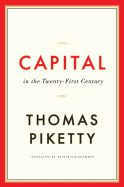
Nova: I'm saying it's a start, Atlas, but there are forces far more profound than caffeine at play. Today, we're diving beyond the immediate market trends to uncover the true, long-term drivers of economic growth. We're drawing insights from two monumental books: Thomas Piketty's "Capital in the Twenty-First Century," a work renowned for its massive, centuries-spanning historical data, and Daron Acemoglu and James A. Robinson's "Why Nations Fail," which offers an interdisciplinary look at political and economic institutions.
Atlas: Okay, so we're talking about the deep currents, not just the surface waves. I feel like a lot of us, especially in business, we're so focused on the next quarter, the next product launch. This sounds like an invitation to zoom out, way out.
Nova: Precisely. It’s about gaining a clearer lens on future opportunities and challenges, by understanding the foundational shifts and structures that dictate the game itself.
The Inevitable Gravity of Capital
SECTION
Nova: So, let's start with Piketty. His core, and frankly, revolutionary insight, boils down to a simple formula: r > g.
Atlas: Ah, the infamous 'r greater than g.' For those of us who perhaps slept through advanced economics, can you break that down into plain English? What exactly is 'r' and 'g' in this context?
Nova: Absolutely. 'r' stands for the average annual rate of return on capital – think investments, property, stocks, inherited wealth. 'g' is the rate of economic growth, essentially the growth of incomes and output. What Piketty, through decades of meticulous historical data from multiple countries, found was that, over long periods, 'r' consistently tends to be greater than 'g.'
Atlas: Okay, so the money you already have, the capital, grows faster than the economy as a whole, faster than most people's wages.
Nova: Exactly. Imagine you have a large inheritance invested, compounding year after year. That capital grows at, say, 5% annually. Meanwhile, the overall economy, and thus average wages, might only be growing at 1-2%. Over a single year, it might not seem like much, but over decades, over generations, that gap widens into a chasm. It’s like the rich get richer, not just because they're smarter or work harder, but because the very structure of capital accumulation favors those who already possess it.
Atlas: I hear that, but isn't that just saying rich people get richer? What's new about that? We've always known there's inequality.
Nova: The novelty, Atlas, and why Piketty's work sparked such a global debate, is that he argued this isn't an anomaly or a bug in the system, but a of capitalism when left unchecked. It challenges the assumption that free markets inherently lead to a more equitable distribution of wealth over time. His extensive research, which combed through tax records and historical archives across centuries, demonstrated this consistent pattern, moving it from a theoretical observation to an empirically proven historical trend. It’s a powerful, almost gravitational pull.
Atlas: A gravitational pull of capital. I like that. So, for a business owner, or someone with a business idea, how might this "gravity of capital" impact them five to ten years down the line? Are we talking about harder access to funding, or just a more competitive landscape?
Nova: It's both, and more profound. If capital continually concentrates, it means fewer players control more resources. For an entrepreneur, this could mean that the cost of capital — borrowing money, attracting investment — could become higher, or the terms less favorable, compared to established, capital-rich entities. It also means that the "playing field" isn't level; some are starting from a much higher altitude, with the wind at their back, simply due to inherited capital. Your brilliant idea might struggle to gain traction against incumbents who have decades of compounding capital behind them. It makes you think about who truly holds the levers of power in the economy.
Institutions: The Architects of Prosperity (or Failure)
SECTION
Nova: Well, that question of who holds the levers of power brings us beautifully to our second monumental insight, one that often acts as a counterpoint or a deeper explanation to the raw mechanics Piketty describes. This comes from "Why Nations Fail" by Daron Acemoglu and James A. Robinson. They argue that institutions, not geography, culture, or even the raw amount of capital, are the primary drivers of national prosperity.
Atlas: Institutions. So, not just the market, but the rules of the market. And the rules of governance. Can you unpack what they mean by 'institutions'? And what's the difference between an 'inclusive' and an 'extractive' one?
Nova: Absolutely. Acemoglu and Robinson, through their comprehensive interdisciplinary research spanning political science, economics, and history across countless nations, define institutions as the humanly devised constraints that structure political, economic, and social interaction. Think of them as the operating system of a society. They categorize them into two main types: inclusive and extractive. Inclusive institutions are those that allow and encourage participation by the great mass of people in economic activities, protect property rights, enforce contracts, and provide public services that foster broad opportunity.
Atlas: Okay, so a society where you have fair laws, a reliable justice system, and everyone has a shot, essentially.
Nova: Precisely. And in contrast, extractive institutions are designed to extract wealth and resources from the majority for the benefit of a small ruling elite. They concentrate power, suppress innovation, and often lack property rights or fair legal systems for the general populace. Think of North Korea versus South Korea. Same geography, same culture, but wildly different economic outcomes due to their drastically different institutional frameworks. Or historically, the contrast between the Venetian Republic, which fostered inclusive merchant institutions, versus the Ottoman Empire, which became increasingly extractive, leading to stagnation. Their work provides a powerful, evidence-based counter-narrative to long-standing environmental or cultural theories of why some nations are rich and others are poor.
Atlas: So, what you're saying is, even if you have a brilliant business idea, the institutional 'soil' you're planting it in determines whether it flourishes or withers? That's a powerful thought. It puts a lot more emphasis on the 'system' than just individual effort.
Nova: It does. It means that an entrepreneur in a country with inclusive institutions – where their property rights are protected, contracts are enforced, and there's broad access to education and finance – has a vastly different probability of success than one in an extractive system, where their innovations might be expropriated, or their business stifled by corrupt officials. It's not just about stopping corruption; it's about building a system that incentivizes broad-based innovation and risk-taking, rather than just rent-seeking by an elite.
Atlas: So, for someone launching a startup today, or thinking about expanding, this isn't just academic. It’s about understanding the fundamental environment. It’s the difference between building a house on solid bedrock versus quicksand.
Nova: Exactly. It broadens our perspective to show that individual business success isn't just about your vision or your team; it's often nested within these much larger, powerful economic and political structures.
Synthesis & Takeaways
SECTION
Nova: So, bringing these two profound insights together, we see that the long-term trends of capital, as Piketty illuminated, combined with the nature of our institutional structures, as Acemoglu and Robinson detailed, are the true architects of our economic reality. They are the 'rules of the game' that shape every market, every opportunity, and every challenge.
Atlas: It's almost like understanding these forces gives you a superpower, or at least a much clearer map. Instead of just reacting to daily headlines, you start to see the tectonic plates shifting beneath the surface.
Nova: Precisely. It’s about moving beyond the hype and understanding the fundamental principles that govern prosperity. It’s not just about you do, but and you do it, within these larger frameworks.
Atlas: So, knowing all this, how does understanding these deep currents change how you'd steer your own ship, your own business, in the next decade? It's a question that demands a lot of reflection, and it really reframes how we look at opportunity and risk.
Nova: It truly does. It empowers you to think strategically about not just your immediate market, but the broader economic and political landscape your business operates within. Understanding these forces, even if they seem daunting, gives you the agency to navigate them more effectively, to anticipate challenges, and to spot genuine, sustainable opportunities.
Atlas: That's actually really inspiring. It's a call to be a more informed, more strategic player in the global economy. I imagine a lot of our listeners are now looking at their business plans with a completely new lens.
Nova: And that's exactly what we hope for. This is Aibrary. Congratulations on your growth!