

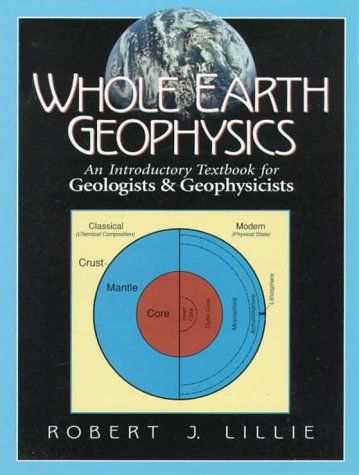
Whole Earth Geophysics
An Introductory Textbook for Geologists and Geophysicists
Introduction
Nova: Picture this: you're standing on solid ground, but beneath your feet, thousands of kilometers of rock, metal, and churning heat are shaping everything about our planet. And yet, no one has ever drilled deeper than about 12 kilometers into the Earth. So how do we actually know what's down there? That question is at the heart of today's topic — a remarkable textbook called "Whole Earth Geophysics" by Robert J. Lillie.
Nova: Fair question! Here's the thing: this isn't just any textbook. It was written by a professor at Oregon State University, Bob Lillie, who spent his career not only doing serious research on mountain ranges in Alaska, Pakistan, and the Himalayas — but also translating complex earth science for the public. He's the same guy who wrote "Parks and Plates," explaining the geology behind America's national parks. And "Whole Earth Geophysics" was his attempt to bridge a yawning gap: geologists who needed to understand geophysical data, and geophysicists who needed geological context.
Nova: Exactly. And the foreword was written by Jack Oliver, a legendary Cornell geophysicist — Lillie's PhD advisor — who warned about specialists becoming too isolated. He called this book "a welcome contribution" at bridging that gap. The core idea is simple but profound: you can't understand the whole Earth with just one tool. Seismic waves tell you one story, gravity another, magnetism another, and heat flow yet another. Only by combining them do you get the full picture.
Seeing the Unseeable
The Four Pillars of Whole Earth Geophysics
Nova: Let's start with the book's organizing principle. Lillie structures everything around four major geophysical techniques: seismology, gravity, magnetism, and heat flow. Each one is like a different lens for viewing Earth's interior.
Nova: Great instinct. Seismology is the star of the show — Lillie devotes five of his ten chapters to it. Here's why: seismic waves are the closest thing we have to X-rays for the planet. When an earthquake happens or when we set off a controlled explosion, waves travel through the Earth's interior, and by measuring how fast they arrive at different locations, we can infer the structure they passed through. It's like a CT scan, but for an entire planet.
Nova: In remarkable detail. Chapters 3 through 7 take you from the physics of elastic waves, through refraction and reflection interpretation, all the way to earthquake focal mechanisms. But here's what makes Lillie's approach special: he illustrates everything. The book has what the foreword calls "scores and scores of figures" — and the author drew them all himself. He even did the cover illustration.
Nova: Absolutely. And that's by design. Lillie knew that geology students tend to be visual learners — they're trained to look at landscapes, rock outcrops, and maps. So rather than overwhelming them with equations, he accompanies every formula with a graphic. The math is there, but it's never just math. There's always a picture showing what the equation means for the actual Earth.
Nova: Gravity comes in Chapter 8, and it's fascinating. Imagine you're flying over a mountain range. Your gravimeter — a device so sensitive it can detect changes of one part in a billion — measures tiny variations in Earth's gravitational pull. A big mountain should pull more, right? But here's the twist: mountains often show a gravity deficit, not a surplus. That's because they have deep crustal roots of lighter rock pushing down into denser mantle material. Lillie walks through the classic Airy and Pratt models of isostasy — basically, how the Earth's crust floats on the mantle like icebergs in water.
Nova: Precisely. And then Chapter 9 on magnetics reveals something even wilder. Rocks record the direction of Earth's magnetic field at the time they formed. When lava cools, magnetic minerals align like tiny compass needles frozen in place. This paleomagnetic record was the smoking gun for plate tectonics — it showed that continents have moved and that the seafloor spreads symmetrically from mid-ocean ridges. Lillie dedicates serious space to explaining how this works.
Nova: Chapter 10. Heat flow measurements tell us about the thermal engine driving the whole system. Mid-ocean ridges have high heat flow because hot mantle material is rising. Old, cold oceanic crust has low heat flow. Continental areas show patterns related to the age of the crust and the concentration of radioactive elements. As Lillie shows, heat flow measurements provide independent confirmation of plate tectonic processes.
The Unifying Theory
Plate Tectonics as the Organizing Framework
Nova: One of the most distinctive things about "Whole Earth Geophysics" is that Lillie places plate tectonics front and center, in Chapter 2, right after the introduction. He doesn't treat it as a separate topic — it's the conceptual glue that holds every subsequent chapter together.
Nova: Because Lillie's entire pedagogical strategy is to show that geophysical observations and plate tectonic theory are mutually reinforcing. At the end of Chapter 2, he has a remarkable section called "Plate Tectonic Constraints Offered by Geophysical Observations." He lists how each technique — seismic refraction, seismic reflection, earthquake studies, gravity, magnetics, and heat flow — each provides a unique constraint on the plate tectonic framework.
Nova: Exactly. Take seismic refraction, for example. By measuring how seismic waves bend and travel through the crust, we can determine crustal thickness. Lillie shows maps of crustal thickness around the world — continental crust averaging 35 to 40 kilometers thick, oceanic crust just 6 to 8 kilometers. Those measurements are fundamental to understanding how plates behave. Gravity then independently confirms those crustal thickness variations through isostasy. Magnetics reveals the age pattern of the ocean floor. Heat flow shows where mantle convection is upwelling and downwelling. Each method corroborates the others.
Nova: And that's the "whole Earth" philosophy in the title. Lillie spent years doing exactly this kind of integrative research. His PhD at Cornell under Jack Oliver, and his fieldwork in Pakistan studying the Himalayan collision zone, taught him that you need multiple geophysical datasets to understand crustal structure. The book reflects that hard-won wisdom.
Nova: This is crucial. The lithosphere is the rigid outer shell — it includes the crust and the uppermost mantle, and it behaves like a brittle, elastic solid. It's broken into tectonic plates. Below it is the asthenosphere, which is still solid but hot enough to flow slowly over geological time. Lillie devotes careful attention to how geophysical observations — particularly seismic wave velocities — define this boundary. Seismic waves slow down in the asthenosphere because the rock, though solid, is closer to its melting point. This velocity drop is observable and measurable, and Lillie shows students exactly how to interpret it.
Pedagogy That Works
The Art of Teaching Geophysics
Nova: Let's talk about what really sets this textbook apart — its teaching philosophy. Lillie made several deliberate choices that were quite innovative for a geophysics textbook in 1999.
Nova: First, every chapter opens with key definitions placed right at the beginning — not buried in a glossary at the end. The idea is that students encounter the critical vocabulary before diving into the content. It's a small thing, but it reflects deep pedagogical thinking.
Nova: Second, the exercises. Every chapter ends with problems that are designed to build multiple skills simultaneously. Some ask students to plot geophysical data alongside geological cross-sections at plate tectonic scales. Others are quantitative, working through the equations. Lillie calls it enhancing "skills at illustration, quantitative problem solving, and the relationship between geophysical observations and geology."
Nova: Not at all. And here's something really unique: Appendix A is a sequenced writing assignment designed to accompany the entire course. Each student picks a region of the Earth and writes about its crustal structure and tectonic evolution, incorporating the geophysical techniques they're learning. This was part of the "Writing Across the Curriculum" movement — the idea that writing isn't just for English class, it's how you learn any subject deeply.
Nova: Exactly. Lillie notes in the preface that the book evolved over 14 years of teaching. He thanks students by name who gave feedback. This wasn't written in isolation — it was refined through actual classroom experience. He also thanks colleagues at multiple universities who reviewed chapters, from the University of Arizona to Whitman College to the U. S. Geological Survey.
Nova: It really was. The acknowledgments section reads like a who's who of solid earth geophysics. And let's not forget — the author illustrated the entire book himself. Every figure, every diagram, every cross-section. He even did the cover art. That level of authorial control over the visual experience is rare and speaks to how carefully he thought about the student's learning journey.
Nova: That's the remarkable thing. The fundamentals of geophysics — how seismic waves propagate, how gravity anomalies are calculated, how magnetic reversals are recorded in rocks — those haven't changed. Universities still use this book. I found it listed in course syllabi from IIT Kanpur in India to the University of Otago in New Zealand, from Florida Atlantic University to Canadian physics departments. It's been cited over 2,800 times. For a textbook in a specialized field, that's extraordinary longevity.
The Deep Dive Chapters
From Seismic Sections to Tectonic Stories
Nova: Let me walk you through the heart of the book: Chapters 5 and 6 on seismic reflection. This is where Lillie really shines, because seismic reflection is the most powerful tool we have for imaging subsurface structure — and also the most complex to interpret correctly.
Nova: That's exactly the journey Lillie takes students on. Chapter 5 begins with a disarmingly simple question: "What is a seismic section?" He then walks through acquisition — how arrays of receivers are laid out, what the common midpoint method is, and why it matters. Then comes processing: the sequence of steps that transforms raw field data into interpretable images. He covers types of velocities, multiples, the seismic waveform, acoustic impedance, reflection coefficients, noise, resolution — all the essential concepts.
Nova: It is, but Lillie keeps it visual. There's a section called "Examples of Waveforms on Seismic Profile" where he shows actual data and points out exactly what each wiggle means. Then Chapter 6 takes it to the next level — structural and tectonic interpretation. This is where he shows how real geological structures appear on reflection profiles. He covers geometric migration effects, velocity effects, raypath bending, and three-dimensional sideswipe effects — all the pitfalls that can trick an inexperienced interpreter.
Nova: It is! Sideswipe is when reflections come from structures off to the side of the seismic line, not directly beneath it. They can create phantom structures that look real but are actually imaging something laterally offset. Lillie demonstrates how to recognize and account for these artifacts.
Nova: That's the genius of it. And then he applies all of this to real tectonic settings: continental rift zones, mid-ocean ridges, passive continental margins, subduction zones, and collisional mountain ranges. Each setting gets its own section with annotated seismic profiles showing the characteristic signatures. For the collisional mountain range section, he's drawing directly from his own research in the Pakistan Himalaya — the seismic reflection data across the Salt Range and Potwar Plateau that his graduate students helped interpret.
Nova: Absolutely. And Chapter 7 on earthquake seismology connects all this to the planetary scale. He shows how the same principles used for shallow exploration apply to using earthquakes as probes of the entire Earth. Travel-time curves from distant earthquakes reveal the major divisions: crust, mantle, outer core, and inner core. The fact that S-waves don't travel through the outer core tells us it's liquid. The fact that P-waves speed up again in the inner core tells us it's solid. All of this is laid out with Lillie's characteristic clarity and illustrated with his own diagrams.
Conclusion
The Legacy of Whole Earth Thinking
Nova: So let's step back and consider what "Whole Earth Geophysics" represents. It was published in 1999, the turn of the millennium, at a moment when plate tectonics was fully mature as a theory and geophysical techniques were becoming increasingly sophisticated. Lillie captured that moment and distilled it into a teaching tool that has endured for over a quarter century.
Nova: I think it's this: the Earth is a single, integrated system, and you can't understand it through any single lens. Seismic waves, gravity, magnetism, and heat flow are not competing methods — they're complementary windows into the same reality. Lillie's book teaches that scientific truth emerges from the convergence of independent lines of evidence. When seismic refraction shows a thick crust under the Himalayas, and gravity shows a corresponding negative Bouguer anomaly, and heat flow is consistent with thickened radiogenic crust — you're not just measuring the same thing three ways. You're building confidence that your model of the Earth is correct.
Nova: It really is. And Lillie embodied it in his own career arc. He went from doing fundamental crustal research in Pakistan and Alaska to writing training manuals for National Park Service interpreters at places like Grand Canyon, Yosemite, and Hawaii Volcanoes. His later book "Parks and Plates" took the same integrative philosophy and applied it to public education. He understood that the wonder people feel standing at the rim of the Grand Canyon can be deepened by understanding the geophysical processes that shaped it.
Nova: Oliver was one of the giants of 20th century geophysics — he was part of the Columbia University team in the 1960s that provided key seismic evidence for plate tectonics. Having him write the foreword was like having a founding father bless the project. He praised Lillie's "straightforward and tightly organized style" and the book's ability to serve multiple audiences: geology students, beginning geophysics students, and even advanced physics students who understand wave propagation but don't know how geophysicists apply it.
Nova: By every measure. Over 2,800 citations, used in courses across the globe, still in print. But more importantly, it trained a generation of earth scientists to think integratively — to look at a mountain range and ask not just what rocks are exposed at the surface, but what the seismic velocities, gravity field, magnetic signatures, and heat flow tell us about the deep structure beneath.
Nova: That's exactly right. As Lillie writes in his dedication: "The Earth is a circle." Everything connects. The surface we walk on, the earthquakes that shake us, the magnetic field that protects us, the heat that drives continents across the globe — it's all one story, and geophysics is how we read it.
Nova: This is Aibrary. Congratulations on your growth!