

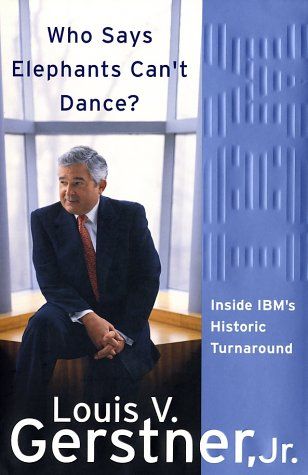
Who Says Elephants Can't Dance? Inside IBM's Historic Turnaround
The Brink of Collapse: When Big Blue Stood Still
The Brink of Collapse: When Big Blue Stood Still
Nova: Welcome to Aibrary, the show where we dissect the strategies that reshape industries. Today, we are diving into a business epic: Louis V. Gerstner Jr.'s book, "Who Says Elephants Can't Dance? Inside IBM's Historic Turnaround."
Nova: : That title alone is fantastic. It immediately sets the stage. But Nova, for listeners who might only remember IBM as the company that made mainframes, what was the reality of Big Blue when Gerstner walked in the door in 1993?
Nova: The reality was dire. Imagine a titan, a company that defined the computer age, hemorrhaging cash. They were losing billions, and the prevailing wisdom on Wall Street was that IBM was too big, too slow, and too fragmented to survive. The plan, which Gerstner inherited, was to carve it up into about eight smaller, supposedly more nimble companies. They were preparing for the corporate equivalent of a controlled demolition.
Nova: : Eight pieces? That sounds like admitting defeat. It’s like saying, 'We can’t steer this aircraft carrier, so let’s just sell the engines, the bridge, and the hull separately.' What was the atmosphere like inside that behemoth?
Nova: It was deeply insular, almost paralyzed. IBM had spent decades focused on its own engineering prowess, its own internal processes. They were looking inward, not outward at the customer. Gerstner noted that the culture was so self-centric that they had lost sight of what the market actually needed. They were a dinosaur waiting for the meteor strike, and they were actively building the launchpad for their own breakup.
Nova: : So, this wasn't just a strategy problem; it was a deep, cultural cancer. And Gerstner, the man brought in to fix it, wasn't even a computer guy. That’s the first shocker, right?
Nova: Absolutely. He came from RJR Nabisco, the food and tobacco giant, after successful stints at American Express and McKinsey. He was an outsider, a customer-side executive, not a lifelong IBM engineer. That outsider perspective was perhaps his greatest asset. He saw the forest, not just the trees of proprietary hardware architecture. This book is the first-hand account of how he taught the elephant to dance.
Key Insight 1: Preserving Integration Over Fragmentation
The Counter-Intuitive First Command: Stop the Breakup
Nova: Let's talk about that first, seismic decision. Gerstner arrives, assesses the situation, and immediately tells the board and the world: 'We are not breaking up IBM.' That flew in the face of every analyst's recommendation. Why was keeping the whole intact so critical?
Nova: : It seems risky. If the parts are struggling, why not spin off the healthy bits and try to save the rest? What did Gerstner see that the experts missed?
Nova: He saw the power of integration, which was IBM's unique selling proposition that they had forgotten how to leverage. He realized that while the hardware divisions were struggling against leaner competitors, the real value for large enterprise customers—the banks, the governments—was in having one throat to choke, one entity responsible for the entire solution. If you break it up, you lose the ability to seamlessly integrate hardware, software, and support.
Nova: : So, the elephant wasn't too big; it was just trying to walk on eight separate legs instead of one coordinated body. How did he sell that vision internally when everyone expected the company to be dismantled?
Nova: It was a massive cultural battle. He had to convince thousands of engineers and managers that the whole was greater than the sum of its soon-to-be-sold parts. He used his customer perspective as the anchor. He famously said something along the lines of, 'I was a customer of IBM, and I didn't want eight different vendors; I wanted one IBM.' That resonated because it grounded the abstract corporate structure in a tangible client need.
Nova: : That’s a powerful framing device. It shifts the focus from internal structure to external value. But culture change at a company that size must be like turning a supertanker in a bathtub. What was the first tangible cultural shift he implemented?
Nova: He tackled the superficial first to signal deep change. One of the most cited examples is the dress code. IBM was famous for its conservative, almost monastic corporate attire. Gerstner introduced flexibility, allowing business casual. It seems minor, but it was a huge symbolic gesture. It told the workforce: 'We are modernizing our thinking, and that starts with how you present yourselves and how you think about your daily work.' It was about giving employees permission to be less rigid.
Nova: : I love that. It’s the classic leadership move: change the symbols to change the mindset. So, he stops the breakup, signals cultural openness, but the financial bleeding is still happening. What was the next strategic pillar he built on this foundation?
Nova: The next pillar was defining the new core business. He had to decide what IBM would sell in the emerging digital world. And that leads us directly to the massive pivot that defined the rest of the decade.
Key Insight 2: The Strategic Shift to Services and Consulting
The Great Pivot: From Boxes to Business Solutions
Nova: The 1990s were the rise of the internet, the dot-com boom, and the shift from selling hardware units to selling integrated solutions. Gerstner saw this coming better than anyone inside IBM. He didn't just try to sell better PCs; he decided IBM needed to become a services powerhouse.
Nova: : This is where the 'elephant dancing' really comes into play, right? Hardware was their bread and butter—the mainframes, the servers. Services are a completely different business model—people-intensive, relationship-driven. How big was that shift?
Nova: It was monumental. Research shows that when Gerstner took over, hardware was overwhelmingly the revenue driver. By the time he stepped down, IBM was generating more than half of its massive revenue from services and software. He essentially created IBM Global Services, which became the largest IT consulting and outsourcing organization in the world. They stopped just selling the tools; they started selling the expertise to run the tools.
Nova: : That’s a massive cultural and operational overhaul. You have to hire consultants, change compensation structures, and train engineers to be client-facing advisors. Were there internal battles over this focus on services over the beloved hardware?
Nova: Absolutely. The hardware divisions felt marginalized. Gerstner had to constantly reinforce the new mantra: the hardware is now an enabler for the service solution, not the end product itself. He pushed the idea of 'e-business' early on, framing the internet not just as a consumer fad but as a fundamental change in how businesses would operate, requiring massive integration projects that only a company the size of IBM could handle.
Nova: : So, when a major bank needed to overhaul its entire transaction system for the web, they didn't just buy new servers; they hired IBM to manage the entire migration, the software integration, and the ongoing maintenance. Is that the essence of the new IBM?
Nova: Precisely. It’s about selling outcomes, not just components. And this strategy proved incredibly resilient. While many pure-play tech companies got hammered when the dot-com bubble burst around 2000, IBM, because of its stable, long-term service contracts, weathered the storm far better. They had locked in recurring revenue streams.
Nova: : It sounds like Gerstner understood that in a rapidly changing tech landscape, the only constant is complexity, and complexity demands integrated expertise. But what about the actual decision-making process? His book details principles for high-stakes leadership. What was his rule for making those tough calls, like committing billions to build out this new services arm?
Nova: He emphasized making decisions based on practical wisdom relevant to the current environment, not dogma. He had a set of principles, often cited as eight core tenets, that guided this. One of the most important was maintaining a relentless sense of urgency. He knew that even while turning the ship, they had to move faster than the market expected, or they’d be overtaken by nimbler competitors who were already service-focused.
Key Insight 3: Redefining Corporate Identity and Urgency
The Culture Code: From Engineering Silos to Customer Focus
Nova: We touched on culture, but it deserves its own deep dive. Gerstner dedicated significant energy to what he called 're-engineering the organization' through cultural change. He didn't just want people to wear different clothes; he wanted them to think differently. What was the core cultural shift he mandated?
Nova: : It seems like the biggest hurdle wasn't technology; it was psychology. How do you take an organization famous for its internal processes and force it to become externally focused?
Nova: The shift was from 'What can we build?' to 'What does the customer need us to build?' He hammered home customer-centricity. He used his own experience as a customer to illustrate the pain points. He demanded that every division, every manager, understand how their work directly impacted the client's success. This required breaking down those deeply entrenched engineering silos that protected their own product lines.
Nova: : I imagine that created friction, especially with long-tenured executives who built their careers on the old hardware-first model. How did he manage that internal resistance?
Nova: He was firm but fair. He made it clear that the old ways were no longer acceptable for survival. He didn't just preach; he tied performance reviews and resource allocation to these new customer-focused metrics. If you weren't contributing to the integrated solution or serving the client, your division’s future funding was in jeopardy. It was a carrot-and-stick approach, but the stick was the existential threat of the company failing.
Nova: : It’s fascinating how often in these massive turnarounds, the leadership challenge boils down to communication and managing fear. Did he use the book to highlight any specific communication techniques he employed to maintain that 'sense of urgency' you mentioned earlier?
Nova: Yes. He stressed transparency, especially about the gravity of the situation early on, but also about the vision for the future. He needed people to believe that the turnaround was possible, which is where the 'elephant dancing' metaphor comes in. It’s about proving that even the largest, seemingly inflexible entity can adapt and perform new, complex maneuvers if the leadership commits to teaching it.
Nova: : So, if we boil down the cultural lessons from the book, it seems to be: 1. Define the new identity clearly. 2. Lead by example, even in small ways like dress code. 3. Align incentives with the new external focus. That sounds like a playbook for any struggling legacy company.
Nova: It is. Gerstner’s core message is that culture isn't a soft skill; it's the bedrock of execution. You can have the best strategy in the world, but if the culture resists it, the strategy dies on the vine. He took a company that was culturally set up to fail and rewired its DNA to succeed in the internet age, all while keeping the brand intact.
Key Insight 4: Measuring Success and Long-Term Vision
The Legacy: From Near Death to Digital Leader
Nova: Let's look at the results. By the time Gerstner retired in 2002, what did the scoreboard look like? How did he quantify the success of teaching the elephant to dance?
Nova: : I recall seeing figures that suggested a massive stock price recovery. Can you put some numbers to that transformation?
Nova: The numbers are staggering. When he arrived in 1993, IBM's stock price was languishing, and they were posting massive losses. Within two years, he had reversed the trend, and by the time he left, the stock price had quadrupled from its low point, and revenues were soaring past $78 billion annually, largely fueled by that services engine. They went from being a company analysts wanted to dismantle to one that was leading the enterprise technology space.
Nova: : That’s a phenomenal return on leadership. But what about the long-term vision? Did the services focus create a new kind of rigidity? Did he set IBM up for the next disruption, like the cloud computing shift that came later?
Nova: That’s the critical question for any turnaround leader. Gerstner built a foundation of agility and customer focus that allowed IBM to adapt later, even if they faced new challenges with cloud dominance. His legacy wasn't just the services pivot; it was proving that a massive, established company fundamentally change its business model without dissolving. He established a new mental model for what IBM was: a solutions provider, not just a hardware manufacturer.
Nova: : The book also covers the PR challenges. How did he manage the narrative externally while undergoing such intense internal change? That’s often where turnarounds fail—when the market loses faith.
Nova: He was very deliberate about controlling the narrative, often by being brutally honest about the challenges while simultaneously showcasing early wins in the services sector. He used the metaphor of the elephant to frame the narrative: yes, we are big, but we are capable of agility. He didn't hide the layoffs or the tough decisions; he framed them as necessary steps toward a unified, customer-focused future. He managed expectations while delivering results.
Nova: : It sounds like the book is less about specific technologies and more about the timeless principles of leadership under duress: courage to defy consensus, clarity in defining the customer, and relentless focus on culture.
Conclusion: The Dance of Resilience
Conclusion: The Dance of Resilience
Nova: We've covered the near-death experience of IBM in 1993, the radical decision to halt the breakup, the massive strategic pivot from hardware to global services, and the deep cultural re-wiring required to make it all happen. What is the single most important takeaway for our listeners today, whether they run a small team or a massive corporation?
Nova: : For me, it’s the power of the outsider's perspective. Gerstner was able to see the integrated value because he wasn't blinded by the internal politics or the legacy engineering mindset. He asked the simplest, most powerful question: What does the customer need to succeed?
Nova: I agree. And I’d add the lesson on culture. Gerstner proved that culture is not a byproduct of strategy; it is the mechanism through which strategy is executed. If you want an elephant to dance, you don't just tell it to move its feet; you have to change its entire internal rhythm. He didn't just save IBM; he redefined what a technology giant could be in the modern era.
Nova: : It’s a masterclass in high-stakes leadership, proving that size is not destiny, and that even the most entrenched organizations can achieve radical transformation if the leader has the vision and the will to challenge every assumption.
Nova: Indeed. The story of Louis Gerstner and IBM is a permanent fixture in the leadership canon because it shows that true transformation requires both strategic brilliance and profound human leadership. It reminds us that even the biggest among us can learn new steps, provided they have the right choreographer.
Nova: : A fantastic exploration of a true corporate resurrection. Thank you, Nova, for guiding us through the pages of "Who Says Elephants Can't Dance?"
Nova: My pleasure. This is Aibrary. Congratulations on your growth!