

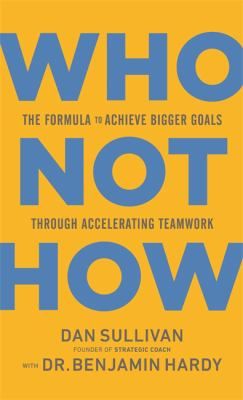
Who Not How
The Formula to Achieve Bigger Goals Through Accelerating Teamwork
The Infinite To-Do List
The Infinite To-Do List
Nova: Have you ever looked at your to-do list and felt a wave of exhaustion before you even picked up a pen? You see twenty tasks, and your brain immediately starts calculating exactly how many hours of your life each one is going to consume. It is a weight that almost every ambitious person carries.
Nova: Exactly. And that is because most of us are asking the wrong question. We are asking, how do I do this? Today, we are diving into a book that suggests a radical shift in perspective. It is called Who Not How, by Dan Sullivan and Dr. Benjamin Hardy. The premise is startlingly simple: whenever you want to accomplish something, stop asking how and start asking who.
Nova: It is much deeper than just delegation. It is about a fundamental shift in how you view your own potential and your relationships with others. Dan Sullivan, who is a world-renowned entrepreneurial coach, argues that the how question is actually a trap that limits your growth and leads to burnout. By the end of this episode, we are going to look at why your best work might actually be done by someone else and how that could be the best thing for both of you.
Key Insight 1
The Trap of How
Nova: To really understand this, we have to look at why we default to how in the first place. From a very young age, especially in school, we are taught that being successful means being able to do things ourselves. If you ask for help on a test, it is called cheating. If you let someone else write your essay, you fail. We are conditioned to believe that personal effort is the only valid path to achievement.
Nova: And Sullivan argues that this mindset is exactly what keeps people stuck. When you ask how do I do this, you are immediately limited by your own current skills, your own energy, and your own twenty-four hours in a day. It creates a ceiling. Think about a big goal, like writing a book or launching a business. If you ask how, you start thinking about the hundreds of steps involved, many of which you have no idea how to do. That is where procrastination comes from. You are overwhelmed because the how is too big for one person.
Nova: Precisely. Procrastination is often just a psychological signal that you are trying to do a how when you should be looking for a who. When you switch to who, the energy changes. Instead of thinking about the technical details of building a website, you think, who is the best person I know at building websites? Suddenly, the project feels possible again because you are not the one doing the heavy lifting in areas where you lack expertise.
Nova: That is a great point, and the book addresses it head-on. A who does not always mean an employee. It can be a partner, a collaborator, or even a piece of software. It is about value exchange. Sometimes your who is someone who actually loves doing the thing you hate. They find it easy, while you find it draining. By bringing them in, you are actually giving them an opportunity to use their unique ability. It is a win-win, not just you dumping work on someone.
Key Insight 2
The Four Freedoms
Nova: Sullivan organizes the benefits of this mindset into what he calls the Four Freedoms. These are the things you gain when you stop being the how for everything in your life. The first is the Freedom of Time.
Nova: And that is the trap! The goal is to use that time to focus on your unique ability, the things that only you can do and that give you the most energy. When you free up your time from mundane tasks, you can think bigger. The second freedom is the Freedom of Money. This sounds counterintuitive because you are often paying people to be your who, right?
Nova: But Sullivan argues that your earning potential is limited by your time. If you spend five hours doing a fifty-dollar task, you just lost five hours where you could have been doing a five-hundred-dollar task. By investing in a who, you increase your capacity to generate wealth because you are focusing on high-value activities. It turns an expense into an investment.
Nova: The third is the Freedom of Relationship. When you operate in a who not how way, you are constantly connecting with talented people. You stop seeing others as competition and start seeing them as potential collaborators. Your network becomes your greatest asset. And the final one is the Freedom of Purpose. This is the big picture. It is the ability to choose what you want to do with your life because you are no longer a slave to the small, daily requirements of your business or your job. You get to define the what and the why, and let others handle the how.
Nova: It really is. Sullivan says that the ego is often the biggest obstacle to who not how. We want the credit, or we think nobody can do it as well as we can. But being the best at everything is a recipe for staying small. To grow, you have to be willing to let someone else be the hero of the how.
Key Insight 3
The Book That Proves the Point
Nova: One of the coolest things about this book is that the book itself is a product of the who not how process. Dan Sullivan is an ideas guy. He has been coaching for decades and has all these brilliant concepts, but he was not a professional book writer in the modern sense. He had the what and the why, but he needed a who for the writing.
Nova: No, he collaborated with Dr. Benjamin Hardy, who is an organizational psychologist and a very successful author. Dan provided the core concepts and the decades of coaching experience, and Ben provided the narrative structure, the research, and the actual writing. If Dan had tried to write it himself, it might have taken years, or it might never have happened because he would have been bogged down in the how of publishing.
Nova: Exactly! Ben Hardy actually talks about how this partnership expanded his own life, too. He got access to Dan's wisdom and a platform he wouldn't have had otherwise. It was not just Dan using Ben; it was two people combining their unique abilities to create something neither could have done alone. That is the essence of collaboration.
Nova: Sullivan uses a tool called the Impact Filter. Before you look for a who, you have to be crystal clear on what the successful outcome looks like. You define the purpose, the importance, and the specific criteria for success. Once you have that clarity, you can hand it to a who and say, this is the result I want, you figure out the how. If you are not clear on the result, you will just frustrate your who because they won't know what they are aiming for.
Nova: That is a perfect analogy. The director sets the vision, but they rely on the cinematographer, the actors, and the editors to bring their own expertise to the table to make that vision a reality.
Key Insight 4
Implementation and Obstacles
Nova: Now, even if you are sold on this, the transition is not always smooth. One of the biggest challenges people face is the cost. They see paying a who as a loss of money. Sullivan suggests shifting from a cost mindset to an investment mindset. If a who saves you ten hours a week, and you use those ten hours to move your business forward in a significant way, that who has effectively paid for themselves many times over.
Nova: In that case, you look for value exchange. Maybe you have a skill they need. Or maybe you can find a who in the form of a mentor who can give you a shortcut that saves you a year of figuring it out on your own. Even using a tool or an automated system is a form of who not how. It is about the refusal to get stuck in the weeds. Another obstacle is the belief that you have to do the hard work yourself to deserve the success.
Nova: Sullivan would say that suffering does not add value to the end product. The customer does not care if you spent twenty hours struggling with a spreadsheet or if you hired a specialist to do it in twenty minutes. They only care about the result. In fact, the specialist probably did a better job. By insisting on doing it yourself, you might actually be providing a lower quality result to the world.
Nova: It is a tough pill to swallow, but it is incredibly freeing once you accept it. It allows you to become a creator of opportunities for others. When you look for a who, you are giving someone else a chance to shine in their area of strength. You are building a community of excellence rather than a silo of mediocrity.
Nova: Look at your to-do list. Find the one thing that has been sitting there the longest, the thing you keep avoiding because you do not know how to do it or you find it incredibly draining. Instead of writing down the next step for how you will do it, write down the name of one person who might already know how to do it. Just one. Reach out to them. Ask for a referral or a collaboration. Start the shift from how to who with just that one task.
The Path to 10x Growth
The Path to 10x Growth
Nova: As we wrap up our look at Who Not How, it is clear that this is more than just a productivity hack. It is a philosophy of growth. Dan Sullivan and Benjamin Hardy are challenging us to stop seeing ourselves as isolated units of production and start seeing ourselves as part of a larger, collaborative ecosystem. When you let go of the how, you stop being a bottleneck in your own life.
Nova: That is the goal. Remember the four freedoms: time, money, relationship, and purpose. They are not just rewards for success; they are the tools that allow you to create even more success. By finding your whos, you are not just getting things done; you are expanding what is possible for your entire life. You are moving from a world of scarcity and effort to a world of abundance and partnership.
Nova: It absolutely does. Thank you for joining us on this deep dive into the mindset of Who Not How. Start looking for your who today, and watch how quickly your world begins to expand.
Nova: This is Aibrary. Congratulations on your growth!