Navigating Change with Psychological Resilience
Golden Hook & Introduction
SECTION
Nova: Give me the most dangerous phrase in modern business.
Atlas: That is easy. It is, We have always done it this way.
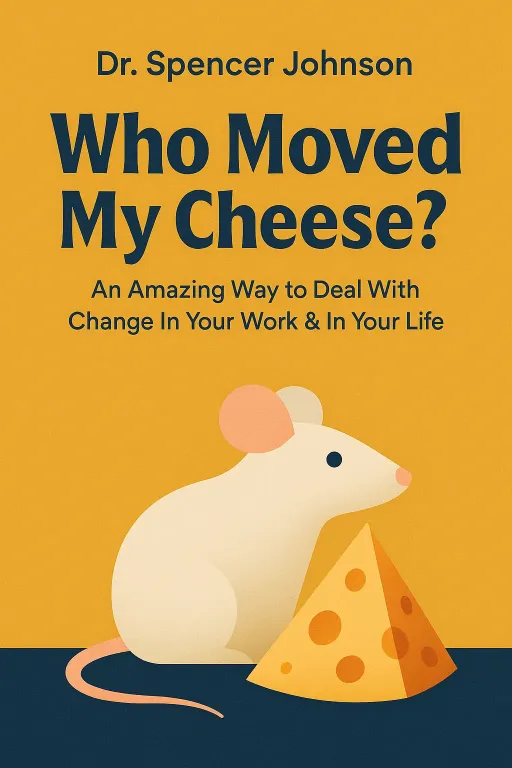
Nova: Exactly. It is the sound of a company slowly suffocating while believing it is just resting. Today, we are going to talk about why that specific comfort zone is actually the most precarious place you can stand. We are diving into two pillars of mental agility. First, the classic parable of the maze, Who Moved My Cheese by Dr. Spencer Johnson.
Atlas: A book that people either love for its simplicity or roll their eyes at because it feels like a corporate fable.
Nova: True, but there is a reason it has been a staple in boardrooms for decades. It taps into the fundamental fear of disruption. And to back that up with some serious scientific horsepower, we are pairing it with Martin Seligman’s Learned Optimism. Seligman is the father of positive psychology, and his work moves us from just feeling good to actually rewiring how we explain setbacks to ourselves.
Atlas: I like that pairing. The Cheese gives us the map, and Seligman gives us the internal compass. For our listeners who are building systems and trying to future-proof their lives, this is not just about staying positive. This is about building a psychological architecture that survives when the ground shifts beneath you.
The Architecture of Change
SECTION
Nova: Let’s start with that maze. In Dr. Johnson’s story, you have four characters. Two mice, Sniff and Scurry, and two little people, Hem and Haw. They are all looking for cheese, which represents whatever we want in life—a job, a relationship, a stable business model. The mice are simple. They notice the cheese is getting smaller, they notice it is disappearing, and they immediately go find more.
Atlas: But Hem and Haw, the little people, they complicate things. They get angry. They feel entitled to the cheese. They sit there waiting for it to come back because they believe the system owes them.
Nova: That entitlement is the trap. When we talk about the Pragmatic Architect, the person who builds systems, the danger is that we fall in love with the system we built. We start to think the system is the goal, rather than the results the system is supposed to produce.
Atlas: I see this constantly. A leader builds a process that works perfectly for a specific market condition. Then the market changes. The leader keeps optimizing the old process, thinking they just need to work harder, or that the market is wrong, or that the customers are being unreasonable. They are essentially yelling at the maze because the cheese moved.
Nova: And that is the definition of fragility. If your success depends on the world staying exactly the same, you are not a strategist; you are a gambler. The lesson from the mice is about sensory awareness. Sniff and Scurry don’t overthink it. They see the supply is dwindling, and they move.
Atlas: But humans are not mice. We have egos. We have identities tied to our work. If I am the person who built this successful model, and the model fails, does that mean I am a failure? That is the emotional block, right? It is not that we are stupid; it is that we are terrified of the identity shift that comes with changing course.
Nova: That is a profound point. The fear of being wrong often outweighs the desire to be effective. When you are clinging to an outdated model, you are prioritizing your past ego over your future viability. You are telling yourself that if you just hold on long enough, reality will conform to your preferences.
Atlas: Which is a losing battle every single time. So, if we accept that the cheese is always moving—which is just the reality of the modern, rapid-fire market—how do we stop the paralysis? How does the strategist move from that state of denial into the state of action?
The Science of Learned Optimism
SECTION
Nova: That is where Seligman comes in. If Johnson’s book tells us that change is inevitable, Seligman’s Learned Optimism tells us how to handle the stress of that movement. Most people think optimism is just a personality trait. You are either a glass-half-full person or you are not. Seligman’s research completely dismantles that. He proves that optimism is a skill. It is an explanatory style.
Atlas: Explain that. What does it mean to have an explanatory style?
Nova: It is the internal narrative you run when something goes wrong. When you lose that client, or when the launch fails, or when your business model gets disrupted, what is the story you tell yourself? Seligman found that people who are resilient explain setbacks in a very specific, technical way. They look at the setback as temporary, specific, and external.
Atlas: Break that down for me. Give me an example of the opposite, because that is what most of us do, right? We default to the pessimistic style.
Nova: Exactly. The pessimistic style is the opposite. It is permanent, pervasive, and personal. Let’s say you lose a big contract. The pessimist thinks: This is permanent—I will never get another client. It is pervasive—my whole business is failing, and my leadership is trash. And it is personal—I am just not good enough at this.
Atlas: Oh, I know that voice well. That is the internal critic that keeps you up at 3:00 AM. It turns a single event into a total identity crisis.
Nova: Now, look at the optimist’s style. They look at that same lost contract and say: This is temporary—I lost this one, but I will get the next one. It is specific—this client was a bad fit, but my other projects are fine. And it is external—the market shifted, or this client had internal budget cuts. It is not about my fundamental worth as a leader.
Atlas: That sounds like a superpower. But here is the pushback: isn’t that just lying to yourself? If the business is actually struggling, doesn’t that kind of optimistic framing just blind you to the reality of the situation?
Nova: That is the most common critique. People think optimism means wearing rose-colored glasses. But Seligman’s research actually shows the opposite. The optimist is often more grounded because they don’t collapse under the weight of the failure. If you are paralyzed by the belief that your failure is permanent and pervasive, you don’t analyze the data. You just hide.
Atlas: I see. So, by framing it as temporary and specific, you actually free up the mental bandwidth to fix the problem. You are not saying everything is fine; you are saying the current situation is solvable.
Nova: Precisely. You are keeping your hands on the steering wheel instead of covering your eyes. The Pragmatic Architect needs this because, in a high-leverage business, you are going to face setbacks. If you interpret every setback as a sign that your foundation is crumbling, you will stop building. You will start retreating.
Atlas: It is like the difference between a contractor who sees a crack in the drywall and thinks the house is collapsing, versus one who sees a crack and thinks, Okay, there is a foundation settling issue here, let me grab the level and fix it. One leads to panic; the other leads to maintenance.
Nova: That is a perfect analogy. The pessimist thinks the crack is the end of the house. The optimist knows the house is still sound, but it needs a repair.
Integrating the Systems
SECTION
Atlas: Let’s pull this together. We have the Cheese, which teaches us that change is inevitable and we need to be ready to move. Then we have Learned Optimism, which gives us the mental framework to handle the discomfort of that movement. How does a leader actually apply these two things tomorrow morning?
Nova: It starts with an audit of your internal dialogue. When you feel that anxiety about a market shift or a project failing, stop and ask yourself the three questions. Is this permanent? Is this pervasive? Is this personal? And then, intentionally rewrite those answers.
Atlas: I like that. It is like debugging code. You are looking for the error in your own logic. If I catch myself saying, The whole industry is dead, I have to stop and say, No, that is the pervasive trap. The industry is changing, but my specific niche is still viable if I adjust.
Nova: Exactly. And then you layer in the Cheese mindset. You ask, Where is the new cheese? You stop obsessing over the old model that is no longer producing results, and you start looking for where the value is actually flowing now.
Atlas: What about the people who are terrified of the risk involved in finding the new cheese? Because moving is scary. Staying put feels safe, even if it is dying.
Nova: That is the crucial realization. Staying put is not safe. It is just slower death. The perceived safety of the status quo is an illusion. When you realize that the risk of standing still is actually higher than the risk of moving, the fear shifts. It becomes a fear of irrelevance rather than a fear of change.
Atlas: That is a powerful reframe. I think a lot of people in our position, the builders and the strategists, they struggle because they feel like they have to have the perfect, guaranteed plan before they move. But Sniff and Scurry didn't have a map. They just had the instinct to keep moving until they found something.
Nova: That is the key. You do not need a perfect plan. You need a bias toward action. You need to be a scientist in your own life. Test a hypothesis. Is this new market viable? Try it. If it works, double down. If it doesn't, you haven't failed; you have gathered data.
Atlas: It turns the whole process into a game of discovery rather than a desperate attempt to protect what you have. I think that is the shift that separates the people who build things that last from the people who get left behind.
Synthesis & Takeaways
SECTION
Nova: It really comes down to this. Your business model is not your identity. Your success is not a permanent state; it is a dynamic process. When you can look at a disruption and say, This is not a personal failure, this is just the cheese moving, you gain an incredible amount of power.
Atlas: And that power allows you to act with clarity. You stop being the person who is anchored to the past, and you start being the person who is actively shaping the future. You are not waiting for the market to give you what you want; you are out there scanning the maze, ready to adapt.
Nova: If you are listening to this, I want you to take one thing from this conversation. The next time you face a significant setback, pause. Don't react. Ask yourself if you are falling into the trap of thinking it is permanent, pervasive, and personal. If you are, stop. Flip the script. Make it temporary, make it specific, and make it external. Then, ask yourself: Where is the new cheese?
Atlas: That is the most productive question you can ask yourself all week. Don't just sit in the empty part of the maze. Get up and start looking.
Nova: Because the maze is big, and there is always more cheese if you are willing to move. This is Aibrary. Congratulations on your growth!