

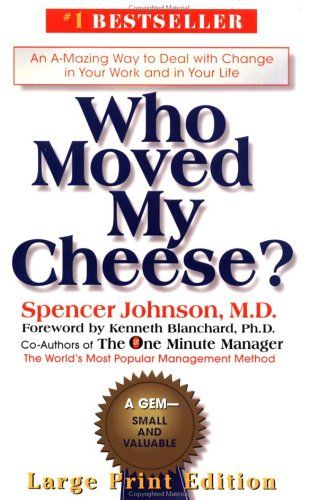
Who Moved My Cheese?
The Universal Fear of the Empty Shelf
The Universal Fear of the Empty Shelf
Nova: Welcome back to 'The Insight Engine.' Today, we're diving into a book so ubiquitous in corporate training rooms that it's practically required reading: Spencer Johnson's 1998 classic, "Who Moved My Cheese?"
Nova: That's the magic, Alex. It distills the entire human experience of disruption into a single, relatable metaphor. The shocking fact is that it sold over 26 million copies worldwide. It’s not just a business book; it’s a survival guide for the inevitable.
Nova: It’s much deeper. The danger is stagnation. The book posits that life is a maze, and what we all chase—our security, our success, our happiness—is the Cheese. And that Cheese, inevitably, moves. The real question isn't it moves, but how you react when the familiar supply vanishes.
Key Insight 1: Allegory Explained
The Maze and the Metaphor: Defining the Cheese
Nova: Let's establish the landscape. We have the Maze. What does the Maze represent in the real world?
Nova: Exactly. And the Cheese itself is the key. Johnson is very clear: the Cheese can be anything you strive for. For some, it’s a massive salary increase. For others, it’s a promotion, a reputation, a stable relationship, or even just the comfort of knowing the routine.
Nova: Precisely. And the search itself is the process of living and working. The book suggests that many people, once they find a big pile of Cheese, stop searching. They settle in, build a home right next to it, and assume it will last forever. That’s where the trouble starts.
Nova: Absolutely. He was writing for a world where job security was already eroding, even if people weren't fully admitting it. The idea of a 30-year career at one company was becoming a relic. The Maze was getting faster, and the Cheese was becoming more ephemeral. The book gives you the language to talk about that anxiety.
Key Insight 2: Decoding the Characters
The Four Archetypes: Sniff, Scurry, Hem, and Haw
Nova: This is where the book truly shines. We have two mice and two Littlepeople. The mice are Sniff and Scurry. Sniff is the early warning system. He sniffs out change early and anticipates it.
Nova: And Scurry? Scurry is the action-taker. Once Sniff alerts him, Scurry doesn't waste time analyzing the past; he immediately starts running the new path. He embodies rapid adaptation.
Nova: They certainly are. Hem is the embodiment of denial and fear. When the Cheese moves, Hem refuses to believe it. He argues, he gets angry, he wastes days or weeks complaining about the injustice of the Cheese moving.
Nova: That’s a powerful way to put it. And then there’s Haw. Haw starts out much like Hem—he’s comfortable, he’s reluctant to leave the familiar Cheese Station C. But Haw has a critical difference: he listens to the little voice inside, the one that whispers, 'If you do not change, you will become extinct.'
Nova: Yes! That’s Haw’s journey from inertia to action. He realizes that the fear of the unknown is less painful than the pain of staying put in a place where there is no longer any reward. He starts small, takes a tentative step, and discovers that the Maze isn't as scary as he imagined.
Nova: It’s about moving from 'Why did this happen to me?' to 'What do I do now?' That shift in perspective is the entire book distilled into one mental pivot.
Key Insight 3: Business Adoption and Simplicity
The Corporate Cult: Why CEOs Love This Parable
Nova: Because it’s a perfect, low-cost tool for cultural change management. When a company needs to pivot—a merger, a technological overhaul, a shift in market strategy—the workforce often defaults to Hem behavior. They resist.
Nova: It’s brilliant corporate shorthand. If a CEO says, 'We need to stop being Hem and start being Haw,' everyone in that organization who has read the book instantly understands the expectation: Stop complaining about the old system and start exploring the new opportunities.
Nova: It absolutely does. The simplicity is both its strength and its weakness. It’s incredibly effective at conveying the to change, but it’s almost entirely silent on the of change, especially in complex organizational settings.
Nova: It focuses purely on the internal mindset, which is powerful, but it can feel dismissive of external realities. It implies that if you just hard enough, like Haw, you will find success. It minimizes the role of leadership in creating the new Cheese or clearing the path in the Maze.
Key Insight 4: Counterarguments and Nuance
The Skeptic's Corner: Oversimplification and Passive Acceptance
Nova: Let's lean into that criticism, Alex. Critics often label it as 'common sense wrapped in a fable' or even 'corporate propaganda.' What’s the most compelling argument against the book’s philosophy?
Nova: It can sound like, 'Your job was eliminated due to outsourcing, but if you were just more like Sniff, you would have seen it coming and you wouldn't be upset now.' It pathologizes the natural human reaction to loss.
Nova: And there’s the issue of agency. The mice, Sniff and Scurry, are purely reactive to the environment. They are subject to the Maze. Haw eventually gains agency by choosing to move, but the book doesn't really explore the possibility of the characters a new Cheese source within the existing structure.
Nova: Johnson’s later work, and some interpretations, suggest that Haw eventually realizes he can write on the walls, which hints at influence, but the primary message remains: the Cheese moves, you follow. We need to remember that while personal resilience is vital, organizational change requires leadership that actively manages the transition, not just tells people to be less like Hem.
Conclusion: Writing Your Own Map
Conclusion: Writing Your Own Map
Nova: We’ve covered a lot of ground in this tiny book. From its massive success as a corporate training tool to the very real criticisms about its simplicity, "Who Moved My Cheese?" remains a cultural touchstone.
Nova: And if you are Hem, or even Haw, the actionable takeaway is Haw’s realization: 'Smell the Cheese often so you know when it is getting old.' Don't wait for the empty shelf. Regularly assess the value of what you have.
Nova: It’s a powerful reminder that growth happens outside the comfort zone, even if the journey there feels like wandering in the dark. We must be willing to write our own map as we go.
Nova: Indeed. This has been an exploration of adaptation, fear, and the inevitable relocation of our goals. This is Aibrary. Congratulations on your growth!