The Quiet Anchor: Cultivating Inner Awareness in a Noisy World
Golden Hook & Introduction
SECTION
Nova: What if I told you that the harder you try to "fix" your life, the more you might actually be missing out on it?
Atlas: Oh man, that's a gut punch, Nova. Because honestly, my default setting feels like "more effort, more output, more fixing." I imagine a lot of our listeners, especially those driven by understanding and purpose, feel that constant hum of needing to something to improve their situation.
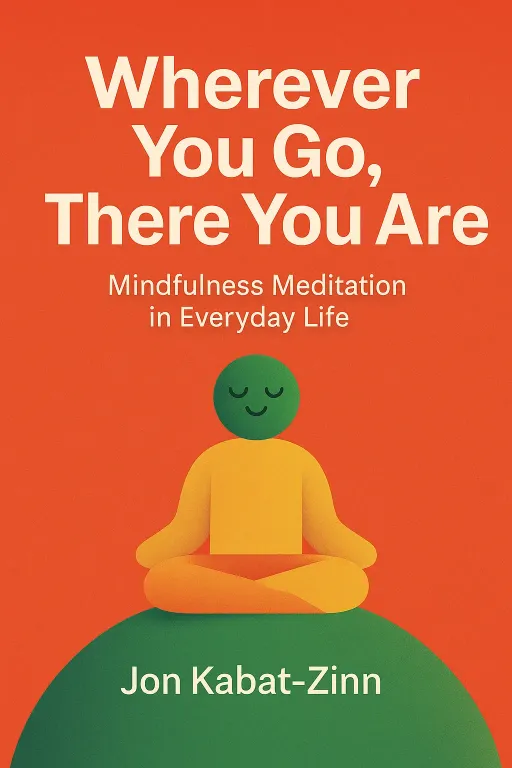
Nova: Absolutely. And that relentless pursuit of external achievements, that feeling of being perpetually busy but still somehow empty, is exactly what we're anchoring into today. We're diving into a profound idea, beautifully articulated in the spirit of a work like Jon Kabat-Zinn's widely acclaimed "Wherever You Go, There You Are." Kabat-Zinn, a pioneer in bringing mindfulness to mainstream Western medicine and psychology, really showed the world that these ancient practices weren't just for monks on mountaintops, but for anyone navigating the noise of everyday life.
Atlas: Right. So, it's not about abandoning our lives, but about something deeper.
Nova: Precisely. It's about shifting our internal landscape.
The Modern Predicament: The Illusion of External Fulfillment
SECTION
Nova: We live in a world that constantly tells us to strive, to achieve, to acquire. From the moment we wake up, we're bombarded with messages that imply our worth is tied to our next accomplishment, our next purchase, our next step on the career ladder. It's like we're all on this giant, invisible treadmill, perpetually speeding up, convinced that the finish line is just around the corner. But the ironic twist is, the faster we run, the more disconnected we often feel from the very selves we're trying to improve.
Atlas: Wow. I know that feeling. It's like you're checking off all the boxes, hitting all the metrics, and deep down, there's still this nagging sense of unease, or even worse, emptiness. For someone who's constantly analyzing and seeking meaning, this can be incredibly frustrating. You're thinking, "I'm doing everything 'right,' so why isn't it right?"
Nova: Exactly. And the book points out that this constant outward focus, this external striving, creates a profound disconnect from our inner selves. We become so adept at navigating the external world, at managing projects and expectations, that we lose touch with the simple, accessible peace that's always present within us. Imagine a highly successful executive, let's call her Sarah. She's got the corner office, the impressive title, the demanding schedule. From the outside, she's the epitome of success. But internally, she's a whirlwind of anxiety, constantly chasing the next deadline, the next promotion, the next big win. Every achievement brings a fleeting high, quickly replaced by the pressure of the next challenge. She's busy, she's productive, but she's also deeply exhausted and perpetually feels like she's not quite enough.
Atlas: That's a perfect example. It sounds like she's trying to fill an internal void with external validation, and it's a bottomless pit. So, what you're saying is that even for the most methodical and purposeful among us, this external chase can lead to a fundamental misalignment?
Nova: A profound misalignment. It's not that ambition is inherently bad. It's that when our sense of self-worth and peace becomes solely dependent on external outcomes, we're building our house on shifting sand. We're constantly looking for the "thing" out there that will finally make us feel complete, overlooking the quiet anchor within.
Atlas: That makes me wonder, then, if this is such a common trap, how do we begin to untangle ourselves from it? How do we find that anchor you're talking about, especially when the world is so loud and demanding?
The Quiet Anchor: Embracing Presence Through Inner Awareness
SECTION
Nova: That's the beautiful pivot. The answer, as Kabat-Zinn so eloquently articulates, isn't to abandon our lives or run away to a quiet monastery. It's about radically re-anchoring ourselves right where we are. It's the profound realization that true peace isn't found by changing our external circumstances, but by shifting our internal attention. Mindfulness, at its core, is about embracing reality fully, not escaping it. It's about being present, non-judgmentally, to the unfolding of each moment.
Atlas: Okay, so "embracing reality fully." That sounds great in theory, but when my day is a constant stream of meetings, decisions, and information overload, what does "embracing reality" actually look like? Is it just trying to "think positive" while all hell breaks loose? For the analysts and meaning-makers out there, we need something tangible, something we can actually.
Nova: Not at all, and it's definitely not just positive thinking. It's far more practical and grounded. Think of it like this: your mind is always going to produce thoughts, your body will always experience sensations, and the world will always present challenges. Mindfulness isn't about stopping any of that. It's about you relate to it. Imagine you're doing something utterly mundane, something you do every single day, perhaps washing dishes. Instead of letting your mind race to your to-do list, or replaying an argument, you simply focus on the warm water, the feel of the soap, the sound of the plates clinking. The smooth, cool ceramic. The scent of the dish soap.
Atlas: Whoa. So, you're saying even something as simple as washing dishes can become a practice? It's like turning an automatic behavior into a conscious experience. That feels almost radical in its simplicity.
Nova: Exactly! It's a radical simplicity. By bringing conscious attention to these ordinary moments, you're not just washing dishes; you're cultivating presence. That's where the resilience builds. You’re training your attention, like a muscle, to return to the present moment, again and again. Kabat-Zinn’s work reminds us that inner peace isn't some rare, elusive state; it's always accessible, no matter where you are or what you're doing. It's about noticing your breath, observing your thoughts as they arise and pass, feeling your feet on the ground. These aren't escapes from reality; they are profound engagements reality.
Atlas: I guess that makes sense. It's not about clearing your mind, but about changing your relationship with your mind. And for someone who values purpose, this practice of cultivating inner awareness isn't just about feeling good; it's about building a stronger, clearer foundation from which to pursue that purpose. It sounds like a methodical skill, like anything else we might analyze and try to master.
Nova: It absolutely is. It's a skill, a practice that builds over time. And it fundamentally shifts where we seek our anchor. Instead of constantly looking outside, we learn to find that quiet, unwavering stability right within ourselves. That's the true source of resilience and deeper self-awareness.
Synthesis & Takeaways
SECTION
Nova: So, what we're really talking about today is moving from a life of constant external striving, which often leaves us feeling disconnected and anxious, to one where we cultivate an inner awareness that becomes our quiet anchor. It's not about ignoring the world's demands, but about finding a calm, clear center amidst the chaos. This shift empowers us to engage with life more fully, more purposefully, and with a deeper sense of peace, regardless of what's happening around us.
Atlas: That's actually really inspiring. It means the answer isn't "out there" somewhere, just beyond our reach. It's fundamentally accessible, right here, right now. It's about changing our internal attention, not our external circumstances. So, for our listeners who are seekers, analysts, and meaning-makers, what's one concrete step they can take today to start cultivating this inner awareness? Something simple, quick, but impactful.
Nova: The most powerful first step is also the simplest. Today, take just five minutes to simply notice your breath. You don't need to change it, or control it. Just observe its rhythm. Feel it enter your body, feel it leave. Feel your body settle into the present moment. Just five minutes. It's a small act, but it's a profound declaration that you are ready to connect with your quiet anchor.
Atlas: That's a great way to put it. A small act, a profound declaration. For anyone looking for deeper meaning or clarity, that simple practice is a powerful entry point to trusting your inner compass.
Nova: Absolutely. And it's a journey that builds resilience, one breath at a time.
Atlas: This is Aibrary. Congratulations on your growth!