The 'Chaos' Trap: Why You Need Mindful Order to Rebuild.
Golden Hook & Introduction
SECTION
Nova: Atlas, what’s the one thing you think everyone overlooks when they’re trying to rebuild their life after a major upheaval?
Atlas: Oh, easy. The 'secret sauce' that's actually just... more sauce. Like, another to-do list, or a new productivity app. We're always looking externally, aren't we?
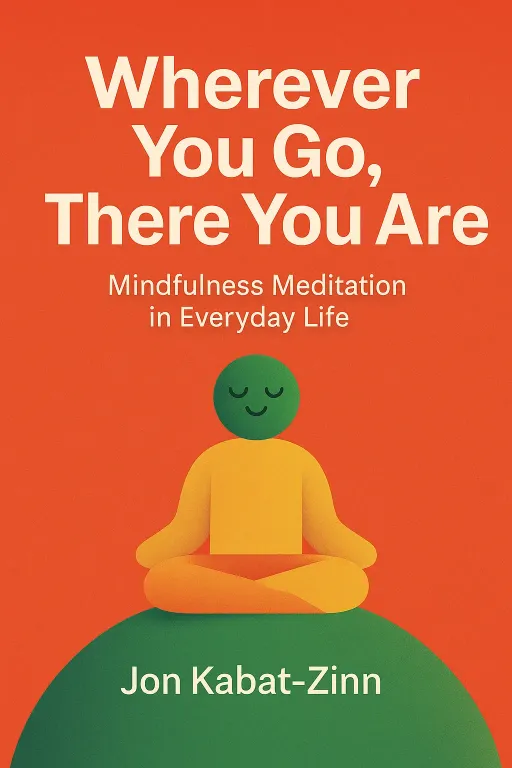
Nova: You're absolutely right! And that's exactly what we're tackling today, but through the lens of two absolute giants. We're talking about "Wherever You Go, There You Are" by the brilliant Jon Kabat-Zinn, and "Thinking, Fast and Slow" by Nobel laureate Daniel Kahneman.
Atlas: Whoa, that's a combo! Kabat-Zinn, the molecular biologist who brought mindfulness into hospitals, and Kahneman, the economist who won a Nobel for showing how irrational we are. How do these two fit together?
Nova: It’s a fascinating synergy! Kabat-Zinn essentially pioneered the scientific study of mindfulness, demonstrating its profound impact on stress reduction and well-being. He made ancient wisdom accessible to modern science. Kahneman, on the other hand, gave us the map to our own cognitive biases, revealing the hidden currents beneath our decisions. Together, they illuminate why our inner game is absolutely crucial for any external rebuilding.
Atlas: So you're saying it's not just about what you, but how you about what you do?
Nova: Precisely. We often get caught in what I call the 'chaos trap,' looking for external solutions when the real problem is an internal blind spot.
The Inner Landscape: Why Mental Chaos Derails Rebuilding
SECTION
Nova: Think about it, Atlas. When you're trying to rebuild something significant – a career, a business, even just your daily routine – where does your focus usually go?
Atlas: Well, if I'm rebuilding a business, I'm thinking market analysis, new strategies, financial projections. If it's a routine, I'm making a new schedule, buying a planner. All very external, very actionable.
Nova: Exactly. And that's natural. We're conditioned to believe that action equals progress. But what if that meticulously crafted plan, those brilliant strategies, are being built on quicksand?
Atlas: Quicksand? Now that sounds unsettling. What kind of quicksand are we talking about here?
Nova: Mental chaos. It’s that ignored inner landscape. It’s the constant chatter, the self-doubt, the anxiety, the endless loops of 'what if' and 'if only.' We might be drawing up magnificent blueprints for our skyscraper, but if our internal foundation is unstable, constantly shifting, that skyscraper is going to crumble.
Atlas: I can definitely relate to that feeling. That relentless internal noise. It feels less like quicksand and more like a stampede of wild horses in my head sometimes. But what does that look like in practice? How does it actually derail plans?
Nova: Let's consider someone like "Sarah." She's a brilliant marketing professional who suddenly found herself laid off. She spent weeks, maybe even months, crafting an impeccable new career plan: target companies, networking strategies, skill-building courses. On paper, it was perfect.
Atlas: Sounds like a strategic rebuilder, someone with a clear purpose.
Nova: Absolutely. But internally, Sarah was a mess. Every rejection email sent her spiraling into self-doubt. Every networking event felt like an interrogation. Her mind was constantly replaying past mistakes, projecting future failures. She'd procrastinate on applications, show up to interviews with palpable anxiety, and struggle to articulate her value because her inner critic was screaming louder than her prepared answers.
Atlas: So, even with the best external strategies, her internal state was undermining every single step. It’s like trying to run a marathon with a lead weight tied to your ankle. You have the training, the route, but something fundamental is holding you back.
Nova: Exactly! Her focused mind, which should have been her greatest asset, was instead her biggest liability. She was reacting to her internal stress and emotional turbulence instead of responding strategically. This is the 'blind spot' Kabat-Zinn talks about: ignoring your present moment creates this mental chaos, and it will derail even the best plans.
Atlas: It makes me wonder if a lot of us are just pushing harder against that internal resistance, thinking more effort is the answer, when maybe the effort needs to be applied first. That’s a counter-intuitive thought for many who are driven by purpose and action.
Mindful Presence: The Foundation for Intentional Response
SECTION
Nova: That’s a profound observation, Atlas, and it brings us perfectly to the solution: mindful presence. If our foundation is crumbling, how do we solidify it? Kabat-Zinn's core teaching is that true peace isn't found in escaping our problems; it's found in learning to be fully present with them.
Atlas: Okay, but "being present" when your world feels like it's falling apart sounds incredibly difficult. How do you do that without just… giving up?
Nova: It’s not about resignation, but observation. This is where Kahneman's work on our automatic biases becomes so illuminating. He shows us our mind's System 1, the fast, intuitive, emotional, often biased thinking, and System 2, the slow, deliberate, logical thinking. When we're in mental chaos, System 1 is running the show, reacting instinctively.
Atlas: So, the quicksand is System 1 in overdrive?
Nova: Precisely. Mindfulness, as Kabat-Zinn teaches, is the practice of observing your thoughts and feelings without judgment. It’s like watching clouds pass in the sky; you notice them, you acknowledge their presence, but you don't climb aboard and fly away with them. This creates a crucial space between stimulus and response.
Atlas: That makes sense. It’s not about stopping the thoughts, which feels impossible, but changing your relationship with them. So, how does that translate into rebuilding? Give me an example.
Nova: Let's look at "Mark." He was a successful entrepreneur whose business failed spectacularly during an economic downturn. His initial reaction was pure System 1: panic, self-blame, anger, a desperate urge to immediately start another venture without proper planning. His internal storm was raging.
Atlas: I imagine a lot of our listeners who've faced similar setbacks feel that desperate urge to "do something, anything" immediately. It's that fight-or-flight response, isn't it?
Nova: Exactly. But Mark, having practiced some basic mindfulness, started dedicating five minutes each morning to just observe his breath, without judgment. He wasn't trying to clear his mind, just to notice what was there. He noticed the panic, the fear, the urge to react. And by simply observing them, he created that space. He saw the thoughts, but didn't become the thoughts.
Atlas: So, he didn't suppress them, he just… acknowledged them?
Nova: Yes. And that allowed System 2 to kick in. Instead of impulsively launching a new, ill-conceived project, he was able to strategically analyze what went wrong, identify new market opportunities, and rebuild his business with clarity and resilience. He turned his inner chaos into calm strength. He learned to navigate the storm by being present, not by trying to outrun it.
Atlas: Wow, that’s actually really inspiring. It’s about cultivating an internal anchor, so no matter how turbulent the external world gets, you have a stable place to operate from. For analytical thinkers, this isn't just about feeling good; it's about making better decisions.
Synthesis & Takeaways
SECTION
Nova: Absolutely. What emerges from combining Kabat-Zinn and Kahneman is this profound insight: inner order isn't a luxury, it's a strategic imperative for anyone serious about rebuilding. It’s the ability to pause, observe your internal state – your thoughts, your biases, your emotions – and then choose an intentional response, rather than being swept away by automatic reactions.
Atlas: So, it's about fortifying your inner world, as our listeners might say, to truly chart that new course and find their next calling. It's the ultimate mental resilience hack. It gives you the power to actually use those frameworks and solutions you've painstakingly developed.
Nova: Precisely. It’s the superpower that transforms potential failure into purposeful growth. It’s the understanding that while external strategies are important, your greatest asset in times of change is a focused, present mind. It’s not about eliminating stress, but changing your relationship with it.
Atlas: That makes me wonder, then: how can you dedicate just five minutes today to simply observe your breath, without judgment, as a tangible first step towards building that inner order?
Nova: A powerful question, Atlas, and a perfect challenge. This is Aibrary. Congratulations on your growth!