Cultivating Mindful Resilience Against Burnout
Golden Hook & Introduction
SECTION
Nova: That tightness in your chest when you open your inbox on a Monday morning? That is not just a sign of a busy schedule. That is an ancient, evolutionary survival mechanism screaming that you are about to be eaten by a saber-toothed tiger, when in reality, you are just looking at an email about a deadline.
Atlas: I love that you started there, because that feeling is exactly what I deal with every single day. And the problem is, we treat that physiological stress response like a productivity fuel, don't we? Like, if I’m not panicked, I’m not working hard enough.
Nova: Exactly. We mistake high-cortisol survival mode for high-performance focus. But it is actually the opposite. Today, we are dismantling that myth. We are looking at how to bridge the gap between ancient mindfulness and modern neuroscience to stop that internal alarm system from constantly misfiring.
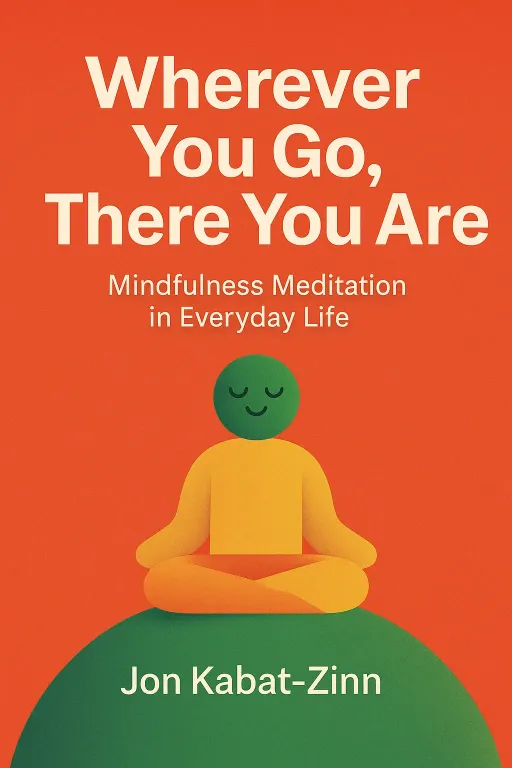
Atlas: And we are not just talking about theory here. We are looking at two very specific, very grounded approaches. On one hand, we have Jon Kabat-Zinn’s perspective in his classic work, Wherever You Go, There You Are. And on the other, we are diving into the clinical, neuro-focused insights from Melanie Greenberg’s The Stress-Proof Brain.
Nova: It is a powerful combination. Kabat-Zinn essentially pioneered the way we bring mindfulness into the secular, medical world. He stripped away the mystery and showed that mindfulness is just non-judgmental awareness. And then you have Dr. Melanie Greenberg, who is a clinical psychologist, focusing on how we can actually rewire the brain. She takes that same awareness and gives it a biological roadmap.
Atlas: That is the perfect pairing. Because one tells me to be present, and the other tells me how to physically change my brain so I can be present without wanting to scream. Let’s start with that "saber-toothed tiger" moment. Why does my brain think a spreadsheet is a predator?
The Neuroscience of the Hijack
SECTION
Nova: What you are describing is the amygdala hijack. It is the most primal part of your brain, the emotional center, and its only job is to keep you alive. When it senses a threat—whether it is a bear in the woods or an aggressive email from a supervisor—it pulls the fire alarm. It dumps adrenaline into your system, shuts down your prefrontal cortex, which is your rational, executive-thinking brain, and prepares you to fight or flee.
Atlas: So, when I am staring at a complex project and I feel that sudden, overwhelming urge to just close my laptop and walk away, that is literally my brain trying to protect me from a threat that doesn't exist?
Nova: That is exactly what is happening. The prefrontal cortex is the part of your brain that handles complex problem-solving, planning, and emotional regulation. When the amygdala hijacks the system, it effectively puts your higher-level thinking on pause. You lose access to your best insights because your brain is too busy preparing for a physical fight that will never happen.
Atlas: This explains so much about that "afternoon slump" feeling. I always thought it was just fatigue. But hearing you describe it this way, it sounds like my brain has been running a marathon for six hours, fighting imaginary tigers.
Nova: That is a brilliant way to put it. You are exhausting your cognitive resources by reacting to non-existent threats. Dr. Melanie Greenberg’s work in The Stress-Proof Brain is so critical here because she explains that we are not victims of this biology. We have this concept called neuroplasticity. We can literally train the brain to keep the prefrontal cortex in the driver's seat, even when the amygdala starts to twitch.
Atlas: Okay, but neuroplasticity sounds like one of those buzzwords. I am a practical person. I want to know how to actually exercise that muscle. How do I stop the amygdala from grabbing the steering wheel in the first place?
Nova: It starts with recognition. Most people live in a state of unconscious reaction. The email pings, the stress spikes, the reaction happens, and they do not even notice the chain reaction. Greenberg’s approach is about creating a gap between the stimulus—the email—and the response.
Atlas: That gap is the hardest part. When that ping happens, the reaction is instantaneous. How do I slow time down enough to insert a choice?
Nova: That is where the second piece of our puzzle comes in: Jon Kabat-Zinn. In Wherever You Go, There You Are, he argues that mindfulness is not some mystical experience where you float away on a cloud. It is just the act of paying attention, on purpose, in the present moment, without judgment.
Atlas: I think that word, "judgment," is the secret. I am always judging my own stress. Like, "Why am I stressed? I shouldn't be stressed. I need to be better than this."
Nova: You just hit the nail on the head. That secondary layer of judgment is what keeps the amygdala engaged. You feel stress, then you judge yourself for feeling it, which creates stress. Kabat-Zinn’s brilliance is in showing us that mindfulness is simply noticing, "Oh, I am feeling a spike of anxiety right now." Just labeling it without adding the, "And I am failing because of it" part.
Atlas: So, it is like observing yourself from a distance?
Nova: Exactly. It is moving from being the character in the movie who is panicking to being the director watching the scene unfold. When you are the director, you can say, "Cut. Let’s change the lighting." When you are the character, you are just trapped in the scene.
Bridging the Gap: The Actionable Blueprint
SECTION
Atlas: Okay, I am with you. So, we have the neuroscience of the hijack, and we have the mindfulness of the observer. How do we synthesize these into a daily habit? Because if I have to go meditate for an hour, I am not going to do it.
Nova: You do not need an hour. You need two minutes. And this is where the integration happens. When you feel that physiological spike, you stop. You don't try to fix the problem yet. You just breathe. Kabat-Zinn suggests simple, mindful breathing to ground yourself. You focus entirely on the sensation of the air entering and leaving your body.
Atlas: And what does that do to the amygdala?
Nova: It sends a signal to your nervous system that you are not, in fact, being chased by a tiger. It shifts you from the sympathetic nervous system, which is your fight-or-flight mode, back to the parasympathetic system, which is your rest-and-digest mode. You are literally telling your body, "Stand down. It is safe."
Atlas: Okay, so I breathe for two minutes. I’ve calmed the physical alarm. Now, what do I do to address the source of the stress? This is where Greenberg’s work comes in, right?
Nova: Yes. Once you are grounded, you ask the primary stress-proofing question: "Is this threat real, or is my brain misinterpreting the situation?"
Atlas: That is so simple, but I can see why it would be effective. It forces the prefrontal cortex back online. It makes me stop and analyze the data rather than just reacting to the emotion.
Nova: Exactly. You are turning the problem into a logic puzzle. Is this email actually a threat to my survival? No. It is a request for data. Is this deadline a life-or-death situation? No. It is a work project. By asking that question, you are delegating the response to the rational part of your brain.
Atlas: I really like how this shifts the identity of the person doing the work. You are not a "stressed person." You are an "analytical architect of your own focus." It changes the whole vibe of the workday.
Nova: It does. And it changes your long-term capacity. Think about the cumulative effect of this. If you do this five, ten times a day, you are literally sculpting your brain’s architecture. You are strengthening the neural pathways of the prefrontal cortex and weakening the knee-jerk reaction of the amygdala. This is neuroplasticity in action.
Atlas: It sounds like I am building a foundation for sustainable growth rather than just white-knuckling my way through the week.
Deepening the Insight
SECTION
Nova: That is the ultimate goal. Most people treat resilience like a resource you spend, and eventually, you run out. But if you practice this, resilience becomes a skill you build. It is not about avoiding stress. It is about changing your relationship with it.
Atlas: I have a question about the "non-judgmental" part. What happens when I try to do this, and I fail? Like, I try to breathe, I try to ask the question, but I am still just incredibly frustrated?
Nova: Then you notice that frustration, too. You say, "Oh, I am feeling frustrated." And then you notice the frustration about being frustrated. You just keep observing. The goal isn't to be a robot who never feels stress. The goal is to be someone who doesn't get swept away by it.
Atlas: That is a huge distinction. I think a lot of people think mindfulness is about achieving a state of perfect calm. But you are saying it is about achieving a state of perfect.
Nova: That is a profound way to put it. Yes. Clarity. You see the stress, you see the reaction, and you see the choice you have to respond differently.
Atlas: I am thinking about the cultural impact of these ideas. Kabat-Zinn’s work really changed how we view mental health, didn't it? It moved it from something "soft" or "alternative" to something that is actually just basic brain hygiene.
Nova: Absolutely. He brought this into major medical centers. He proved that this is not about incense and candles; it is about cognitive health. And Greenberg adds the modern, clinical validation to it. Together, they form a complete picture. One gives you the philosophy of being, the other gives you the mechanics of doing.
Atlas: It feels like this is the missing piece for anyone in a high-pressure environment. We are all trained to optimize our workflows, our time management, our software tools. But we rarely talk about optimizing the hardware—the brain—that is actually doing all that work.
Nova: We are the only piece of technology that doesn't come with an instruction manual. We are expected to just "figure it out." But these books provide that manual. It is about understanding that your brain is not an enemy to be conquered, but a tool to be calibrated.
Atlas: I love the idea of calibration. It sounds so much more precise than "self-improvement." It implies that the potential is already there; we just need to tune it.
Synthesis & Takeaways
SECTION
Nova: So, let’s synthesize this for our listeners. If you are feeling overwhelmed, you do not need a massive lifestyle overhaul. You need two minutes and two questions.
Atlas: Two minutes for the mindful breathing to reset the nervous system. And the two questions are: "Is this threat real?" and "Is my brain misinterpreting the situation?"
Nova: And remember, the goal isn't to eliminate stress. The goal is to reclaim your executive function. When you can discern between a real threat and a perceived one, you stop wasting your energy on the wrong things.
Atlas: That really does change the day. It turns that "Monday morning" panic into an analytical, productive session. I feel like if I start my day with that awareness, the rest of the day has a completely different trajectory.
Nova: That is the power of being a mindful architect. You are not waiting for the environment to become calm. You are building the internal structure to remain calm regardless of the environment.
Atlas: I am definitely going to try this. It is one of those things where the simplicity is deceptive. It seems so easy, but it is actually a massive shift in how we operate.
Nova: It is the most challenging work you will ever do, and the most rewarding. It is the work of being human in a modern world.
Atlas: I love that. Well, that is a perfect place to wrap up. We have explored the amygdala hijack, the power of non-judgmental awareness, and the practical, two-minute blueprint to rewire our stress response.
Nova: And remember, you don't have to get it right every time. You just have to notice when you are off-track and come back to the present. That is the practice.
Atlas: Thank you for walking me through this. I feel like I have a much better handle on my own "hardware" now.
Nova: It has been a pleasure. And to our listeners, take those two minutes. Your brain will thank you.
Atlas: This is Aibrary. Congratulations on your growth!