

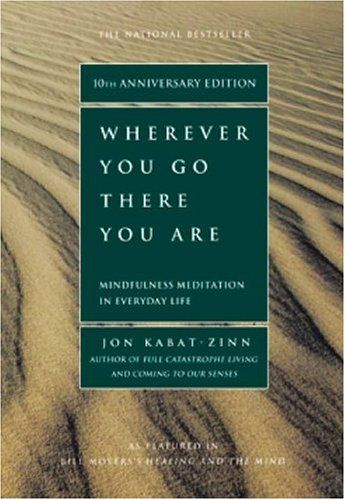
Wherever You Go, There You Are
Mindfulness Meditation in Everyday Life
Introduction
Nova: Have you ever noticed how we spend most of our lives trying to get somewhere else? We are constantly planning for the next vacation, the next job, or even just the next hour. But there is a classic book that challenges that entire way of living. It is called Wherever You Go, There You Are by Jon Kabat-Zinn.
Atlas: I have to admit, when I first saw that title, I thought it was a travel guide. Like some kind of witty commentary on how you can never escape your luggage. But it is actually the opposite of a travel guide, right?
Nova: Exactly. It is a guide to staying put. Not necessarily physically, but mentally. Jon Kabat-Zinn is often called the father of modern secular mindfulness, and this book, which came out in 1994, was really the moment mindfulness broke into the mainstream. It is not about becoming a monk or moving to a cave. It is about the fact that no matter where you run, your mind, your habits, and your internal world come right along with you.
Atlas: So, the title is actually a bit of a warning. You can go to the most beautiful beach in the world, but if your mind is a chaotic mess of stress and anxiety, you are still going to be stressed on that beach. You are there, and so is your stress.
Nova: Precisely. Kabat-Zinn argues that we spend so much time in what he calls automatic pilot that we actually miss most of our lives. We are living in the future or the past, and the present is just this inconvenient bridge we have to cross to get there. Today, we are going to dive into his philosophy and see how he suggests we actually show up for our own lives.
Key Insight 1
The Art of Non-Doing
Nova: One of the most provocative ideas in the book is the concept of non-doing. In a world that is obsessed with productivity and side hustles, Kabat-Zinn tells us to stop. But he does not mean stop being productive. He means stop trying to get somewhere else while you are doing what you are doing.
Atlas: Non-doing sounds like a fancy word for being lazy. How does he distinguish between just sitting on the couch scrolling through your phone and this intentional non-doing?
Nova: That is a great question. Scrolling on your phone is actually a form of doing. You are consuming, you are reacting, you are distracting yourself. Non-doing is a deliberate choice to be still and fully present with whatever is happening, without trying to change it. It is about being rather than doing. He uses this great phrase: we are human beings, not human doings.
Atlas: I like that. But it feels incredibly uncomfortable. If I sit still for five minutes without a goal, my brain starts screaming at me. It starts listing all the emails I should be answering or the laundry that needs folding.
Nova: And Kabat-Zinn would say that is exactly the point. That screaming is your automatic pilot trying to regain control. He suggests that mindfulness is the act of observing that screaming without getting swept away by it. It is like watching a storm from inside a sturdy house. You see the wind and the rain, but you are not being blown away.
Atlas: So, it is not about clearing the mind? Because that is the biggest misconception I hear. People say they cannot meditate because they cannot stop thinking.
Nova: Right! He is very clear about that. You cannot stop thoughts any more than you can stop the waves in the ocean. But you can learn to surf. Mindfulness is the surfing. It is the awareness of the thoughts. He defines mindfulness as paying attention in a particular way: on purpose, in the present moment, and non-judgmentally.
Atlas: That non-judgmental part seems like the hardest bit. I can pay attention to my thoughts, but usually, my attention is followed immediately by me telling myself how stupid those thoughts are.
Nova: That is where the seven pillars of mindfulness come in. These are the foundational attitudes he says we need to cultivate. They are non-judging, patience, beginner's mind, trust, non-striving, acceptance, and letting go. If you can bring those to your non-doing, the whole experience changes.
Atlas: Non-striving really jumps out at me. We are taught from birth to strive. If you are not striving, you are failing. How do you meditate without striving to be good at meditation?
Nova: It is a paradox, right? You are meditating to get the benefits of meditation, but the more you strive for those benefits, the less likely you are to get them. Kabat-Zinn says you have to let go of the idea of getting anywhere. You are already here. There is nowhere to go. You are just sitting to sit. It is the ultimate act of rebellion against a culture that demands results.
Key Insight 2
The Seven Pillars and the Beginner's Mind
Nova: Let's look closer at those pillars, because they really are the backbone of the book. Take the beginner's mind. This is the idea of seeing things as if for the first time. We think we know what a raisin tastes like or what our walk to work looks like, so we stop actually seeing them.
Atlas: I definitely do that. I could walk the same route for ten years and not notice a new tree being planted. My brain just filters it out because it is familiar.
Nova: Exactly. Kabat-Zinn argues that this filtering makes our lives feel shorter and duller. When you use a beginner's mind, you drop your expectations and your past experiences. You look at your partner, your child, or even a sunset with fresh eyes. It prevents us from being stuck in our own ruts.
Atlas: And what about trust? He mentions trusting yourself. That feels a bit risky if you feel like your mind is a mess.
Nova: It is about trusting your own intuition and your own body. Instead of looking to an external authority or a book to tell you how you should feel, you trust your own experience. It is a form of self-reliance. You are the only person who can live your life, so you have to trust the signals your life is giving you.
Atlas: I also wanted to ask about patience. In the book, he says patience is a form of wisdom. But usually, we think of patience as just waiting for something better to happen.
Nova: For Kabat-Zinn, patience is the recognition that things unfold in their own time. You cannot hurry a flower to bloom. When we are impatient, we are essentially saying we don't want to be in this moment; we want to be in the next one. Patience is the act of being completely open to this moment, even if it is uncomfortable or boring.
Atlas: That ties back into acceptance, doesn't it? Acceptance always sounds like giving up to me. Like, if I accept that I am stressed, I am just going to stay stressed forever.
Nova: That is a common misunderstanding. Acceptance in this context isn't passive resignation. It is just acknowledging the reality of what is happening right now. If it is raining, you accept that it is raining. Denying it or getting angry at the clouds doesn't stop the rain. Once you accept that it is raining, you can decide to grab an umbrella. But you have to start with the truth of the moment.
Atlas: So, it is about clarity. You can't change a situation effectively if you are busy pretending it isn't happening or wishing it were different. You have to see it clearly first.
Nova: Precisely. And that clarity comes from non-judging. We spend so much energy categorizing everything as good, bad, or neutral. This person is annoying, this weather is terrible, this coffee is okay. Kabat-Zinn suggests that this constant judging is exhausting. When we stop judging, we free up all that energy to actually experience our lives.
Key Insight 3
Becoming the Mountain
Nova: One of the most famous parts of Wherever You Go, There You Are is the section on guided visualizations, specifically the Mountain Meditation. It is a powerful way to understand how mindfulness works in the face of life's chaos.
Atlas: I have heard of this one. You are supposed to imagine yourself as a mountain, right? But I always wondered, why a mountain? Why not a tree or a river?
Nova: A mountain represents ultimate stability. Think about it. A mountain sits there through every season. In the summer, it is scorched by the sun. In the winter, it is covered in ice and snow. Storms come, clouds cover the peak, tourists come and go, but the mountain just sits. It remains the mountain.
Atlas: So the weather represents our emotions and life events?
Nova: Exactly. The weather is constantly changing. Sometimes it is beautiful, sometimes it is violent. But the mountain doesn't take the weather personally. It doesn't try to hold onto the sunny days or push away the blizzards. It just embodies stillness and strength. When we practice this meditation, we are training ourselves to be the mountain, while our thoughts and feelings are just the weather passing through.
Atlas: That is a really grounding image. It makes me realize how often I think I am the storm. I feel angry, and I think, I am an angry person. But the mountain meditation says, no, you are the mountain, and anger is just a thunderstorm passing over your peak.
Nova: That is a huge shift in perspective. And he follows it up with the Lake Meditation. In this one, you imagine your mind as the surface of a lake. When the wind blows, the surface gets choppy and distorted. You can't see through it. But if you go deep enough, the water is always still and clear, no matter what is happening on the surface.
Atlas: I like that because it acknowledges that we can't always control the wind. Life is going to be windy. People are going to be difficult, work is going to be stressful. But we have this depth within us that remains untouched.
Nova: And the key is that the lake doesn't fight the wind. It just contains it. Kabat-Zinn is teaching us how to hold our experience, rather than being held captive by it. He also talks about the importance of posture in these meditations. He says that how you sit is a statement in itself. Sitting with a straight back and an open chest isn't just about ergonomics; it is an embodiment of dignity.
Atlas: Dignity. That is an interesting word to use for meditation. It makes it feel more like an act of self-respect than just a relaxation technique.
Nova: It is! He says that by sitting, you are making a statement that you are worth your own time and attention. You are taking a stand for your own life. It is a very empowering way to look at something as simple as sitting still.
Key Insight 4
Mindfulness in the Mundane
Nova: Perhaps the most practical part of the book is where Kabat-Zinn explains that mindfulness isn't just for the meditation cushion. If you can only be mindful while sitting in a quiet room, you are missing the point. He talks about mindfulness in everyday activities, like cleaning the stove or taking out the trash.
Atlas: This is where it gets real for me. I can see myself trying to be a mountain for ten minutes, but being a mountain while I am stuck in traffic or doing the dishes? That feels like a whole different level.
Nova: He actually has a chapter called Going Upstairs. He suggests that even the act of walking up a flight of stairs can be a complete meditation. Instead of thinking about what you are going to do when you get to the top, you feel the weight shifting from one foot to the other. You feel the breath in your lungs. You are just walking up the stairs.
Atlas: It sounds like it would make everything take longer. If I am being that intentional, am I going to be late for everything?
Nova: It is funny, people often find the opposite. When you are fully present, you are more efficient because you aren't wasting energy on unnecessary stress or distraction. You are less likely to drop things or make mistakes. But more importantly, you are actually living those moments. If you spend your whole life rushing to the next thing, you are essentially wishing your life away.
Atlas: He also talks about parenting as a meditation, which I found fascinating. Because parenting is usually the least calm thing I can imagine.
Nova: He calls it the ultimate long-term retreat. He points out that children are naturally mindful. They are fully in the moment until we teach them not to be. Parenting mindfully means seeing your children for who they are, rather than who you want them to be. It means responding to them rather than reacting out of your own stress.
Atlas: That goes back to the non-judging and the beginner's mind. Seeing your kid with fresh eyes every day instead of just seeing the mess they made or the noise they are making.
Nova: Exactly. And he even applies this to things like physical pain. Kabat-Zinn's background is in medicine—he started the Mindfulness-Based Stress Reduction clinic. He found that when people with chronic pain stopped fighting the pain and started observing it mindfully, their relationship to the pain changed. The pain might still be there, but the suffering decreased because they weren't adding the layer of mental resistance to it.
Atlas: So, the suffering is the resistance? The pain is the event, but the suffering is our reaction to it?
Nova: That is a classic Buddhist insight that Kabat-Zinn brings into a secular, medical context. He says we can't always control the 10,000 joys and 10,000 sorrows of life, but we can control how we show up for them. Whether you are eating a grape or dealing with a major life crisis, the practice is the same: come back to the breath, come back to the present, and just be there.
Conclusion
Nova: We have covered a lot of ground today, from the seven pillars of mindfulness to the stability of the mountain. Wherever You Go, There You Are is a reminder that the life we are looking for is already happening, right under our noses.
Atlas: It is a bit of a relief, honestly. The idea that I don't have to go to a retreat in the Himalayas to find peace. I just have to show up for my own life, even the boring parts. Especially the boring parts.
Nova: That is the secret. The mundane moments are the fabric of our lives. If we wait for the big, exciting moments to be happy, we are going to miss about 99 percent of our existence. Kabat-Zinn's work has paved the way for mindfulness in schools, hospitals, and workplaces, but at its heart, it is a very personal invitation. It is an invitation to stop running and start living.
Atlas: I think the biggest takeaway for me is that mindfulness isn't a destination. It is not something you achieve and then you are done. It is a way of being that you have to choose over and over again, every time you realize you have drifted off into automatic pilot.
Nova: And that realization—the moment you notice you are not present—that is actually the moment of mindfulness. You don't have to judge yourself for drifting. You just gently bring yourself back. As the title says, wherever you go, there you are. You might as well get to know the person who is always there with you.
Atlas: It is a lifelong journey that doesn't require a single plane ticket. Just a little bit of breath and a lot of patience.
Nova: Well said. If you are looking for a place to start, this book is a timeless companion. It doesn't ask you to change who you are; it just asks you to be who you are, fully and without apology.
Nova: This is Aibrary. Congratulations on your growth!