Navigating the Digital Frontier: Humanity's Future with Technology
Golden Hook & Introduction
SECTION
Nova: Imagine a future where humanity isn’t just using technology, but literally with it. Where our very essence, our potential, is being continuously redefined and expanded by the machines we create. Sounds like science fiction, right? But what if the very act of that evolution also carried a hidden cost, subtly chipping away at the unique spark of our individual selves?
Atlas: Whoa, Nova, that’s a pretty heavy thought to start with. You’re painting a picture of both boundless possibility and a quiet, almost insidious erosion of identity. That’s a tightrope walk.
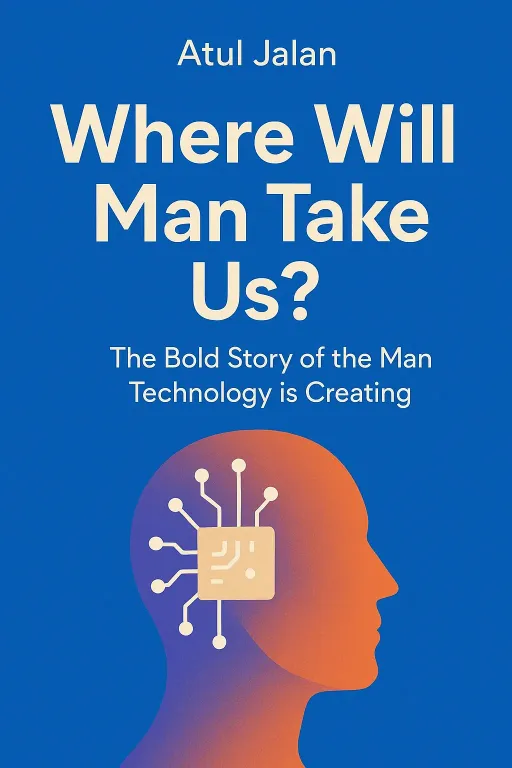
Nova: It absolutely is, Atlas. And it’s the profound tension at the heart of our discussion today. We’re diving into two brilliant, yet contrasting, perspectives that force us to confront our relationship with the digital frontier. On one hand, we have Atul Jalan’s visionary work,, a book that's been widely acclaimed for its optimistic, forward-thinking perspective on how technology can redefine human potential. Jalan, a futurist and entrepreneur, isn't just predicting the future; he’s challenging us to consciously architect it.
Atlas: And on the other side of that coin, we have the equally powerful, and frankly, quite unsettling, counter-narrative from Jaron Lanier in. Lanier, a true pioneer of virtual reality and a founding father of digital culture, offers a sharp critique. His unique position as someone who helped build the digital world makes his warnings about its reductive nature incredibly potent. It’s a book that sparked quite a debate upon its release, with some hailing him as a prescient prophet and others finding his views overly pessimistic.
Nova: Exactly. So, what we’re really exploring today is this deep question: How can we actively shape technology to enhance humanity's future, rather than passively allowing it to redefine us in ways that might diminish our core values and individuality? It’s about agency, intention, and understanding the profound choices before us.
Deep Dive into Technology as an Enhancer (Jalan)
SECTION
Atlas: I love that framing, Nova, because it moves beyond just being 'pro-tech' or 'anti-tech.' So, let’s start with Jalan’s vision. When he talks about technology redefining human potential and our very essence, what does that look like in practice? Are we talking about augmenting our bodies, our minds, or something even more fundamental?
Nova: It’s all of the above, Atlas, but with a crucial distinction. Jalan isn't just talking about building better tools; he's talking about a symbiotic relationship, a genuine co-evolution. Think of it less like a hammer and nail, and more like a second brain, or an extension of our sensory apparatus. He envisions technology as a canvas for our deepest human desires to explore, create, and connect on unprecedented scales.
Atlas: I can see that. It's like our primal urge to build, but now we're building extensions of our minds, not just our muscles. But how does Jalan see us 'redefining' our essence? Are we talking about neural implants that let us control devices with our thoughts, or something more subtle, like AI companionship changing how we understand relationships?
Nova: Both, actually. He delves into areas like neural interfaces, where our thoughts could directly interact with digital environments, opening up new forms of communication and creativity. Imagine artists who can sculpt virtual worlds with their minds, or scientists who can "feel" complex data sets. But it's also about the more subtle ways AI is becoming an extension of our cognitive processes. Consider personalized learning AI that understands your unique learning style better than you do, guiding you to master complex subjects at an accelerated pace. Or AI that helps you draft a symphony, not by writing it for you, but by understanding your musical intent and suggesting harmonies you might never have conceived.
Atlas: That sounds almost utopian. The idea of technology not just aiding us, but genuinely expanding what it means to be human, to be creative, to learn. But wait, what’s the catch? Is there a point where the extension becomes the master? Where does the 'human' part of 'human potential' go if AI is doing half the thinking or creating?
Nova: That's the core tension Jalan acknowledges, even in his optimism. He argues that the danger isn't in the technology itself, but in our. He believes we have agency. The goal isn’t to outsource our humanity, but to use technology to it. He suggests that if we approach this co-evolution consciously, with a clear understanding of our values, we can direct technology to help us become human, not less. For example, by offloading rote tasks to AI, we free up our minds for deeper philosophical inquiry, for more profound creative expression, for more meaningful human connection. He pushes us to think of it as shedding limitations, much like our ancestors shed fur or developed language, to unlock new modes of being. It's about taking technology somewhere, not the other way around. He suggests that this forward-looking perspective is vital, otherwise, we risk reacting to the future instead of designing it.
Deep Dive into The Perils of Reductive Platforms (Lanier)
SECTION
Atlas: That’s a powerful distinction: agency versus passivity. But that leads us perfectly to the other side of this coin, doesn't it? Because while Jalan sees this incredible future where we consciously evolve with technology, someone like Jaron Lanier is sounding a very different kind of alarm. He’s arguing that we’re often allowing technology to diminish us.
Nova: Precisely. Lanier, with his deep understanding of how these systems are built, argues that many digital platforms — especially social media and what he calls 'Web 2.0' — are fundamentally reductive. They take the rich, messy complexity of human experience and try to distill it into quantifiable data points: likes, shares, followers, metrics. And in doing so, they subtly but powerfully reshape our behavior, our thoughts, and even our sense of self.
Atlas: He’s not just talking about privacy, is he? He's really digging into how these platforms can diminish our very humanity. What does he mean by the title of his book,?
Nova: It’s a profound statement, Atlas. He means that our individual consciousness, our unique creativity, our nuanced emotions, cannot be fully captured or represented by the simplified interfaces and algorithms of these platforms. When you reduce a person to a profile, a series of posts, or a set of preferences, you lose the essence of what makes them uniquely human. We start to self-censor, to perform for the algorithm, to cater to what gets rewarded with engagement, rather than expressing our authentic selves.
Atlas: That sounds rough, but it resonates. For anyone trying to build something unique, or just be themselves online, you feel that pressure to conform to what the platform 'wants.' I mean, it’s like being an aspiring architect who can only build houses that fit into a pre-approved, algorithmically optimized template. The unique vision gets flattened.
Nova: Exactly! Lanier argues that this creates a 'hive mind' effect. Instead of fostering true individuality, these platforms encourage a kind of groupthink, where opinions are polarized, debates are shallow, and genuine creative expression is often drowned out by meme culture or viral trends. He points out how platforms incentivize a lowest common denominator of interaction, favoring outrage or superficiality over thoughtful discourse. It's not just that our creativity is commodified; it's that the of creativity itself shifts from personal exploration to algorithmic optimization.
Atlas: So, how does Lanier propose we resist this gravitational pull? Because it feels like these platforms are so deeply embedded in our lives, it's hard to imagine just opting out. What’s his call to action for reclaiming our distinct voices?
Nova: His resistance isn't about abandoning technology entirely. He’s too much of a tech visionary for that. Instead, it’s about conscious engagement and refusing to be reduced. He urges us to reclaim our individual agency by understanding how these systems work and by consciously choosing to express our full, complex selves. It means valuing unique, nuanced thought over instant validation, and resisting the urge to simplify ourselves for algorithmic consumption. It’s about building a strong inner compass, as our user profile might suggest, to navigate these powerful external forces. He advocates for a return to what he calls "digital dignity" – recognizing that our human experience is inherently richer than any data point.
Synthesis & Takeaways
SECTION
Nova: So, we have these two powerful, almost conflicting visions. Jalan’s boundless potential for human augmentation and co-evolution, and Lanier’s urgent warning against the subtle diminishment of our core humanity by reductive platforms. It’s like looking through two different lenses at the same future.
Atlas: It truly is. It's not about being purely pro-tech or blindly anti-tech, is it? It’s about being incredibly intentional. For our listeners, who are trying to navigate this digital frontier, who are aspiring architects of their own future and empathetic navigators of the world around them, what’s the core insight here? How do we hold these two truths at once?
Nova: The core insight, Atlas, is that technology is not a neutral force that simply 'happens' to us. It's a mirror and a tool, and what it reflects and what it builds depends entirely on our values, our awareness, and our active participation. Jalan inspires us with the of profound growth, while Lanier warns us of the of passive consumption. The real power lies in our conscious choice to engage with technology in a way that enhances our core values and individuality, rather than letting it erode them. It’s about asking that deep question every single day:
Atlas: That’s a powerful question to hold onto. It means we don't just consume, we create, we question, we lead. It means protecting that unique spark, that messy, unquantifiable human element. It reminds me that true growth isn't just about accumulating more, but about thoughtfully integrating what serves us and discarding what diminishes us.
Nova: Exactly. It's about embracing the unknown with our questions as our compass, and protecting that focused learning time to understand these complex dynamics. That's how we build a strong inner compass for the future we wish to shape.
Atlas: Absolutely. And that’s a journey we hope you’ll continue with us.
Nova: This is Aibrary. Congratulations on your growth!