

Unlocking Your Creative Genius: Harnessing Serendipity in Agent Engineering.
Golden Hook & Introduction
SECTION
Nova: What if I told you that the 'aha!' moment, that sudden flash of genius we all chase, is actually a myth? And that believing in it might be holding back your Agent engineering breakthroughs?
Atlas: Wait, are you saying that all those stories about Newton's apple or Archimedes in the tub are just… feel-good fiction? Because honestly, that's how I often feel when I'm staring at a complex architectural problem, waiting for that lightning bolt.
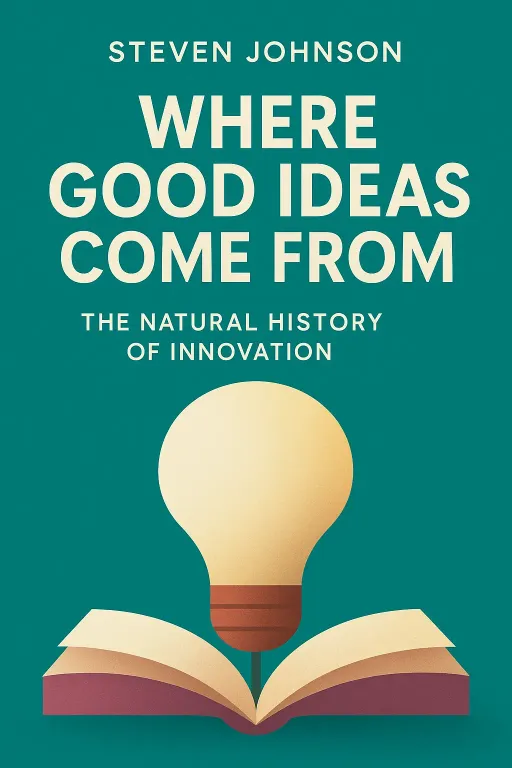
Nova: Exactly! And that's what we're dissecting today, drawing insights from two seminal works: Steven Johnson's 'Where Good Ideas Come From' and Frans Johansson's 'The Medici Effect.' Johnson, with his fascinating blend of science journalism and interactive media, really unearths how innovation truly blossoms. And Johansson, whose own incredibly diverse upbringing, having grown up in Sweden with a Swedish father and a Chinese mother, and working across fields from sports to IT, gives us a practical roadmap for generating those breakthroughs.
Atlas: Okay, so if it's not the lightning bolt, what is it? Because for us building complex Agent systems, 'innovation' needs to be more than just a hope and a prayer. We need a method, something we can actually engineer.
The Myth of Isolated Innovation & Slow Hunches
SECTION
Nova: You got it. Johnson introduces this brilliant concept of 'slow hunches.' He argues that great ideas aren't these sudden, isolated flashes. Instead, they're often incomplete thoughts, half-formed ideas that linger in our minds, occasionally bumping into other half-formed ideas. It’s a bit like a collection of puzzle pieces, each intriguing on its own, but only truly making sense when they finally click together after years of subtle nudges.
Atlas: Huh. So, like that nagging feeling you have about a piece of code that could be optimized, or a system architecture that feels clunky, but you can't quite put your finger on how to fix it, until you accidentally see someone else's totally unrelated solution to a different problem, and suddenly, boom?
Nova: Precisely! He uses the example of Tim Berners-Lee and the World Wide Web. It wasn't a single 'eureka!' moment in a vacuum. Berners-Lee had a long-standing 'hunch' about information sharing, about hyperlinking documents, and about network protocols. These weren't sudden insights; they were nurtured over years, in a highly collaborative, information-rich environment like CERN. The 'adjacent possible' is a key part of this. It’s the idea that at any given moment, the universe of possible innovations is constrained by the existing elements. You can only combine what's already there to create something new.
Atlas: So, it's not about inventing completely new atoms, but about finding novel ways to combine the ones we already have, the existing libraries, models, data structures. That makes total sense for Agent engineering, where we're often integrating existing LLMs, tools, and data sources in new, intelligent ways. But how do you these 'slow hunches' and 'adjacent possibles' in a structured, deadline-driven engineering environment? It sounds a bit… fuzzy, almost too organic for a rigorous field.
Nova: That's a great question, and it's where the next piece of the puzzle fits in. Johnson emphasizes that these hunches need time and space to 'collide.' They need to be shared, discussed, even argued over, in environments that foster open exchange. Think of the coffee houses of the Enlightenment, or the bustling labs of Silicon Valley. It's about creating permeable membranes between ideas, allowing them to mingle freely.
Atlas: So, it’s about intentionally designing for those 'collisions' rather than just hoping they happen by chance? Because for a full-stack engineer or an architect, the default mode is often deep focus, maybe even isolation, to solve a specific problem. Breaking that pattern seems counter-intuitive to 'getting work done.'
Harnessing Serendipity: The Power of Intersectional Thinking
SECTION
Nova: Absolutely, and that's where Frans Johansson's 'The Medici Effect' beautifully complements Johnson's ideas. He takes this concept of combining existing elements and amplifies it by focusing on 'intersectional thinking.' He shows how breakthroughs often happen not within a single field, but at the intersection of different fields, disciplines, or cultures. It's about deliberately bringing together disparate concepts to create something entirely new.
Atlas: So, like bringing a linguist, a neuroscientist, and a software engineer into a room to build a new natural language processing agent, instead of just having the NLP team in their own silo? Because for us architects, getting different domain experts to even speak the same language, let alone innovate together, can be a monumental challenge.
Nova: It can be, but the payoff is immense. Johansson's classic example is the invention of the electric car. It didn't come from a linear progression purely within the automotive industry. It came from the convergence of automotive engineering, battery technology from outside the traditional car world, and even new design philosophies focused on sustainability. Or consider the early days of personal computing – it combined electronics, user interface design, and even counter-culture ideals of empowerment. It's about deliberately stepping outside your silo. It’s a conscious act of boundary-breaking.
Atlas: That’s actually really inspiring. I imagine a lot of our listeners, especially architects and value creators, are constantly trying to bridge those gaps between business needs, technical capabilities, and user experience. So, the 'Medici Effect' is about actively seeking out those intersections, rather than just hoping they happen, or worse, walling ourselves off?
Nova: Precisely. It’s about creating an environment where diverse ideas and cross-pollinate. It’s not just random; it’s about intentionally designing for serendipity. For Agent engineering, this means not just optimizing within your existing tech stack, but looking at how concepts from biology – like swarm intelligence or neural networks – or psychology – like cognitive biases or decision-making models – or even art, could inspire radically new agent behaviors, interaction models, or even their foundational architectures. It's about asking, 'What can I learn from a completely different domain that could unlock a new dimension for my agent?'
Atlas: That’s a powerful shift. It moves us from merely problems to actively new possibilities. For someone passionate about becoming a domain expert and achieving breakthroughs, this feels like a cheat code for creativity. It’s about looking at how a system works in one area and asking, 'Can I apply that principle to my Agent architecture?'
Synthesis & Takeaways
SECTION
Nova: Absolutely. So, connecting Johnson's 'slow hunches' and 'adjacent possible' with Johansson's 'Medici Effect,' we see that creativity isn't a solitary flash, but a collaborative, interconnected process. It's not about waiting for inspiration, but about building the conditions for it to emerge. For our listeners, especially those building high-performance Agent systems, the deep question is: where in your current Agent engineering workflow could you intentionally create more opportunities for this 'slow hunch' cultivation and 'intersectional thinking'?
Atlas: That's a profound challenge. For an architect, it means moving beyond just technical integration to actively designing systems and even team structures that foster these unexpected collisions of ideas. It’s about being a 'value creator' by orchestrating serendipity, by bringing together seemingly unrelated pieces of knowledge or people.
Nova: Exactly. It’s about breaking down the boundaries between technical and business, between different domains, between different skill sets. This isn't just about building better, more stable, or more extensible agents; it's about building a better future by fundamentally changing we build them. It's about designing for discovery.
Atlas: So, the growth advice is clear: pick one cross-domain Agent application case study—maybe an agent that blends finance with psychology, or healthcare with environmental science—dissect its core design principles, and then try to apply those intersectional concepts to your own project. That’s a concrete step towards turning these insights into actual breakthroughs, and becoming that expert you aspire to be.
Nova: Absolutely. Break boundaries, connect the unconnected, and watch the innovations flow. It's about cultivating the conditions for genius, not just waiting for it.
Atlas: Nova, this has been incredibly insightful. It really shifts the perspective from waiting for inspiration to actively building pathways for it. Thank you.
Nova: Always a pleasure, Atlas.
Atlas: This is Aibrary. Congratulations on your growth!