

The Network Effect: How Connections Drive Innovation
Golden Hook & Introduction
SECTION
Nova: You know, Atlas, we’re all told the story of the lone genius, right? The apple falling on Newton’s head, Archimedes in the bathtub shouting “Eureka!” It’s this romantic image of a single, brilliant mind having a sudden, isolated flash of insight that changes the world.
Atlas: Oh, absolutely. The solitary inventor toiling away, then! A lightbulb moment, literally. It’s a compelling narrative, makes for great movies. But I’m guessing you’re about to tell me it’s not quite that simple, are you?
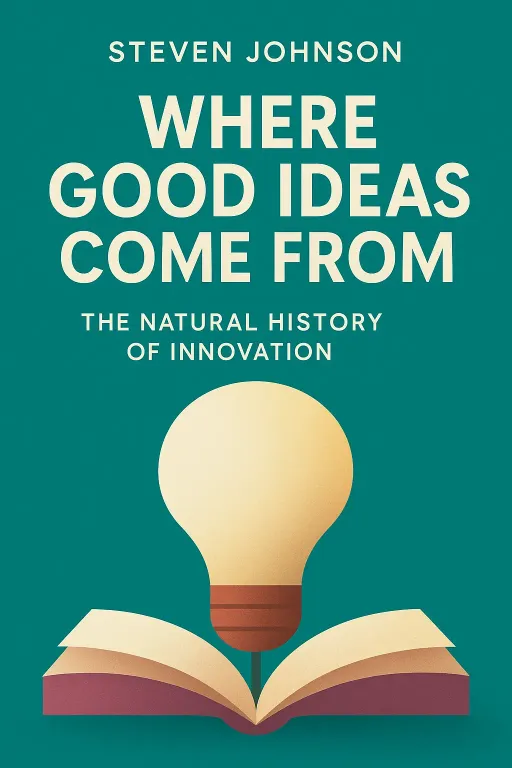
Nova: Not simple at all. In fact, it's often a profound blind spot. We fixate on the individual, when the real engine of groundbreaking ideas is something far messier, far more collaborative. It’s what Steven Johnson explores so brilliantly in his book,.
Atlas: Johnson, yes! He’s known for diving into complex systems and making them entirely accessible. So, how does his take on innovation fundamentally challenge this lone genius myth we’ve all grown up with? What’s the real story, then?
The Myth of Lone Genius & The Power of Liquid Networks
SECTION
Nova: Well, Johnson argues that innovation doesn't happen in a vacuum. It thrives in what he calls ‘liquid networks.’ Think of it like this: if ideas are droplets, they need to be able to flow, collide, and combine with other droplets to form something new and powerful. They can’t do that if they’re stuck in isolated, rigid containers.
Atlas: I like that analogy – 'liquid networks.' So, it’s not about waiting for a single brilliant person to have a revelation, but about creating an environment where ideas are constantly bumping into each other, cross-pollinating?
Nova: Exactly. He looks at historical examples, like the coffeehouses of 18th-century London. These weren’t just places to grab a latte; they were vibrant hubs where merchants, artists, scientists, and philosophers would gather, share news, debate theories, and swap observations. The sheer density of diverse minds and loose connections created an incredibly fertile ground for new concepts to emerge.
Atlas: That’s a fascinating case. So the coffeehouse itself became a kind of 'liquid network.' It wasn't one guy inventing the stock market in his attic; it was the financiers and traders sharing gossip and insights over a cup of joe that led to more sophisticated financial instruments.
Nova: Precisely! Or consider Tim Berners-Lee and the World Wide Web. While he’s rightly credited with its invention, the seeds for the web were sown in a highly collaborative environment at CERN, a place teeming with physicists, computer scientists, and engineers from around the globe, all sharing information and tools. The very culture of information sharing at CERN was a liquid network that allowed universal linking to become not just an idea, but a necessity.
Atlas: But wait, isn't there still a 'genius' who puts the pieces together? Or are we saying the network the genius? Because for anyone building a team or an organization, you still value individual talent, right? You still need that spark.
Nova: You absolutely do. It’s not about denying individual brilliance; it's about understanding the in which that brilliance flourishes. A genius in isolation might have great ideas, but a genius embedded in a rich, diverse, and fluid network has a far greater chance of those ideas colliding with others, evolving, and actually becoming something impactful. The network amplifies individual talent, giving it the raw materials and the collaborative friction it needs to truly ignite. It’s about creating the conditions for sparks to fly, not just waiting for lightning to strike.
Navigating Disruption: Why Networks Matter for Survival and Growth
SECTION
Nova: So, if ideas thrive in these vibrant, interconnected networks, what happens when organizations foster them? When they become rigid, insular, and focused only on what’s already working?
Atlas: That makes me wonder… I imagine a lot of our listeners, who are building systems, leading teams, or trying to scale, might be thinking about how to becoming one of those rigid organizations. What’s the risk if you miss these liquid networks?
Nova: That’s where Clayton Christensen's landmark work,, comes into play. He showed how even incredibly successful, well-managed companies can stumble and fail when faced with disruptive innovations. And a huge part of that dilemma is how they deal with emergent networks.
Atlas: Hold on. So, even by doing everything "right"—listening to customers, investing in R&D, optimizing processes—a company can still fail? That sounds almost counter-intuitive for someone who's spent their career building robust systems. How does that connect to these 'liquid networks' we've been talking about?
Nova: It’s because the disruptive innovations often emerge in completely different, often overlooked, 'liquid networks' of customers, technologies, and ideas. Take Blockbuster, for example. They were the undisputed king of video rentals, with a vast network of stores and a loyal customer base. They listened to their best customers, who wanted the newest releases, conveniently located.
Atlas: Right, they had the prime real estate, the marketing, the established brand. They were the definition of "doing things right" in their market.
Nova: Exactly. But in the periphery, a different kind of 'liquid network' was forming: early internet users, tech enthusiasts, and people frustrated with late fees. This nascent network was experimenting with online DVDs-by-mail services, like Netflix, which initially seemed like a niche, low-margin business to Blockbuster’s leadership. It didn’t fit their existing network model of physical stores and immediate gratification.
Atlas: So Blockbuster was focused on optimizing its network, while Netflix was cultivating a liquid network, almost under their radar. And by the time Blockbuster recognized the threat, it was too late. The new network had already solidified and gained momentum.
Nova: That’s the innovator's dilemma in action. Established companies become so good at serving their primary network that they develop structural blind spots to the smaller, often less profitable, 'liquid networks' where disruptive ideas are brewing. They don't see the value until it's too late, because it doesn't look like "innovation" through their existing lens.
Atlas: This sounds like a critical blind spot for 'The Architect' in all of us. We build systems, we create structures, we optimize for efficiency. How do we build these liquid networks within our own organizations or communities, rather than just waiting for them to happen, or worse, being disrupted by them?
Nova: That's the deep question, and it’s about more than just "networking." It’s about designing for serendipity. It means encouraging cross-disciplinary collaboration, creating physical and virtual spaces where people from different departments or even different industries can casually interact and share ideas. It means fostering a culture of psychological safety where nascent, half-baked ideas aren’t immediately shot down. It's about open information flows, not hoarding knowledge. It’s about diverse teams, not just in demographics, but in thought and experience.
Synthesis & Takeaways
SECTION
Atlas: So, it's about shifting our focus from solely spotlighting individual brilliance to illuminating the entire stage where ideas dance and collide. It’s about recognizing that the environment we create often dictates the quality and frequency of those sparks.
Nova: Precisely. It’s a profound shift in perspective. Fostering these liquid networks isn't just about 'more connections'; it's about creating the conditions for —collisions of diverse thoughts, backgrounds, and perspectives. It's the systemic recognition that our collective intelligence, when properly channeled, far outweighs any single mind.
Atlas: This gives me chills. For anyone building systems, leading teams, or just trying to make a meaningful dent in the universe, this means actively designing for collision, not just creation. It’s about building human connection into the very fabric of innovation.
Nova: It really is. It means understanding that the future isn't just invented by a few; it's co-created by many, in these dynamic, often invisible, networks. Our greatest innovations often arise from the unexpected dance between disparate ideas.
Atlas: Wow. So, your challenge this week: find one new 'liquid network' to dip your toes into, or create a space for an unexpected idea collision within your own work. It could be a new online community, a cross-departmental coffee chat, or even just asking a colleague from a different field for their perspective on a problem. Journal what sparks.
Nova: This is Aibrary. Congratulations on your growth!