

The 'Adjacent Possible' Law: Expanding Your Horizon Without Losing Focus
Golden Hook & Introduction
SECTION
Nova: Most people think the best way to innovate, to find that next big breakthrough, is to lock yourself in a room, focus intensely, and wait for a flash of individual genius. What if I told you that's almost entirely wrong, and it might actually be holding you back from truly transformative ideas?
Atlas: Hold on, Nova. Are you really suggesting that the image of the lone inventor toiling away in their lab, that classic narrative, is a myth? Because for a lot of our listeners, especially those in high-stakes, competitive fields, that intense focus is practically a religion.
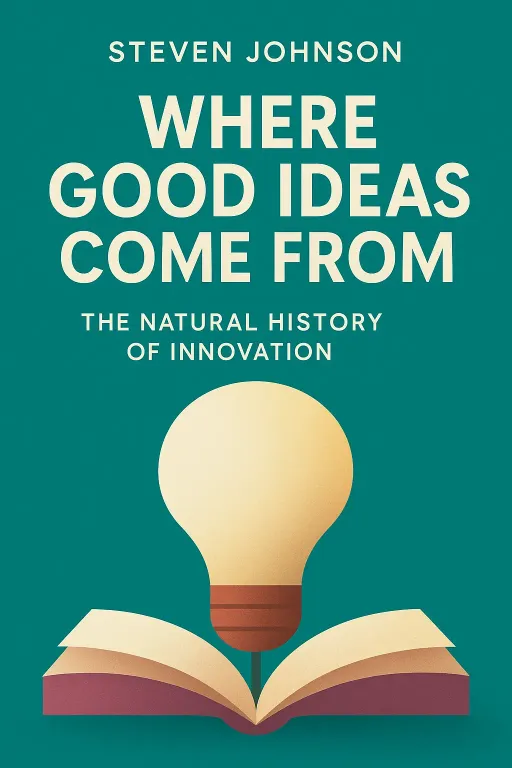
Nova: Absolutely, Atlas. It's not just a myth, it's a deeply misleading one. Today, we're diving into what we call the "adjacent possible" – that fertile ground just beyond our current understanding. And we're going to explore it through the brilliant insights of two books: Steven Johnson's "Where Good Ideas Come From" and David Epstein's "Range."
Atlas: Oh, I like that. The "adjacent possible." It sounds like the sweet spot between comfortable and completely overwhelming.
Nova: Precisely. And what's fascinating is how these authors, with their distinct backgrounds, converge on this idea. Steven Johnson, for instance, a renowned media theorist and science writer, brings this incredible interdisciplinary lens to understanding how innovation truly happens. And David Epstein, with his roots in journalism and sports, grounds his argument for broad exploration in incredibly tangible, high-performance contexts.
Atlas: That's a great combination already. So, we're not just talking theory, we're talking about how these principles play out in the real world.
Nova: Exactly. Today, we'll slice through the romanticized notion of singular genius. We'll explore how ideas truly come to be, moving beyond that myth. And then, we'll discuss why being a generalist might actually be your secret weapon for navigating an uncertain future and discovering what's just on the horizon.
The Nature of Breakthroughs: Beyond Solo Genius to Connected Ecosystems
SECTION
Nova: So let's start with that first big idea: the nature of breakthroughs. Johnson's "Where Good Ideas Come From" really unpacks this concept of the "adjacent possible." He argues that truly significant innovations don't just spring forth fully formed from one person's mind. They arise from environments that foster diverse connections, what he calls "liquid networks," and from something he terms "slow hunches."
Atlas: Slow hunches? That sounds almost… counter-intuitive to the fast-paced, always-on world we live in. I mean, we're constantly pushed for immediate results and instant insights. So, you're saying that mythical 'aha!' moment is actually just the tip of a very slow-moving iceberg?
Nova: In many cases, yes! Think of it like this: an idea isn't a single, perfect seed. It's more like a collection of smaller, incomplete ideas, fragments of insight, that float around, sometimes for years. A slow hunch is one of those fragments, something you vaguely sense but can't quite articulate or connect to anything concrete yet.
Atlas: That makes me wonder, how does that even work? How do these "slow hunches" become anything useful if they're just… floating? Can you give an example of one of these "liquid networks" in action, where multiple, seemingly unrelated ideas just coalesce?
Nova: Absolutely. Consider the story of the World Wide Web itself. We often credit Tim Berners-Lee, and rightly so, for its creation. But Johnson illustrates beautifully how it wasn't a sudden flash of genius in isolation. Berners-Lee was working at CERN, the European Organization for Nuclear Research. This was a place overflowing with brilliant minds from different disciplines, all trying to share complex information across vast distances.
Atlas: Right, a very high-intellect, high-connectivity environment.
Nova: Exactly. Berners-Lee had a "slow hunch" about connecting information in a non-linear way, something he'd been thinking about for years. But it was the of CERN – the diverse connections, the shared problem, the existing network infrastructure, the informal coffee-break conversations – that provided the 'liquid network' for these disparate ideas to finally collide and merge into the Web. It wasn't just his genius; it was his genius. The cause was a personal hunch meeting a fertile environment, the process was iterative connection and development, and the outcome was revolutionary global communication.
Atlas: That's fascinating. For leaders trying to foster innovation, it sounds like building the right environment is more critical than just hiring one 'superstar innovator.' It's about the ecosystem. But how do you those liquid networks? Is it just about putting smart people in a room and hoping for the best? Because we've all been in those "innovation" meetings that go nowhere.
Nova: That's a crucial distinction. It's not just about proximity, but about creating conditions for and. It means encouraging diverse teams, fostering informal communication channels, and giving people the freedom and bandwidth to explore ideas outside their immediate deliverables. It’s about creating an atmosphere where half-formed ideas aren't immediately dismissed but can find their complementary pieces. It’s about curiosity and collaboration, not just competition.
Atlas: So, it's less about scheduled brainstorming and more about creating an ambient hum of intellectual exchange. I can see how that would organically feed those "slow hunches." It's about designing for discovery, not just demanding it.
The Power of Generalism and Broad Exploration for Innovation
SECTION
Nova: And that leads us perfectly into our second big idea, which is about thrives in these liquid networks, and who is best equipped to explore that "adjacent possible." It turns out, it's often not the hyper-specialist, but the generalist, as brilliantly argued by David Epstein in his book, "Range."
Atlas: Wait, so you're telling me that in a world absolutely obsessed with specialization – the "10,000 hours" rule, deep expertise in one narrow vertical – that actually might be a disadvantage for innovation? That feels like a direct challenge to the conventional wisdom that drives so much career advice and corporate strategy.
Nova: It absolutely is, and Epstein provides compelling evidence for it. He argues that in complex, unpredictable environments – which, let's be honest, describes most of our world today – generalists often outperform specialists. Generalists, with their broader experiences and diverse knowledge bases, are better at making connections across fields, adapting to new challenges, and applying insights from one domain to an entirely different one. They have the "range" to see the "adjacent possible" where specialists might only see walls.
Atlas: That makes me think about some of our listeners who are global explorers or strategic analysts, constantly trying to connect dots across different markets or technologies. They're often pressured to pick a niche. So, how does a generalist's broad experience directly lead to a breakthrough in an unexpected field? Can you give an example of someone who thrived precisely because they specialize early?
Nova: Definitely. Epstein gives many examples, but one that really sticks is that of Johannes Kepler. Before becoming the astronomer who precisely described planetary motion, Kepler was a theologian, a mathematician, and dabbled in everything from optics to music theory. He brought this incredible breadth of knowledge to his astronomical observations. His deep understanding of geometry and music, for instance, allowed him to perceive patterns in planetary orbits that others, more narrowly focused on pure astronomical data, missed. He wasn't just looking at the stars; he was looking for the underlying harmonies, the mathematical music of the spheres.
Atlas: That's a perfect example. He was able to bridge concepts that others, perhaps more narrowly focused on just astronomical observation, wouldn't have even considered relevant. He had the vocabulary from multiple disciplines to articulate what he was seeing.
Nova: Exactly. The cause of his breakthrough wasn't just observing planets; it was observing them. The process involved applying theories from seemingly unrelated fields, and the outcome was a fundamental shift in our understanding of the cosmos. This ability to synthesize disparate information, to find those unexpected connections, is the hallmark of the generalist.
Atlas: That's a powerful counter-narrative to what many of our listeners, especially those in fast-paced, specialized industries like digital marketing analytics or cross-cultural marketing, are told. They're often encouraged to dive deep into one specific tool or one specific cultural segment. So, for someone aiming for sustained growth and strategic advantage in such a dynamic landscape, how do they cultivate this 'range' without feeling like they're just dabbling or spreading themselves too thin?
Nova: That's the million-dollar question, and it's not about being a dilettante. It's about being broad. It means not just consuming information within your silo, but actively seeking out knowledge from different disciplines, engaging with diverse perspectives, and even pursuing hobbies or interests completely unrelated to your main work. It's about understanding that the solutions to tomorrow's complex problems often lie at the intersection of fields, not deep within one.
Atlas: So, it's about being strategically curious, then? Not just exploring for exploration's sake, but with an eye towards bridging concepts that others might miss, almost like a future-focused leader anticipating where the next big connection will be.
Synthesis & Takeaways
SECTION
Nova: Precisely, Atlas. When you combine Johnson's insights on liquid networks and slow hunches with Epstein's argument for generalists, you get a powerful framework for truly understanding innovation. Breakthroughs aren't about solo genius or narrow, intense focus. They're about creating environments for diverse connection and cultivating personal breadth – having the "range" to spot those "slow hunches" and bring them to fruition within those "liquid networks." It's about strategically positioning yourself within the "adjacent possible."
Atlas: That makes so much sense. It's about expanding your horizon without losing focus, but redefining what 'focus' truly means. It's not just about drilling down, but also about looking up and sideways. So, for our listeners, the strategic analysts and global explorers, what's one tiny step they can take this week to start cultivating this kind of thinking?
Nova: Here's a very concrete, actionable step: dedicate 30 minutes this week – just 30 minutes – to exploring a topic completely unrelated to your core work. And as you explore, actively look for unexpected connections. It could be anything: ancient history, astrophysics, abstract art, behavioral economics in a different context. The key is the intentional search for bridges you wouldn't normally make.
Atlas: I love that. It's not about becoming an expert in that new field, but about training your brain to see connections, to foster those slow hunches. It's about creating your own personal "adjacent possible" through intentional, diverse input. That's a powerful way to think about sustained growth and strategic advantage, especially for the future-focused leader.
Nova: It truly is. Because the biggest innovations often come from those who dared to look just beyond the edge of what everyone else was seeing.
Atlas: Absolutely. That's an inspiring thought to end on.
Nova: This is Aibrary. Congratulations on your growth!