

Stop Chasing Randomness, Start Engineering Serendipity: The Guide to Intentional Discovery
Golden Hook & Introduction
SECTION
Nova: Most people think groundbreaking ideas strike like lightning. A sudden, brilliant flash of genius that changes everything in an instant. But what if that's not just wrong, but actively hindering your next big breakthrough?
Atlas: Whoa, really? That's a bold claim, Nova. I mean, we've all seen the stories: Newton and the apple, Archimedes in the bath. It feels so... serendipitous. Are you saying those moments weren't what they seemed?
Nova: Absolutely, Atlas. We're conditioned to believe in these isolated eureka moments, but the cold fact is, innovation often feels like a lucky accident, but it can be cultivated. Today, we're diving into a powerful idea from a guide we're calling "Stop Chasing Randomness, Start Engineering Serendipity: The Guide to Intentional Discovery." It's an exploration built on the insights of influential thinkers like Steven Johnson, who's reshaped our understanding of creativity, and W. I. B. Beveridge, whose classic work has guided scientific inquiry for generations.
Atlas: Okay, so this isn't just about waiting for inspiration to hit. It's about a fundamental shift in how we approach discovery. For our listeners who are constantly seeking impactful innovation, this sounds like a game-changer. What's the core idea here?
Nova: The core of our podcast today is really an exploration of how we can move beyond passively waiting for inspiration to actively designing our lives and work for continuous, meaningful innovation. We're going to challenge that myth of the lone genius and show how great ideas are actually engineered.
The Genesis of Breakthrough Ideas: Slow Hunches & Connected Networks
SECTION
Atlas: That's a fascinating reframe. So, if breakthroughs aren't just lightning strikes, how do they actually form? Where do these great ideas come from?
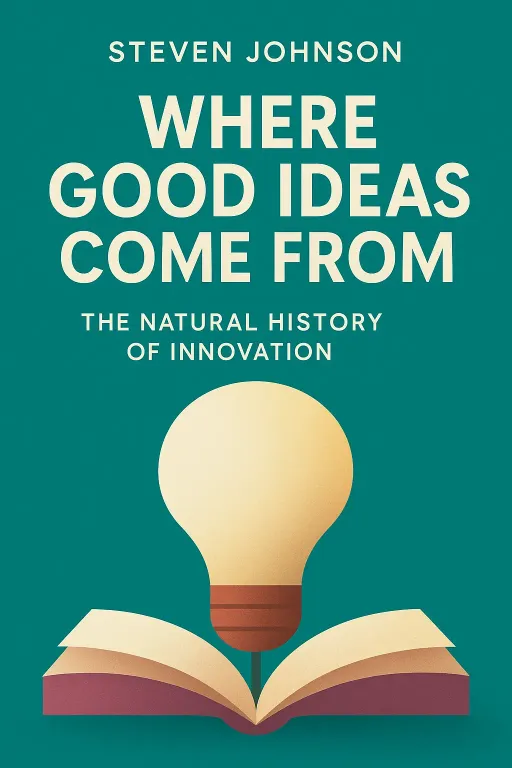
Nova: Well, Steven Johnson, in his seminal work "Where Good Ideas Come From," introduces this brilliant concept of "slow hunches." He argues that groundbreaking ideas rarely arrive as fully-formed epiphanies. Instead, they're often partial, incomplete thoughts, nascent insights that simmer in our minds, sometimes for years. They're not sudden flashes; they're more like faint signals that need to connect with other signals.
Atlas: I’ve definitely felt that – you have a nagging feeling, a piece of an idea, but it's not quite whole. So you’re saying those fragments are actually the seeds of something big? But how does a 'slow hunch' become a 'breakthrough'?
Nova: Exactly. The magic happens when these slow hunches collide and combine with other slow hunches, often from different minds or different domains. Johnson shows that these ideas thrive in what he calls "liquid networks"—environments that are open, connected, and allow for the free flow and collision of diverse information and perspectives. Think of the coffee houses of the Enlightenment, or the early days of the internet.
Atlas: Can you give us a vivid example of a 'slow hunch' in action? Something that felt random but wasn't, that illustrates this collision?
Nova: Absolutely. Take the World Wide Web itself. Tim Berners-Lee didn't wake up one morning with the complete blueprint for the internet as we know it. He had a slow hunch, a problem he kept circling: how to share information more easily among physicists at CERN. He was working in an environment rich with other brilliant minds, with existing technologies like hypertext and the internet, which were separate slow hunches in themselves. He started with a small, internal project, a personal database, then began to connect it to the network, and gradually, through years of tinkering, iterating, and combining these existing ideas and technologies, the World Wide Web emerged. It wasn't a single "aha!"; it was a confluence of many "hmm, what if...?" moments in a highly connected space.
Atlas: That's a perfect example. It debunks the myth that he just conjured it out of thin air. It was a process, a gradual assembly of existing parts in a new way. But wait, this implies a certain passivity, like we just need to hang out in smart places and wait for our hunches to connect. For our strategic innovators, those who want to things, what's the active role here? How do we consciously foster such spaces?
Nova: That's the critical question, Atlas. It's not about passive waiting; it's about active cultivation. If ideas are slow hunches that need connection, then our next step is to understand how we can that connection. It shifts our focus from hoping for inspiration to designing the conditions for it.
Engineering Serendipity: Cultivating Conditions for Intentional Discovery
SECTION
Nova: So, that naturally leads us to the second key idea: engineering serendipity. If we accept that ideas are slow hunches that mature and connect, then what deliberate practices can we adopt to create environments and mindsets conducive to these unexpected discoveries? This is where thinkers like W. I. B. Beveridge come in, emphasizing the foundational elements of scientific discovery.
Atlas: For our strategic innovators, 'engineering serendipity' sounds like a beautiful paradox. It's like trying to plan for the unplanned. How do we actually do that?
Nova: Beveridge, in "The Art of Scientific Investigation," highlights the importance of observation, curiosity, and an open mind. He stresses that good science often begins not with a brilliant theory, but with asking the right questions, and more importantly,. It's about being present enough to observe something unusual, and curious enough to chase that thread, even if it seems irrelevant at first.
Atlas: That makes sense. Like, if you're only looking for what you expect, you'll miss everything else. But for our strategic innovators, 'open mind' sounds great, but how do you that into a process? How do you move beyond just 'being curious' to actually for curiosity in a team or a project?
Nova: That's where Nova's Take comes in: building a system for innovation means consciously designing spaces and processes that encourage this collision of ideas and persistent, curious exploration. It's about creating "idea-generating ecosystems." Imagine a garden where you intentionally plant different species close to each other, knowing that their proximity might lead to unexpected cross-pollination. Or a chef who deliberately experiments with seemingly disparate ingredients, knowing a new flavor profile might emerge.
Atlas: I can see that. So, it's not just about hiring smart people and putting them in a room. It's about structuring the and the. What are some practical, tangible ways our listeners can start doing this right now?
Nova: It could be as simple as scheduling "curiosity hours" where team members are encouraged to explore topics completely outside their immediate project scope. Or implementing a "diverse input" rule, where every decision or problem-solving session include perspectives from at least two completely different departments or fields. The key is to force those collisions, to actively expose your slow hunches to other slow hunches.
Atlas: That's brilliant. It's about creating the fertile ground. So, what's a tiny step someone could take this week to actually start engineering their own serendipity?
Synthesis & Takeaways
SECTION
Nova: This whole discussion boils down to a profound shift: innovation isn't a mystical gift, it's a skill you can cultivate, an environment you can design. By understanding that ideas are slow hunches that need connection, and by consciously building systems for curiosity and observation, we move from chasing randomness to engineering intentional discovery.
Atlas: That's actually really inspiring. It means you don't have to wait for the muse; you can actually set up the conditions for the muse to show up more often. It's about shifting from 'finding the needle' to 'building a better magnet,' as you said.
Nova: Exactly! And a fantastic tiny step to start building that magnet, straight from our guide, is this: dedicate 15 minutes this week to exploring a topic completely outside your usual domain. Just 15 minutes. Look for unexpected connections to your current challenges. Read about astrophysics if you're in marketing, or ancient history if you're a software engineer.
Atlas: I love that. It's so actionable, and it directly feeds into the idea of creating those collisions of disparate ideas. That's going to resonate with anyone who is driven by intellectual curiosity and wants to see their efforts lead to meaningful innovation. It's a low-barrier entry to a high-impact outcome.
Nova: Precisely. It’s about making space for those slow hunches to find their partners. This is Aibrary. Congratulations on your growth!