

Beyond the Brainstorm: How to Generate Truly Novel Ideas
Golden Hook & Introduction
SECTION
Nova: Atlas, five words to describe your current creative process. Go.
Atlas: Stuck. Overthinking. Re-reading. Still stuck. And… one more… 'Help!' Does that count as one word?
Nova: Oh, it definitely counts! And I think a lot of our listeners can relate to that feeling of creative stagnation. We're often told to 'think outside the box,' but what if the box isn't the problem? What if it's the of the box itself?
Atlas: That’s a great way to put it. Because honestly, the pressure to come up with something 'new' feels immense sometimes, like it has to be this sudden, brilliant flash of insight.
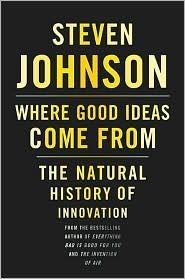
Nova: Exactly. And that's what we're challenging today. We're cracking open 'Where Good Ideas Come From: The Natural History of Innovation' by Steven Johnson. What's fascinating about Johnson is his background as a science writer and media theorist. He doesn't just look at human invention; he weaves together biology, urbanism, and digital culture to show how innovation isn't just some isolated human genius endeavor, but a deeply natural, often messy, evolutionary process.
Atlas: Oh, I like that. So, it’s not about waiting for lightning to strike. It’s about building a better lightning rod?
The Myth of the Eureka Moment: Innovation as a Slow Collision
SECTION
Nova: Precisely! Johnson argues that the 'eureka' moment, that sudden flash of genius, is largely a myth. It's great for Hollywood, but it rarely reflects how groundbreaking ideas actually emerge. He calls them 'slow hunches.'
Atlas: Slow hunches? That sounds… less dramatic. I picture a scientist in a lab, surrounded by bubbling beakers, and then BAM! The solution appears.
Nova: That's the romanticized version, right? But the reality is often much more like Charles Darwin developing his theory of natural selection. It wasn’t a single 'aha!' moment. It was a glacial process, a slow collision of diverse concepts over years.
Atlas: Wait, really? I always imagined Darwin on the HMS Beagle, looking at finches, and the whole thing just clicked into place.
Nova: Well, the finches were certainly a piece of the puzzle. But Darwin had been collecting observations for years, filling notebooks with his thoughts on geology, animal breeding, and geographical distribution. Then, years later, he read Thomas Malthus's essay on population, which argued that populations grow faster than food supplies, leading to struggle.
Atlas: So, he was observing nature, then he read an essay about economics and human population? That seems like a pretty unrelated field.
Nova: Exactly! That's the magic. Malthus's idea wasn't specifically about biology, but it provided a framework for Darwin to understand the struggle for existence in the natural world. Then he started looking at pigeon breeding, how breeders artificially selected traits. It was the of all these seemingly disparate fields—biology, economics, artificial selection—that allowed his 'slow hunch' to finally crystallize into the theory of natural selection.
Atlas: That’s incredible. So, the idea wasn’t born whole; it was assembled, piece by piece, from different intellectual neighborhoods. It makes me think about how much pressure we put on ourselves to have these instant breakthroughs.
Nova: Absolutely. Johnson emphasizes that these hunches need time to marinate, to bump into other ideas, to even fail and be reshaped. It's less about a singular moment of brilliance and more about creating an ecosystem where diverse ideas can freely interact and evolve over time. It’s about being patient with the process.
Atlas: So, for someone like me, who feels 'stuck' sometimes, it's not about forcing the 'aha!' It's about feeding the hunch? Giving it more inputs, even if they seem irrelevant at first?
Nova: Precisely. It’s about recognizing that knowledge isn't a straight line. It's a tangled web, and innovation often happens at the intersections.
Ecosystems of Innovation: Why Diverse Connections Matter
SECTION
Atlas: That makes perfect sense. If Darwin's theory needed those diverse inputs, then how do we actively create those conditions for our own ideas to collide and evolve? Because sitting in my office, reading the same reports, doesn't exactly feel like a vibrant ecosystem.
Nova: That's where Johnson introduces the concept of 'liquid networks' and 'adjacent possibles.' Imagine an environment where ideas are fluid, where they can easily flow and connect with other ideas, often in unexpected ways.
Atlas: Liquid networks. I like that visual. So, not stagnant ponds, but flowing rivers of thought?
Nova: Exactly. Think about the early internet, or even coffee houses during the Enlightenment. These were places, virtual or physical, where people from different backgrounds—scientists, philosophers, artists, merchants—would gather and simply talk. Ideas would rub up against each other, recombine, and spark new thoughts that none of them would have had in isolation.
Atlas: So, the physical space itself played a huge role? It wasn't just individual genius, but the collective brainpower flowing through these hubs?
Nova: Absolutely. These spaces fostered what Johnson calls 'adjacent possibles' – the idea that new innovations are often just a step away from existing ones, but you need diverse connections to see those possibilities. A new idea isn't created; it's usually a recombination of existing elements. The more varied your elements, the more novel your potential recombinations.
Atlas: That’s a great way to put it. It sounds like the opposite of a 'siloed' corporate environment, where everyone stays in their lane. So, how can someone like me, who might be deep in one field, actually build these 'liquid networks' and cross-pollinate ideas?
Nova: It’s about deliberate exposure to novelty. If you're a software engineer, read a book on ancient philosophy. If you're a marketer, take a class on urban planning. Attend conferences outside your industry. Follow people on social media who think radically differently from you. The goal isn't to become an expert in everything, but to expose your 'slow hunches' to new stimuli.
Atlas: That makes me wonder… is it enough to just diverse information, or do you have to actively engage with it, try to make connections?
Nova: Both, but engagement is key. It's not passive consumption; it's about actively asking: "What new, seemingly unrelated field could I explore to cross-pollinate ideas with my current creative endeavors?" It’s a nudge towards novelty, a deliberate effort to expand your intellectual periphery.
Atlas: So, it's about designing your own serendipity, in a way. Creating the conditions for those unexpected collisions to happen, rather than just hoping for them. That's actually really inspiring. It takes the pressure off being a lone genius and puts it on being a curious explorer.
Synthesis & Takeaways
SECTION
Nova: Precisely. Johnson's work fundamentally shifts our understanding of innovation. It's not about individuals having singular moments of brilliance, but about creating environments where diverse ideas can interact, evolve, and slowly coalesce into something truly novel. It's a more collaborative, organic, and ultimately more accessible view of how we push the boundaries of what's possible.
Atlas: It makes me think about my own routine. How often do I actively seek out ideas that are completely outside my comfort zone? Not often enough, I’ll admit. But hearing about Darwin's slow hunch, and the power of liquid networks, it really highlights the importance of that intellectual wanderlust.
Nova: Absolutely. The next truly novel idea might not come from working harder within your existing framework, but from exploring an entirely different one, and allowing those distant concepts to eventually collide. It’s about cultivating fertile ground, not just planting a single seed.
Atlas: That’s such a hopeful way to look at it. So, for our listeners, the challenge isn't to force a 'eureka' moment, but to actively expand their intellectual ecosystem. What seemingly unrelated field will you explore this week to feed your slow hunches?
Nova: This is Aibrary. Congratulations on your growth!