

The Unspoken Power
Golden Hook & Introduction
SECTION
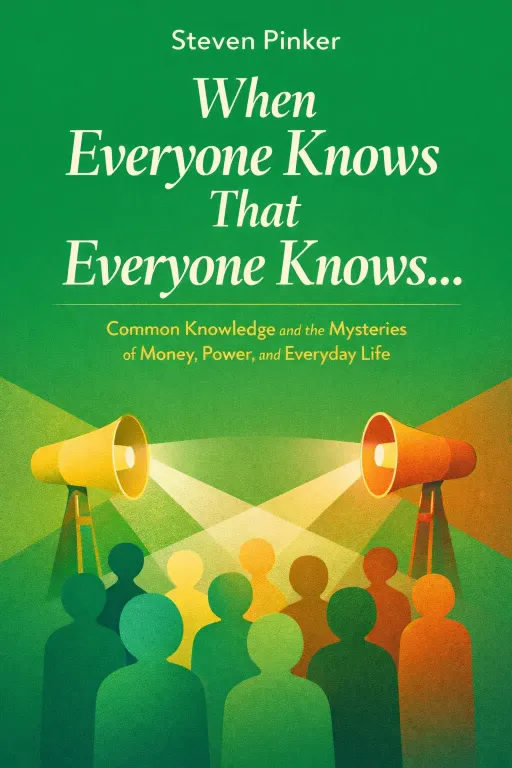
Michelle: That awkward moment when everyone in the room is thinking the same thing, but nobody says it? That silence is more powerful than you think. It’s the invisible force that props up dictators, creates billionaires, and might even explain why you blush. Mark: Oh, I know that silence. I was in a meeting last year for a project that was just a complete train wreck. Everyone knew it. You could feel it in the air. But we all just sat there, nodding, sipping our coffee, pretending the train wasn't actively on fire. The silence was deafening. Michelle: Exactly! And that deafening silence, that gap between what everyone privately knows and what everyone publicly acknowledges, is the subject of our deep dive today. We're exploring the ideas in a fascinating, highly anticipated new book by the legendary cognitive scientist Steven Pinker. Mark: Ah, the Steven Pinker. The Harvard professor, two-time Pulitzer finalist. He’s a giant in this field. What’s the book? Michelle: It’s called When Everyone Knows and Everyone Knows…, and it’s this brilliant exploration of a concept called "common knowledge." Pinker argues it’s one of the most important and misunderstood forces in human social life. And that silence in your meeting, Mark, is a perfect example of it failing to form. Mark: I’m intrigued. And also a little nervous about what you’re going to tell me about my meeting etiquette. Let’s do it.
The Emperor's Nudge: What 'Common Knowledge' Really Is
SECTION
Mark: Okay, so let's start at the beginning. What is this 'common knowledge' exactly? Isn't it just… stuff everyone knows? Michelle: That’s what’s so fascinating! It’s not. And the best way to understand the difference is through a story we all think we know: "The Emperor's New Clothes." Mark: Right. The naked emperor, the swindling weavers, the kid who calls him out. Michelle: Precisely. So, picture the scene. The emperor is parading down the street, completely naked. And in the crowd, every single person is thinking the exact same thought: "The emperor has no clothes on." Every adult, every child. They all privately know the truth. But they’re all looking at each other, seeing smiles and polite applause, and thinking, "Gosh, it must just be me. I must be unfit for my office if I can't see these magnificent clothes." Mark: This is what Pinker calls "pluralistic ignorance," right? Where everyone privately rejects a norm but incorrectly assumes that everyone else accepts it. Michelle: You got it. Everyone has private knowledge, but they believe the public knowledge is the opposite. Then, a little child, who hasn't learned these social games yet, says, "But he hasn't got anything on!" Now, here’s the crucial part. The child isn't telling anyone a fact they don't already know. Every single person already knew the emperor was naked. Mark: Whoa, okay. So what changed? Michelle: The state of the knowledge changed. Before the child spoke, you knew the emperor was naked. But you didn't know if I knew. And I didn't know if the person next to me knew. After the child's public declaration, everyone instantly knows that everyone else knows. And they know that everyone else knows that they know. It becomes this infinitely recursive loop of awareness. That is common knowledge. Mark: It’s not just knowing. It’s knowing that we all know. It’s like the difference between sending a text and seeing that little "Read" receipt pop up. Before the receipt, you hope they read it. After, you both know it’s been seen. The game has changed. Michelle: That's a perfect analogy! And this isn't just for fairy tales. Think about this amazing anecdote from the old Soviet Union. A man stands in Red Square handing out blank pieces of paper. The KGB, of course, arrests him. They ask, "Why are you distributing blank leaflets?" And the man replies, "What is there to write? It's so obvious!" Mark: Wow. He didn't have to write a single word. Michelle: Because the problem wasn't that people didn't know the regime was oppressive. The problem was that no one knew how many other people knew. The public act of handing out blank paper was a signal. It created common knowledge of the shared, unspoken discontent. And that is what dictatorships fear most. Not private thoughts, but the moment those thoughts become common knowledge, because that’s the moment a revolution becomes possible.
The Viral Verdict: Common Knowledge in the Age of Outrage and Bubbles
SECTION
Mark: That makes so much sense for fairy tales and old Soviet jokes. But how does this play out today? It feels like social media has put this whole process on steroids. Michelle: It absolutely has. Social media platforms, with features like the 'Retweet' or 'Share' button, are basically common-knowledge-generating machines. And Pinker dives into the dark side of this with the now-infamous case of Justine Sacco. Mark: Oh, I think I remember this. The tweet, the flight... it was brutal. Michelle: It was a perfect storm. In 2013, Sacco, a PR executive, is about to fly to South Africa. She posts a tweet, intended as a sharp, ironic joke about her own white privilege: "Going to Africa. Hope I don’t get AIDS. Just kidding. I’m white!" She had only 170 followers. She gets on the plane, completely offline for 11 hours. Mark: And the internet just… erupts. Michelle: It explodes. The tweet is screenshotted, retweeted, and within hours, #HasJustineLandedYet is the number one trending topic worldwide. People are tracking her flight path. They’re gleefully anticipating her life being ruined. Her employer sees the outrage and fires her mid-flight. When she lands and turns on her phone, her life has been destroyed. Mark: That's horrifying. She was publicly tried and convicted before she even knew she was on trial. Michelle: Exactly. The tweet itself was the offense, but Twitter’s architecture created instantaneous common knowledge of the outrage. Everyone could see that everyone else was furious. It wasn't about a nuanced discussion of her intent; it was about signaling your own moral virtue by joining the mob. The common knowledge of the transgression became the event itself. Mark: So this is why things feel so chaotic now? Because common knowledge can be manufactured instantly and isn't always based on truth or context? Michelle: It's a huge part of it. And it's not just for moral panics. Pinker points to the 2022 Super Bowl, which some called the "Crypto Bowl." All these companies spent millions on ads with celebrities like Matt Damon and Larry David. Mark: "Fortune favors the brave!" I remember that one. Michelle: Right! And the fascinating thing is, the ads weren't really explaining what cryptocurrency was or why it was a good investment. They were doing something much more subtle. They were creating a common expectation. By running an ad during the Super Bowl—a national ritual where you know tens of millions of other people are watching—they were sending a message: "Look how many other people are interested in this. This is the next big thing. You don't want to be left behind." Mark: It’s the ultimate FOMO machine. You’re not buying because you understand it; you’re buying because you think everyone else is about to buy. Michelle: Precisely. It’s a speculative bubble built entirely on common knowledge of hype. And we all know how that ended. The bubble burst spectacularly, because just as common knowledge can build a market, it can also tear it down the moment doubt becomes the new shared reality. The moment it became common knowledge that FTX was a house of cards, everyone ran for the exit at the same time.
The Unspoken Contract: How We Use Innuendo and Blushing to Manage Reality
SECTION
Michelle: It's incredibly powerful, and because it's so powerful, we've developed these incredibly sophisticated, almost unconscious, ways to manage it in our daily lives. This is where it gets really personal and, honestly, a little funny. Mark: You mean all the things we don't say? Michelle: Exactly. Pinker calls it indirect speech. Think about the classic, awkward end-of-date scenario. Why does someone say, "Would you like to come up for a coffee?" instead of just, "Would you like to come up and have sex?" Mark: Oh, I've definitely been on both ends of that 'coffee' question. If you ask directly and they say no, the night is just… over. It’s so awkward. There’s no going back. Michelle: There's no going back! That's the key. A direct proposition, if rejected, makes the rejection common knowledge. You both know the offer was made, you both know it was rejected, and you both know the other person knows. The relationship model has been broken. But with the "coffee" innuendo, if they say, "No, I've got an early morning," you can both pretend you were just talking about coffee. Mark: Right! You’re giving them—and yourself—plausible deniability. Michelle: Here's the brilliant twist from Pinker. What you're plausibly denying isn't the meaning. Both people usually know exactly what "coffee" means. What you're denying is that it became common knowledge. You’re preserving the shared fiction that you’re just friends who might have coffee. You avoid crossing that Rubicon. It's like in Seinfeld, when George is about to tell a woman he loves her, and Jerry warns him, "If you don’t get that return… that’s a pretty big matzo ball hanging out there." Once it's out, it's common knowledge. It's a matzo ball. Mark: That is the perfect analogy. The matzo ball of common knowledge! But what about when we can't use words? What about when we just mess up? Michelle: That's where our bodies have their own common-knowledge generators. Think about blushing. It's involuntary, it's conspicuous, and it's deeply human. When you trip in public or say something stupid, your face turns red. Mark: So blushing is basically your body's way of hitting 'reply all' on your most embarrassing moment? Michelle: It's a non-verbal apology! It’s your body broadcasting a message that is impossible to fake: "I know I just violated a social norm. I am embarrassed. I know that you know I'm embarrassed, and I submit to the social judgment." It’s an incredibly powerful signal that repairs social bonds. It tells everyone you’re not a psychopath; you’re just clumsy. You understand the rules, even if you just broke one.
Synthesis & Takeaways
SECTION
Mark: Wow. So from the Emperor's clothes to a red face at a party, it's all governed by this same hidden logic. What's the big takeaway here? Are we all just puppets in this invisible web of what we think other people think? Michelle: I don't think we're puppets. I think we're players in a very complex and beautiful game. Pinker's work shows that common knowledge is like the operating system of our social world. It runs quietly in the background, but it dictates everything. Understanding it doesn't trap you; it liberates you. It explains why we use innuendo, why protests can suddenly erupt, and why online mobs form with such speed. Mark: So it's a tool, not a cage. Michelle: Exactly. It’s a tool. It can be used to build incredible things—trust, cooperation, social movements. Apple used it with their famous '1984' Super Bowl ad to create a common belief that the Macintosh would be a revolution, and it became one. But that same tool can be weaponized to create panic and division. The real skill, Pinker suggests, is learning to see it. To recognize when common knowledge is being built, when it's being suppressed, and to decide for yourself when to contribute to it, and when to let things remain unsaid. Mark: It’s about knowing when to be the kid who points at the emperor, and when to just offer someone a cup of coffee. Michelle: That’s it perfectly. It makes you wonder: what 'emperor's new clothes' are we all pretending to see in our own lives, just waiting for someone to speak up? Mark: That is a heavy question to end on. And a great one. For our listeners, if you've ever had one of those "emperor's new clothes" moments, we'd love to hear about it. Join the conversation with the Aibrary community online and share your story. Michelle: This is Aibrary, signing off.