

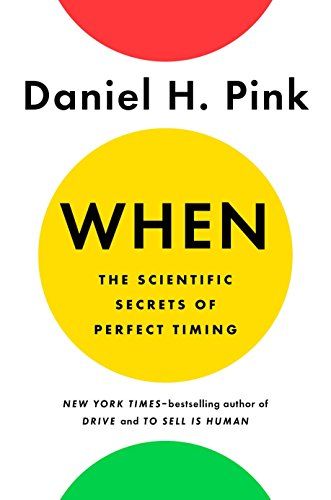
When
The Scientific Secrets of Perfect Timing
Introduction: Why We Get Timing Wrong
Introduction: Why We Get Timing Wrong
Nova: Welcome to The Insight Engine. Today, we’re diving into a topic that dictates everything from our quarterly reports to our creative breakthroughs: timing. We all say timing is everything, but Daniel H. Pink argues in his book, "When," that timing isn't some mystical art form; it’s a hard science.
Nova: Precisely. Pink synthesized over 700 studies from biology, psychology, and economics to prove that our internal clocks—our circadian rhythms—are the hidden architects of our success or failure. He found that when we fight our biology, we’re essentially trying to run a marathon with a flat tire.
Nova: That’s the scope of it. It’s about aligning the of work you’re doing with the of energy you have at that specific moment. We’re going to break down the three distinct phases of the day that Pink identifies, and how mastering them can radically change your productivity and creativity.
Mapping Your Circadian Architecture
The Three Stages of the Day: Peak, Trough, and Recovery
Nova: The foundation of Pink’s argument rests on the human body’s natural, predictable energy curve. Think of your day not as one long, flat stretch of productivity, but as a three-act play: Peak, Trough, and Recovery.
Nova: That’s the Trough, and you’re in good company. Pink’s research shows that for most people—especially those who are 'larks' or morning people—the Peak occurs in the first few hours after waking. This is when our core body temperature is rising, and our alertness is at its maximum. This is prime time for high-stakes, analytical work.
Nova: That’s the common, but often wrong, assumption. The Peak is where our executive function is sharpest, and critically, where we are best at batting away distractions. It’s the time for what Pink calls 'analytic tasks'—things that require deep focus and logical processing. If you’re trying to write a novel in the morning, you might be wasting your best cognitive resource.
Nova: Not at all. The Trough, which generally hits between 1 PM and 4 PM for most adults, is when our body temperature dips, and our ability to focus intently plummets. Pink argues this is the time for routine, administrative, or low-stakes work. Think answering emails that don't require deep thought, filing, or scheduling. It’s about matching the low-energy state with low-cognitive-demand tasks. You’re still being productive, just not fighting your biology.
Nova: That brings us to the third stage: Recovery. This phase begins in the late afternoon and evening. As our bodies prepare for sleep, our cognitive functions shift. The sharp, analytical focus of the Peak is gone, but in its place, we get a boost in divergent thinking. This is when we are best at creative tasks, brainstorming, and seeing the big picture.
Nova: Pink suggests the morning fog might actually be a form of mild cognitive impairment that allows for less rigid thinking, which is useful, but the creative surge comes in the Recovery phase when the brain is more relaxed and less inhibited. It’s the difference between solving a complex equation—Peak—and generating ten novel solutions to a problem—Recovery.
The Power of Bookends and Halftimes
The Science of Beginnings, Midpoints, and Endings
Nova: Beyond the daily rhythm, Pink dedicates significant attention to how we approach the of projects and tasks. He looks at beginnings, midpoints, and endings, revealing that our psychological response to these markers is incredibly consistent across cultures and tasks.
Nova: The research points to the beginning of a cycle—whether it’s the start of the day, the start of a week, or the start of a new project—as a time of heightened motivation and optimism. Pink calls this the 'Fresh Start Effect.' People are more likely to commit to positive changes, like starting a diet or a new workout routine, right at the beginning of a defined period. Think New Year’s resolutions, but applied to Tuesday morning.
Nova: Absolutely. The midpoint is a crucial psychological anchor. When we know we are exactly halfway through a task, our motivation often spikes. Think about a marathon runner hitting the 13.1-mile mark. They aren't tired yet; they’ve just confirmed they’ve done half the work and only half remains. It provides a burst of energy.
Nova: Exactly. You create a psychological finish line. Pink cites studies showing that people working on tasks with clear midpoints—like a 10-page paper—are more persistent than those working on tasks with vague endpoints, like a 20-page paper where they don't know where the halfway point is.
Nova: Endings are powerful because they solidify memory and impact future behavior. Pink discusses how the brain craves closure. If a task ends abruptly or unsatisfactorily, it lingers. Conversely, a well-timed, deliberate ending—what he calls 'the final flourish'—helps us process the experience and move on with greater clarity. This is why rituals around finishing a major work cycle or even a difficult conversation are so important. They signal to the brain, 'This chapter is complete and filed away.'
When to Be Social and When to Be Alone
Beyond the Clock: Chronotypes and Contextual Timing
Nova: We’ve focused heavily on the time of day, but Pink also delves into you are—your chronotype—and the importance of the time of year, which adds another layer of complexity to this science.
Nova: He confirms that chronotypes are real, largely genetic, and they dictate when your Peak, Trough, and Recovery phases naturally occur. A Lark peaks early and crashes early. An Owl peaks late and crashes late. The crucial takeaway isn't just knowing which you are, but understanding that operates on a different clock.
Nova: Precisely. And Pink offers solutions for this mismatch. For instance, when dealing with a group, the best time for collaborative, creative work is often mid-morning, after the Larks have had their analytical peak, but before the Trough hits everyone simultaneously. It’s a compromise zone.
Nova: It’s both internal and external. Pink points to research showing that our energy levels and even our risk tolerance shift seasonally. For instance, studies suggest that people are often more optimistic and willing to take financial risks in the spring and summer months than in the fall and winter. This is tied to broader biological cycles, not just the weather.
Nova: It is. And one final, fascinating point from the research: the timing of negative feedback. Pink found that when giving critical feedback, the timing relative to the task matters immensely. If you give negative feedback immediately after a task, the recipient tends to focus only on that criticism and ignore any positive aspects. But if you wait until the next day, or at least until the next distinct phase, the recipient is more likely to process the feedback holistically, incorporating both the good and the bad.
Nova: Exactly. It’s about respecting the brain’s processing time, whether that’s for a creative idea in the afternoon or for absorbing constructive criticism the next morning. It’s all about context and alignment.
Conclusion: Engineering Your Perfect Day
Conclusion: Engineering Your Perfect Day
Nova: We’ve covered a lot of ground today, Alex. From the biological reality of the Peak, Trough, and Recovery cycle to the psychological power of bookending our tasks. The core message from Daniel Pink’s 700+ studies is clear: stop relying on willpower alone.
Nova: That’s the transformation. The actionable takeaway is simple: Audit your day. Identify your Peak time—when are you sharpest? Reserve that for your most difficult, analytical work. Use your Trough for maintenance and routine. And save your Recovery time for brainstorming and creative problem-solving.
Nova: Absolutely. Timing isn't about squeezing more into your day; it’s about doing the thing at the time so that the work flows more naturally and effectively. It’s about working with your biology, not against it.
Nova: My pleasure, Alex. Remember, the secret to success isn't just working hard; it's working smart, and knowing to work smart. This is Aibrary. Congratulations on your growth!