

The Pressure Cooker: Why High Performers Need to Master Rest, Not Just Work.
Golden Hook & Introduction
SECTION
Nova: What if I told you the biggest mistake high performers make isn't working too little, but resting too little, and doing it all wrong?
Atlas: Whoa. That's a bold claim, Nova. I imagine a lot of our listeners, especially those in high-stakes, fast-paced environments, are probably scoffing right now. The mantra is always "work harder, hustle more."
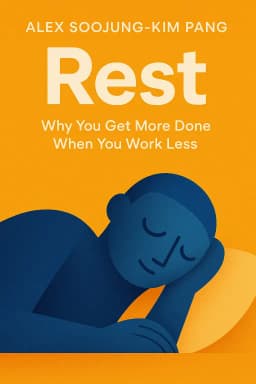
Nova: Exactly, Atlas! And that's precisely the myth we're here to dismantle today. We're diving into two absolutely pivotal books that flip that narrative on its head: "Rest: Why You Get More Done When You Work Less" by Alex Soojung-Kim Pang, and "When: The Scientific Secrets of Perfect Timing" by Daniel H. Pink. What's particularly fascinating about Pang's work is his background; as a visiting scholar at Stanford and a consultant in future studies, he didn’t just theorize about rest. He spent years meticulously researching how some of history's most creative and successful individuals achieved their breakthroughs not by relentlessly grinding, but by mastering a very specific kind of deliberate rest.
Atlas: Okay, so it’s not just about taking a break. You’re saying there's a way to rest, a strategic way, that actually enhances performance? Because honestly, for anyone building a 0-1 growth strategy, or juggling a demanding career with new family life, the idea of "resting more" often feels like admitting defeat.
Nova: It feels counterintuitive, doesn't it? But yes, it's about understanding that rest isn't the absence of activity; it's a different of activity. And that brings us to our first core idea…
The Power of Deliberate Rest: Beyond Idleness
SECTION
Nova: Pang argues that deliberate rest—things like deep play, quality sleep, and regular exercise—isn't a luxury. It's an active ingredient, a fundamental component of high achievement, sustained productivity, and profound creativity. It’s what fuels those "aha!" moments.
Atlas: Hold on. "Deep play" sounds like something my toddler does. For someone trying to scale a startup, how is that not just… idleness? We’re talking about people who are often celebrated for their 80-hour work weeks. How do you convince them that playing a board game or going for a walk is actually?
Nova: That's a brilliant question, Atlas, and it gets to the heart of the misconception. Pang points out that many historical figures renowned for their intellectual prowess or creative output didn't just work hard; they rested. Take Charles Darwin, for example. He had a strict routine: he’d work intensely for a few hours in the morning, then take a long walk around his Sandwalk, often for two hours. He’d return, work a bit more, and then spend time reading novels or playing backgammon. He wasn't just killing time; these periods of active disengagement were where his subconscious mind would process complex biological data, connect disparate ideas, and often, where insights for his monumental theories would emerge.
Atlas: So it's not about stopping, but about switching gears to something equally engaging but different? Something that lets your brain simmer in the background? Can you give me a specific instance where this "deliberate rest" directly led to a breakthrough for someone?
Nova: Absolutely. Think about mathematicians or physicists who often report solving complex problems not while staring at equations, but while showering, walking, or even just before falling asleep. The conscious mind might be stuck, but when you step away and engage in a different, less cognitively demanding activity, your diffuse mode of thinking kicks in. It’s like shaking a jar of marbles; they settle into a new configuration. For Darwin, those long, reflective walks were his mental "shaking jar." They allowed the seemingly chaotic observations he made to coalesce into the elegant theory of natural selection. It was active mental processing, just not the focused, direct kind.
Atlas: That gives me chills. That’s a powerful reframing. So, for a busy professional who feels guilty even taking a lunch break, let alone "deep playing," what kind of deliberate rest are we talking about? Is it just walking?
Nova: It’s highly personalized, but it often involves activities that are physically active but mentally restorative. Long walks, as we mentioned, are fantastic. Swimming, gardening, playing a musical instrument, even engaging in a hobby that requires deep focus but isn't work-related, like woodworking or painting. The key is that it's something you to do, that engages you, and that allows your mind to wander or focus in a different way. It’s about building in restorative practices that aren't just about unwinding, but about your mental and creative resources. Sleep, of course, is foundational. Pang emphasizes that sleep isn't just downtime; it's when your brain consolidates memories, clears out metabolic waste, and prepares for the next day's cognitive load. Chronic sleep deprivation isn't just tiring; it's actively degrading your ability to perform at your best.
Atlas: I can definitely relate to the feeling of trying to push through exhaustion, only to find my clarity and creativity plummet. It sounds like Pang is telling us to embrace a more humane, and ultimately more effective, way of working.
Optimizing Your Energy: The Science of Timing and Recharge
SECTION
Nova: And that naturally leads us to Daniel H. Pink's incredible work in "When: The Scientific Secrets of Perfect Timing." Because once you understand kind of rest you need, the next crucial question is to do it. Pink dives deep into the hidden patterns of the day and how timing profoundly affects our performance.
Atlas: Okay, so my natural rhythm matters. But for someone whose schedule is dictated by investor calls, team demands, and a toddler's nap schedule – how do you possibly "optimize" that? It feels impossible, like a luxury only available to those with complete control over their calendars.
Nova: That’s a completely valid reaction, and it’s where Pink’s research becomes incredibly practical, even for the most constrained schedules. He identifies three main chronotypes: "larks", "owls", and "third birds". The critical insight is that most people, roughly 80%, follow a similar daily pattern of performance: a "peak" in the morning, a "trough" in the early afternoon, and a "recovery" period later in the day.
Atlas: So you're saying we all have a natural energy curve, regardless of whether we're an early bird or a night owl?
Nova: Precisely. And the key is to align your tasks with these natural fluctuations. Pink suggests scheduling your most demanding, analytical work—the deep strategy sessions, the complex problem-solving, the 0-1 growth blueprints—during your "peak" period. For most people, that's the morning. The "trough," which for many hits between noon and 4 PM, is when our vigilance and ethicality dip. This is the time for critical decisions or complex negotiations. This is when you should schedule administrative tasks, emails, or even better, take a restorative break.
Atlas: That’s a great way to put it. So, for someone who has back-to-back meetings all day, how do you even begin to implement this? It sounds like you need to completely overhaul your work culture.
Nova: Not necessarily a complete overhaul, but a conscious re-evaluation of how you use your time, even in small blocks. Pink highlights the power of. Instead of just powering through the trough, even a 10-15 minute walk outside, away from screens, can significantly restore your focus. He emphasizes that the of break matters: highly restorative breaks involve movement, nature, and social interaction, not just switching from one screen to another. For the "recovery" period, typically late afternoon, our mood and creativity tend to rebound. This is an excellent time for creative brainstorming, less critical collaborative work, or tasks that require synthesis rather than intense analytical focus.
Atlas: So it's not about having a perfectly free day, but about consciously placing different types of activities into your natural energy windows, even if those windows are small? Like, if I know my brain turns to mush at 2 PM, I shouldn't be trying to write investor pitches then. I should be answering emails or taking a micro-break.
Nova: Exactly! It's about working your biology, not against it. Imagine the impact on a growth officer's decision-making if they consistently made critical strategic choices during their peak, and used their trough for less demanding, more administrative tasks. The quality of output would dramatically improve, and the feeling of mental fatigue would lessen. Pink's research shows that even small adjustments to timing can yield significant improvements in productivity, well-being, and even ethical decision-making.
Synthesis & Takeaways
SECTION
Nova: So, bringing it all together, what Alex Soojung-Kim Pang and Daniel H. Pink reveal is something profoundly empowering: intelligent rest isn't a luxury or a sign of weakness; it's a strategic imperative. It's the secret weapon for sustained high performance, profound well-being, and preventing the kind of burnout that silently erodes creativity and effectiveness, especially for high-achievers. It’s about working smarter, not just harder.
Atlas: That's a really powerful reframing. It completely challenges the "hustle until you drop" mentality that's so prevalent in demanding industries. So, for our listeners who are feeling that underlying hum of exhaustion, that constant pressure, what's one concrete step they can take to start mastering rest, not just work?
Nova: I love that question, Atlas. And it ties directly into the "healing moment" concept. My recommendation is simple: schedule a non-negotiable 15-minute block today for deliberate rest. This could be a short walk outside, quiet reflection with no devices, or simply staring out the window and letting your mind wander. Treat it like a critical meeting that cannot be moved.
Atlas: And that's not just about feeling better, but literally performing better? Making smarter decisions, being more creative, and ultimately driving better growth?
Nova: Precisely. It's an investment in your cognitive capital, your emotional resilience, and your long-term capacity to innovate and lead. It’s an act of strategic self-care that pays dividends far beyond those 15 minutes.
Atlas: Powerful stuff. Thank you, Nova! This has been incredibly insightful.
Nova: Thank you, Atlas! And thank you to all our listeners for joining us and for investing in your growth.