

The Pressure Cooker: Why High Performers Need to Master Rest, Not Just Work.
Golden Hook & Introduction
SECTION
Nova: Most of us wear busyness like a badge of honor, right? We equate packed calendars and endless to-do lists with success. But what if I told you that the secret to truly performance, to unlocking your next big breakthrough, isn't more hours, but more intelligent rest?
Atlas: Oh man, that's going to hit home for so many of our listeners. Especially those in high-stakes environments, building something from scratch, where every minute feels like it be productive. The idea of "more rest" often feels like a fantasy, not a strategy.
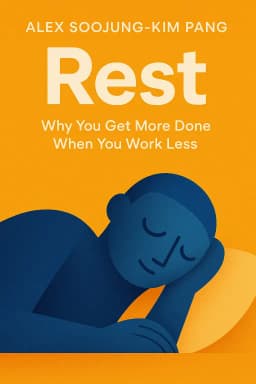
Nova: Exactly! And that's precisely why today, we're diving into two brilliant minds who fundamentally challenge that paradigm. We're talking about Alex Soojung-Kim Pang's groundbreaking book, "Rest: Why You Get More Done When You Work Less," and Daniel H. Pink's illuminating "When: The Scientific Secrets of Perfect Timing."
Atlas: I’m curious, what makes these authors uniquely qualified to tackle such a counter-intuitive idea? Because for many, the default is just to push harder.
Nova: Well, Alex Soojung-Kim Pang actually started his career as a Silicon Valley consultant, advising tech giants, before shifting to explore the science of rest as a visiting scholar at Stanford. His journey from the heart of "hustle culture" to advocating for deliberate rest gives his work incredible weight. And Daniel Pink, he’s just a master at translating complex social science into incredibly accessible, actionable insights. He has this knack for taking something you intuitively feel and then giving you the data and framework to understand it works.
Atlas: So basically, these aren't just feel-good books; they're backed by serious research, offering a strategic advantage for anyone who's trying to innovate and lead.
Nova: Absolutely. The core of our podcast today is really an exploration of how intelligent rest, far from being a luxury, is the hidden lever for sustained high performance and personal well-being. Today we'll dive deep into this from two perspectives. First, we'll explore why deliberate rest is an active ingredient in high achievement, then we'll discuss how optimizing our timing and strategic breaks can unlock peak performance.
Rest as an Active Ingredient for High Achievement
SECTION
Nova: So, let's start with Alex Soojung-Kim Pang and his radical redefinition of "rest." He argues that rest is not simply the absence of work, or some passive state of idleness. Instead, it's an in high achievement. It's a deliberate practice that fuels creativity and sustained productivity, making you better at what you do.
Atlas: Okay, but for someone building 0-1 growth strategies in a startup, the idea of "deliberate rest" can feel like a contradiction. Every minute not actively building or strategizing feels like a lost opportunity. How do you convince someone that pausing is actually productive?
Nova: That's where Pang brings in some incredible historical examples. Take Charles Darwin, for instance. He had this incredibly disciplined morning routine of focused work, but after lunch, his schedule looked almost… lazy. He'd go for long walks, read novels, nap, and then return to some light work or social engagement.
Atlas: Wait, Darwin, the guy who revolutionized biology, took naps and read novels in the middle of the day? That doesn't sound like the relentless, always-on genius we often imagine.
Nova: Exactly! Those long walks and seemingly "unproductive" times weren't idleness; they were crucial for his breakthroughs. Pang argues that this deliberate rest allowed Darwin's diffuse thinking mode to kick in. It gave his brain the space to connect seemingly disparate ideas, to incubate complex problems, and to synthesize information in ways that intense, focused work alone couldn't. It's where the "aha!" moments often happen.
Atlas: So, it's not about stopping activity, but shifting to a different of activity that allows your brain to process differently. I can definitely relate to getting my best ideas when I'm on a walk or in the shower, not necessarily staring at a spreadsheet.
Nova: Precisely. Pang identifies several forms of this deliberate rest: deep play, restorative sleep, and active rest like those walks. It’s about choosing activities that truly recharge you, rather than just passively consuming entertainment that might actually drain you further. It's the difference between scrolling on your phone and going for a brisk walk in nature. One is often a distraction, the other is active restoration.
Atlas: That makes me wonder, how do you differentiate between true deliberate rest and just plain procrastination or distraction? Because I imagine a lot of us would love to say our Netflix binge is "deliberate rest."
Nova: That's a critical distinction. Deliberate rest has an intentionality to it. It’s chosen, it’s often active in some way, and it leaves you feeling genuinely refreshed and more capable of tackling your challenging work. Procrastination or passive consumption often leaves you feeling drained or guilty. It's about what Pang calls "deliberate practice" balanced with "deliberate rest." High performers aren't just working hard; they're resting strategically.
Optimizing Performance Through Timing and Strategic Breaks
SECTION
Nova: And that naturally leads us to the second key idea we need to talk about, which often acts as a perfect counterpoint to what we just discussed: Daniel Pink's work on the science of timing. Once we accept that rest is valuable, the next question is to do what.
Atlas: Oh boy, I’ve been thinking about this a lot. In a startup, the day can feel like a chaotic scramble. You’re reacting to urgent issues, constantly pivoting. How do you find any "perfect timing" in that environment?
Nova: That's where Pink's insights are so powerful. He reveals that our cognitive abilities and energy levels aren't constant throughout the day. We have these hidden patterns, or chronotypes, that dictate when we're at our best for analytical work, for creative thinking, or for collaboration. He identifies three main chronotypes: larks, owls, and the majority, "third birds," who fall somewhere in between.
Atlas: So you're saying there's a science to why I'm completely useless at creative brainstorming after 3 PM?
Nova: Exactly! For most people, the typical day follows a peak, a trough, and then a rebound. Our peak is usually in the morning for focused, analytical work. The trough hits in the early afternoon, where our vigilance and mood dip. And then there's a rebound in the late afternoon for more creative, insightful tasks. Pink gives powerful examples, like how surgeons perform better in the morning, or how judges tend to make harsher parole decisions right before lunch, when their mental energy is at its lowest.
Atlas: Wow. That's kind of heartbreaking, but it makes so much sense. So, if we know these patterns, how do we actually apply them, especially when our schedules are often dictated by team meetings, investor calls, or customer demands?
Nova: That's where strategic breaks come in. Pink isn't suggesting you overhaul your entire company's schedule overnight. Instead, he advocates for understanding your own personal chronotype and then strategically placing your most demanding tasks during your peak times. And critically, he emphasizes the power of "micro-breaks" and naps. He talks about the "nappuccino"—drinking coffee right before a 15-20 minute nap. The caffeine kicks in just as you wake up, giving you a powerful, refreshing boost.
Atlas: A nappuccino? That sounds like a cheat code for productivity! But seriously, finding even 15 minutes in a day can feel like a luxury. What kind of breaks are we talking about?
Nova: It's not about long, indulgent breaks. It's about short, restorative ones. A 10-minute walk outside, listening to a favorite song with your eyes closed, or even just staring out the window and letting your mind wander. These aren't just "time off"; they are crucial resets for your attention and energy. Pink's research shows that even these brief, strategic pauses can significantly improve focus, decision-making, and overall well-being. It’s about leveraging these natural energy dips, not fighting them.
Atlas: So, it's about being intentional with our energy, rather than just pushing through the fatigue. That sounds like it could dramatically improve the quality of output, not just the quantity.
Nova: Precisely. It's about working smarter, not just harder. By understanding our natural rhythms and integrating deliberate rest and strategic breaks, we're not just avoiding burnout; we're actively optimizing for sustained high performance, creativity, and deeper insights.
Synthesis & Takeaways
SECTION
Nova: So, bringing Pang and Pink together, the message is clear: rest isn't a reward for hard work, it's a fundamental component of it. It's not about being idle, it's about being strategic.
Atlas: Right. It's about recognizing that our brains and bodies aren't machines that can run indefinitely at peak capacity. Prioritizing intelligent rest becomes a strategic choice, not a weakness, especially for those in demanding roles who need sustained innovation and clarity.
Nova: Exactly. It's a competitive advantage. And the best part is, you don't need a massive overhaul to start. Our healing moment for listeners today is simple: schedule a non-negotiable 15-minute block today for deliberate rest. This could be a short walk, quiet reflection, or simply staring out the window. Experiment with what truly recharges you.
Atlas: That's actually really inspiring. Because that underlying hum of exhaustion we talked about at the beginning, it's a signal. And these insights give us a clear path to address it, not just for short-term fixes, but for long-term well-being and sustained growth.
Nova: Absolutely. It's about building a life and a career that's not just productive, but sustainable and deeply fulfilling.
Atlas: A powerful reminder that sometimes, the most productive thing you can do is... nothing at all.
Nova: This is Aibrary. Congratulations on your growth!