

The Pressure Cooker: Why High Performers Need to Master Rest, Not Just Work.
Golden Hook & Introduction
SECTION
Nova: What if I told you the secret to outperforming everyone isn't working harder, but actually… less?
Atlas: Oh man, Nova, that sounds almost heretical in our high-growth, always-on world. Especially for anyone building a startup from scratch. We’re taught to grind, to push, to out-hustle the competition. "Less" usually means "falling behind."
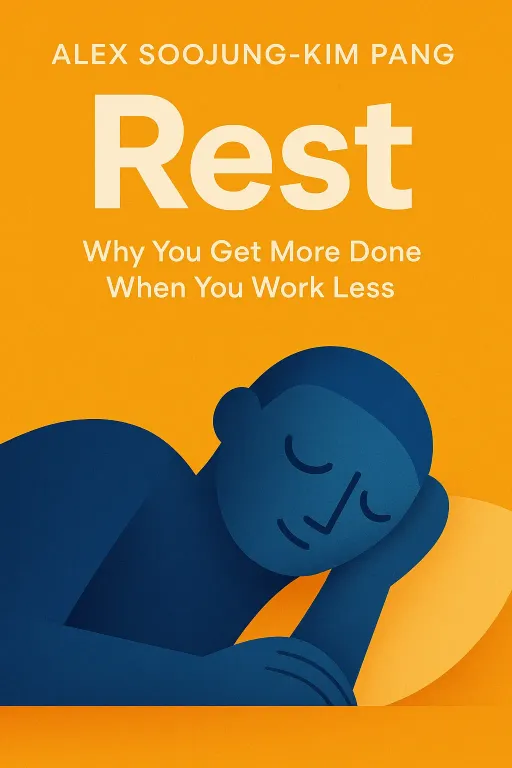
Nova: Exactly! It flies in the face of everything the modern professional is told. But today, we're diving into two brilliant books that fundamentally challenge that notion, proving that intelligent rest isn't a weakness, but a critical strategy for both professional success and personal well-being. We’re talking about "Rest: Why You Get More Done When You Work Less" by Alex Soojung-Kim Pang, and "When: The Scientific Secrets of Perfect Timing" by Daniel H. Pink.
Atlas: Two heavy hitters! I'm curious about Pang's perspective. What makes his take on rest so compelling?
Nova: What’s fascinating about Pang is his background. He wasn't some armchair academic; he was a consultant for Silicon Valley tech companies. He saw firsthand the relentless pace, the burnout, the brilliant minds hitting walls. His insights aren't just theoretical; they're born from observing the very culture that often demonizes rest. He literally watched high performers crumble, and then he went and researched why.
Atlas: That resonates. Anyone in a fast-paced environment, trying to build something from zero-to-one, experiences that hum of exhaustion he talks about. It's not a badge of honor; it’s a warning signal. So, what's his big revelation about rest? Because 'rest' sounds suspiciously like 'not working,' which is a tough sell.
The Counter-Intuitive Power of Deliberate Rest
SECTION
Nova: That’s the core of his argument, Atlas. Pang identifies what he calls "deliberate rest." This isn't just vegging out or passive idleness. It's active, intentional downtime that directly fuels creativity, problem-solving, and sustained productivity. He argues that rest is not the opposite of work; it's a partner to it, an active ingredient in high achievement.
Atlas: Wait, so you’re saying my Netflix binge isn't deliberate rest? My brain definitely feels rested afterwards, but I’m not sure it’s fueling my next growth strategy.
Nova: Not quite, no. Think of it more as deep play. Pang points to historical figures who integrated this beautifully. Charles Darwin, for example, would spend hours walking around his property, thinking, observing, but not actively "working" on his theories. Einstein was a keen sailor; the rhythmic, non-linear thinking involved in sailing often sparked his breakthroughs. These weren't escapes from work; they were integral parts of their creative process. They understood that the conscious mind needs to step back for the subconscious to connect dots.
Atlas: I mean, that sounds lovely for Darwin with his sprawling estate, or Einstein sailing. Most of our listeners are juggling high-stakes projects, tight deadlines, and, for many, new family responsibilities. How does a Chief Growth Officer building a startup, or a new mom trying to balance it all, fit in "deep play" or "strategic sailing"? It feels like a luxury we can't afford.
Nova: That’s a valid point, and it’s where Pang offers practical insights. Deliberate rest isn't always about grand gestures. It can be micro-rests: a 15-minute walk outside, focused meditation, even just staring out the window for a few minutes. It's about disengaging from the task at hand to allow your mind to wander, to process, and to make new connections. He talks about how these micro-breaks prevent decision fatigue and improve focus when you working.
Atlas: So basically, instead of pushing through that wall of mental fog, you step away, do something completely different, and come back with a fresh perspective. I can see the appeal, but it requires a fundamental shift in how we perceive our day. It asks us to trust that stepping away will actually make us more effective, not less.
Nova: Exactly! It’s an investment, not a luxury. Pang shows that the most productive people aren't working 80-hour weeks; they're working highly focused hours, interspersed with high-quality, deliberate rest. It's about quality of attention, not quantity of time. It's about creating space for intuition and insight to emerge.
Atlas: That’s actually really inspiring. Because the alternative – just pushing through until you hit burnout – is not sustainable. Especially in a role that demands constant innovation and strategy. You can't innovate when you're running on fumes.
Strategic Timing: Orchestrating Your Day for Peak Performance and Recharge
SECTION
Nova: And speaking of strategic, that leads us perfectly into Daniel Pink's insights on "When." If Pang tells us rest is crucial, Pink tells us to best apply it, and when to tackle our most demanding work. He argues that timing isn't just an art; it's a science.
Atlas: I’ve been thinking about this a lot. My energy levels definitely aren't constant throughout the day. Some mornings I feel like I can conquer the world; other afternoons, I’m just trying to keep my eyes open. How does Pink help us decode that?
Nova: Pink identifies what he calls the "hidden patterns" of the day. He explains that most people experience a daily energy curve: a peak, a trough, and a recovery. For the majority of us, the peak is in the morning, the trough is in the early afternoon, and then there's a slight recovery later in the day. He also delves into chronotypes – whether you're a "lark", an "owl", or a "third bird".
Atlas: Okay, so if I’m a morning person, I should be doing my most cognitively demanding tasks – like strategizing for 0-1 growth or complex problem-solving – during my peak. That makes sense. But what about the trough? That 2 PM slump is real.
Nova: Absolutely. Pink suggests that the trough is the time for analytical tasks or big decisions. That's when we're most prone to errors. Instead, he advises using the trough for administrative tasks, answering emails, or even better, taking a restorative break. This could be a walk, a short nap if possible, or a social interaction. He calls this the "nappuccino"—a coffee followed by a short nap, so you wake up when the caffeine kicks in.
Atlas: A nappuccino! I love that. But what if your team isn't on the same chronotype? Or what if your schedule is dictated by external meetings and client calls that don't care about your personal trough? For a new mom, your "peak" might be entirely dictated by when the baby is sleeping!
Nova: That’s the real-world challenge, and Pink addresses adaptability. While ideal alignment is powerful, even small adjustments can make a difference. If you can't shift your entire schedule, try to identify your "mini-peaks" or "mini-recoveries." For instance, if your mornings are always meeting-heavy, can you carve out 30 minutes those meetings for deep work? Or during your afternoon slump, can you schedule collaborative, less cognitively demanding tasks, rather than trying to force creative output?
Atlas: So it's about being intentional with the time you have control over, and understanding your own body's rhythm, even if you can't perfectly orchestrate every minute. It’s a shift from "when can I fit work in?" to "when am I for this type of work?"
Nova: Precisely. It’s about leveraging your natural biology instead of fighting it. When you align your work with your internal clock, you not only perform better, but you also conserve energy, making you less susceptible to burnout, which is critical for sustained growth and well-being.
Synthesis & Takeaways
SECTION
Atlas: This is a huge reframing. It takes rest from being this guilty indulgence or a sign of weakness, and elevates it to a strategic, almost high-performance tactic.
Nova: Absolutely. Both Pang and Pink give us the blueprint for a more humane, yet incredibly effective, way to work and live. It’s not about working less for the sake of it, but working smarter by understanding the cyclical nature of our energy and the profound restorative power of deliberate rest. For anyone feeling that constant hum of exhaustion, this is a clear signal that the old approach isn't working.
Atlas: It’s empowering, really. It means that taking a 15-minute walk isn't slacking off; it's actively contributing to better decision-making and more innovative solutions later in the day. It’s about cultivating resilience, not just pushing through exhaustion.
Nova: Exactly. It’s about mastering rest, not just work, to truly thrive. So, I challenge our listeners today to reflect: When was the last time you engaged in rest? Not just zoning out, but truly disengaging to recharge your creative and cognitive batteries?
Atlas: That's a powerful question. And one that could fundamentally change how you approach your day, your work, and your life.
Nova: This is Aibrary. Congratulations on your growth!