The Invisible Threads: How Nonverbal Cues Shape Your Influence
10 minGolden Hook & Introduction
SECTION
Nova: We've all heard the old adage, "actions speak louder than words." It's practically etched into our collective consciousness. But Atlas, what if the actions you are actually shouting the loudest? What if your body is betraying your true intentions, or worse, undermining your best ideas, without you ever uttering a single sound?
Atlas: Whoa, Nova, that's a powerful thought to kick us off! It’s almost unsettling to think about, especially for those of us who spend so much time crafting the perfect message. We focus so much on the verbal, the explicit, that we might be completely missing the entire silent symphony playing out beneath the surface.
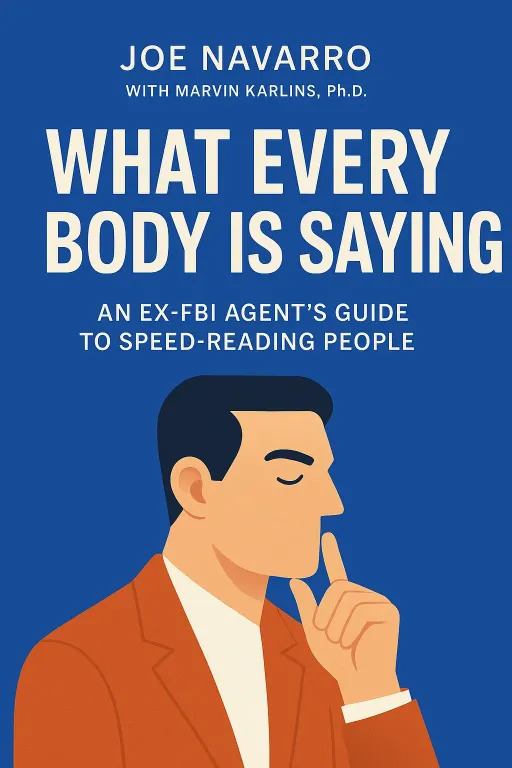
Nova: Exactly! And that's precisely what we're diving into today. We're pulling back the curtain on the invisible threads of communication, exploring how nonverbal cues shape everything from trust to influence. We'll be drawing insights from two incredible books: Joe Navarro's fascinating "What Every Body is Saying," and Amy Cuddy's impactful work, "Presence."
Atlas: And Navarro, in particular, has such a wild background. I mean, a former FBI agent, right? He spent decades literally decoding human behavior for national security. It's not just theory for him; it's about life-or-death situations where reading a twitch or a glance could make all the difference. That kind of real-world, high-stakes experience immediately gives his insights a different weight.
Nova: Absolutely. His experience gives him a unique lens, moving beyond pop psychology into something deeply practical and profoundly insightful. So, let’s start there, Atlas. Let's talk about the silent language others are speaking, often without even realizing it.
The Silent Language of Influence: Reading Nonverbal Cues
SECTION
Nova: Navarro's core premise, honed over 25 years in counterintelligence, is that our bodies are constantly leaking information. He calls these "tells" – unconscious signals that reveal our true feelings, intentions, and even our comfort levels. The verbal part of our brain can lie, but our limbic system, that ancient, emotional part of our brain, often can't.
Atlas: So he’s saying our bodies are essentially truth detectors? That’s a bit out there, Nova. For someone trying to navigate complex organizational structures or unify diverse perspectives, it sounds like it could turn you into a suspicious detective, constantly looking for hidden meaning. How does a global architect use this without becoming utterly paranoid?
Nova: That’s a brilliant question, and it gets to the heart of how to use this knowledge constructively. Navarro isn't advocating for suspicion. Instead, he teaches us to observe for. When someone's words say one thing, but their body says another, that's where the real information lies. Think of it as enhancing your empathy, your ability to understand unspoken needs or discomfort, rather than just spotting deception.
Atlas: Okay, I like that – enhancing empathy, not just detection. Can you give us an example? Something where these nonverbal "tells" really made a difference?
Nova: Of course. Imagine a critical negotiation. A CEO is confidently presenting numbers, stating their firm commitment to a deal. But as they speak, you notice their hand repeatedly stroking their neck, a self-soothing gesture. Or perhaps their feet, unconsciously, are angled towards the door, even as their words are about staying in the room. The verbal message is "I'm all in," but the nonverbals are screaming "I'm stressed, I'm uncomfortable, I want out."
Atlas: That’s fascinating. So, the cause is discomfort or stress, the process is an unconscious self-soothing or escape signal, and the outcome for you, the observer, is a deeper understanding of their true state. It gives you an edge. You realize their verbal confidence might be a facade, and you can then adjust your approach, perhaps by addressing their underlying concerns rather than just pushing the numbers.
Nova: Exactly. It's about picking up on those micro-signals – a lip compression, a sudden shift in posture, a slight increase in blink rate – that indicate a shift in comfort or confidence. It allows you to build stronger connections because you're addressing the person, not just the persona they're presenting. It's about knowing when to push, when to pull back, and when to truly listen to what isn't being said.
Atlas: So, it's not about becoming a mind-reader, but a better human-reader. Understanding the limbic system's honest reactions opens up a whole new layer of communication.
Power Posing & Internal State: Shaping Your Reality from Within
SECTION
Atlas: That makes me wonder, Nova, if we're constantly broadcasting with our bodies, what about what we're to broadcast, even to ourselves? How much control do we actually have over these invisible threads? Because if someone's feet are pointing to the door, can they just… change that?
Nova: That’s a perfect segue into our second key insight, drawn from Amy Cuddy's groundbreaking work on "Presence." If Navarro teaches us to read the invisible threads of others, Cuddy shows us how to weave our own. Her research, famously presented in a hugely popular TED Talk, demonstrates that our body language doesn't just reflect our internal state; it can actually it.
Atlas: Wait, hold on. So, you're saying that simply adopting a certain posture can physiologically change how I feel and perform? That sounds a bit like wishing something to be true. For someone focused on building responsible tech or navigating complex global growth, authenticity is paramount. How do you ensure you're not just 'faking it' and coming across as disingenuous?
Nova: That's a critical distinction, Atlas. Cuddy isn't advocating for inauthenticity or deception. She's talking about yourself for authenticity. Her research shows that adopting "high-power poses"—expansive, open postures, like standing with hands on hips or leaning back with feet on a desk—for just two minutes can actually change your body chemistry. Your testosterone levels, associated with confidence and assertiveness, can increase, while cortisol, the stress hormone, decreases.
Atlas: So it's not just a mental trick, there's a biological component to it. That's fascinating. Can you paint a picture of how this plays out in a real-world scenario?
Nova: Absolutely. Imagine a nurturing innovator, deeply passionate but perhaps a bit nervous before a crucial pitch for a new, transformative AI ethics project. They feel the weight of responsibility, the need to unify diverse perspectives on a complex issue. Instead of hunching over their notes, they step into a private space beforehand. For two minutes, they stand tall, shoulders back, hands on their hips – a classic 'Wonder Woman' or 'Superman' pose.
Atlas: And what happens internally?
Nova: The internal shift is profound. They don't magically become a different person, but their body sends signals to their brain: "I am powerful, I am capable." This physiological change reduces their anxiety, boosts their self-assurance. When they walk into that room, they're not faking confidence; they've their body and mind to access their authentic competence more effectively. Their posture then naturally projects that presence, influencing how others perceive their ideas and leadership.
Atlas: That’s actually really inspiring. So, it's about embodying the confidence you already have, but might be struggling to access, especially in high-pressure moments. It's a way to bridge the gap between your internal capability and your external expression, which is crucial for leaders who need to inspire trust and demonstrate clear vision. It’s not about acting, but about enabling your true self to shine through.
Synthesis & Takeaways
SECTION
Atlas: So, Nova, we've explored decoding the silent language of others with Navarro, and encoding our own internal state for greater presence with Cuddy. It feels like we're talking about mastering both sides of the nonverbal coin. What’s the overarching impact on influence and leadership when you bring these two ideas together?
Nova: The synthesis is incredibly powerful for anyone navigating complexity, whether that's in global leadership, building responsible tech, or balancing a demanding professional and personal life. It's about developing a profound sensitivity to the subtle currents of human interaction. When you can read the unspoken anxieties or enthusiasms of your team, and simultaneously project a grounded, authentic presence through your own body language, you foster trust and drive progress in a way words alone never could.
Atlas: It emphasizes that true influence isn't just about what you say, but how you show up, both in observing others and presenting yourself. It makes you realize that every interaction is a rich tapestry of verbal and nonverbal cues, and mastering both gives you a strategic advantage. It’s about building futures, not just managing today.
Nova: Exactly. These invisible threads are the bedrock of genuine connection and effective leadership. They allow you to move beyond surface-level interactions to truly understand, inspire, and unify. It's about being present, both for others and for yourself.
Atlas: So, for our listeners today, especially those strategic balancers and global architects, what’s one small step they can take to start weaving these threads into their daily lives?
Nova: My challenge is simple: today, during your very next conversation, try to focus only on the nonverbal cues. What stories do the bodies tell that the words might be obscuring or amplifying? And then, before your next challenging meeting, take just two minutes to adopt a power pose in private. Feel the shift. You might be surprised at the profound impact these tiny adjustments can have on your influence.
Atlas: I love that. It’s a practical, actionable step that immediately taps into these powerful insights. The silent language is always speaking; it’s up to us to learn to listen and respond.
Nova: Absolutely. And to consciously choose the message our own bodies are sending.
Atlas: This is Aibrary. Congratulations on your growth!